Compliance 2026: How IT Systems Will Affect NYC Legal and Financial Firms
Financial and legal leaders in New York City are facing their biggest compliance challenge yet. NYDFS cybersecurity regulation amendments took effect in November 2023, with phased compliance deadlines running through November 2025. NYDFS has active enforcement authority and may impose significant civil penalties for cybersecurity violations, with amounts determined based on the nature and severity of the conduct..
Your current IT systems need to do more than store data and run reports. They must track every access point, monitor for security threats in real time, and produce audit-ready evidence on demand. Under NYDFS Part 500, Class A companies must implement endpoint detection and response, centralized logging and security alerting, privileged access monitoring, and commonly-used password blocking by May 1, 2025. If your systems can't do this automatically, you're already behind.
The compliance landscape has shifted from checking boxes to proving results. Regulators want to see that your controls actually work, not just that you have policies in place. Your IT infrastructure will determine whether your firm can meet these demands or face mounting penalties and enforcement actions.
Key Takeaways
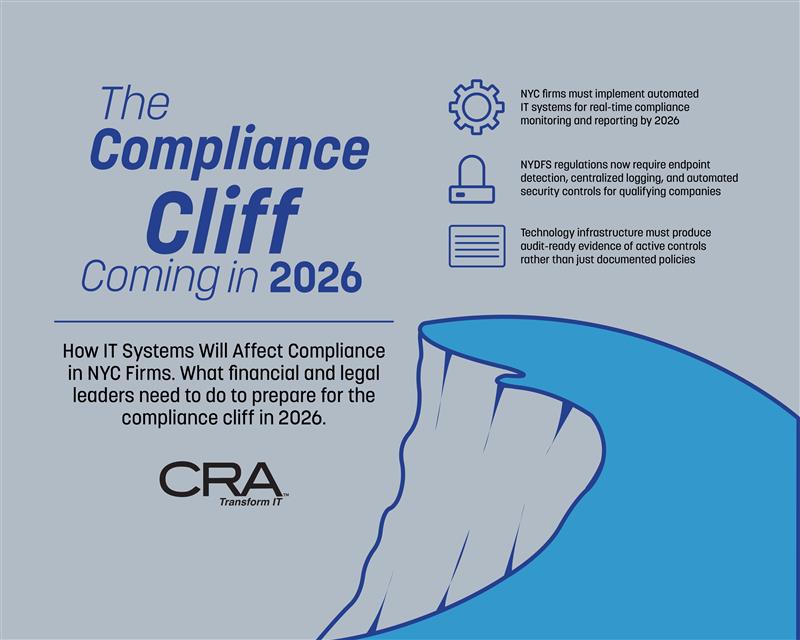
- NYC firms must implement automated IT systems for real-time compliance monitoring and reporting by 2026
- NYDFS regulations now require endpoint detection, centralized logging, and automated security controls for qualifying companies
- Technology infrastructure must produce audit-ready evidence of active controls rather than just documented policies
The Coming Compliance Cliff: Key Challenges for 2026
Compliance teams in NYC financial firms face three major pressure points in 2026: intensified regulatory enforcement with shifting priorities, a surge in technology-enabled financial crime, and conflicting regulatory standards across jurisdictions that demand new approaches to risk management.
Rising Regulatory Scrutiny and Enforcement Focus
The Department of Justice has created a new Market, Government, and Consumer Fraud Unit specifically to pursue customs fraud and tariff evasion. This enforcement focus extends beyond trade compliance. FinCEN is restructuring its entire approach to financial crimes enforcement through alerts and notices rather than formal rulemaking.
You need to understand that compliance now happens through advisories. FinCEN expects you to operationalize each alert it publishes. Your technology systems must be flexible enough to translate evolving guidance into daily controls.
Key enforcement changes include:
- Streamlined Suspicious Activity Report filing processes
- Increased penalties for sanctions violations
- Expanded whistleblower rewards for customs and tariff fraud
The regulatory burden appears lighter on paper. In practice, you face more frequent changes that require faster adaptation from your compliance infrastructure.
Emerging Risks in Financial Crime and Scams
Americans lost $12.5 billion to fraud in 2024, representing a 25% increase from the previous year. These numbers only reflect reported losses. Most fraud victims never contact authorities.
Criminals use advanced AI systems while many compliance teams still rely on older machine-learning technologies. Generative AI creates synthetic identities, deepfake videos, and convincing phishing campaigns at scale. These tools operate autonomously and improve through repetition.
Common fraud types increasing in 2026:
- Ransomware attacks
- Pig butchering scams
- Account takeovers
- Crypto-wallet transfers
- Romance and investment scams
Your KYC and AML programs need updates to address these specific threats. Small and midsize financial firms face particular challenges because they often lack access to advanced fraud detection technologies. The technology gap between criminals and compliance teams puts your organization at a disadvantage.
Navigating Divergent Regulatory Frameworks
Cryptocurrency regulation remains fragmented despite efforts toward standardization. The GENIUS Act establishes a framework for stablecoins in the US. The EU's Markets in Crypto-Assets framework and the UK's Financial Services and Markets Act provide different approaches.
Your compliance team must assess risks from crypto-based businesses and customers without consistent global standards. Traditional banks show caution toward crypto, but Banking as a Service and fintech partnerships continue growing. This growth increases the volume of potentially illicit money entering the financial system.
Data privacy laws add another layer of complexity. Different states enforce different requirements. Your systems need encryption, strong access controls, and continuous monitoring capabilities. Third-party interactions require careful oversight.
Sanctions lists update constantly as global conflicts drive policy changes. You cannot rely on manual list matching anymore. Your compliance systems need automated monitoring that provides real-time updates and dynamic risk scoring for potential matches.
How IT Systems Are Transforming Compliance in NYC Firms
IT systems are reshaping how NYC firms handle compliance through automation, artificial intelligence, and cloud-based platforms. These technologies help compliance teams move away from manual processes and spreadsheets toward real-time monitoring and continuous control validation.
Role of Automation and Artificial Intelligence
Compliance automation replaces manual checklists with software that monitors and manages evidence for regulatory frameworks continuously. Your compliance team can now track control validation in real time instead of scrambling before audits.
AI tools help you detect patterns in financial transactions and flag suspicious activity faster than traditional methods. However, you need expert human oversight to validate AI outputs and prevent false positives.
The technology gap between criminals using AI and compliance departments using legacy systems creates risk. Criminals deploy AI to execute sophisticated fraud at scale while many firms still rely on outdated monitoring tools.
Your smaller fintech divisions and digital platforms face the most vulnerability without advanced analytics capabilities. AI acts as a force multiplier for both compliance teams and criminals, so you need to adopt these tools strategically.
Integration of RegTech and Compliance Automation Tools
RegTech platforms connect your compliance, operations, and data teams through integrated technology architectures. These systems support frameworks like SOC 2, ISO 27001, HIPAA, and SOX through continuous monitoring rather than periodic reviews.
You can automate evidence collection across multiple regulatory requirements at once. This reduces the manual work your team spends on documentation and reporting.
Key RegTech capabilities include:
- Real-time control validation for maintaining audit readiness year-round
- Automated regulatory change tracking to keep pace with new requirements
- Cross-border compliance monitoring for multi-jurisdiction operations
- Integrated risk assessments that connect vendor, cyber, and financial risks
The volume and speed of regulatory changes now outpace manual compliance processes. Your firm needs scalable automation to simply keep up with new standards.
Cloud Infrastructure and Vendor Dependencies
Cloud-based compliance systems offer connected architectures that share data across your risk management functions. You gain visibility into controls across different departments and third-party relationships.
However, cloud infrastructure introduces vendor risk into your compliance program. You need to understand how your compliance data is stored, who has access, and what happens if a vendor experiences downtime or a breach.
Your vendor oversight must include compliance automation tool providers themselves. Evaluate their security certifications, data handling practices, and disaster recovery capabilities.
Third-party dependencies multiply when you use multiple RegTech solutions. You should map which vendors support critical compliance functions and develop contingency plans for vendor failures.
Preparing for New and Evolving Regulations in 2026
NYC firms face a wave of regulatory changes in 2026 that will directly impact IT infrastructure, data governance, and operational resilience. From European mandates affecting global operations to expanded privacy requirements and updated cybersecurity frameworks, compliance leaders must act now to ensure their systems can meet these demands.
Digital Operational Resilience Act (DORA) and Operational Resilience
DORA is in full effect in 2026, requiring financial firms operating in or with the EU to maintain strict operational resilience standards. This regulation focuses on your ability to withstand, respond to, and recover from ICT-related disruptions.
You need to implement continuous monitoring of third-party ICT service providers. DORA requires written agreements with all critical vendors and mandates testing of your resilience at least annually. Your IT systems must log all cyber incidents and report major disruptions to regulators within strict timeframes.
Key DORA Requirements:
- ICT risk management frameworks integrated into your overall risk strategy
- Incident reporting protocols with specific timelines
- Digital operational resilience testing, including threat-led penetration testing
- Third-party risk management with contractual oversight provisions
- Information sharing arrangements about cyber threats and vulnerabilities
If your NYC firm serves European clients or operates through EU entities, DORA applies to you. Your IT infrastructure must support automated incident detection and reporting capabilities.
AI Act, MiCA, and CSRD: Global and Sector-Specific Mandates
The EU AI Act creates risk-based obligations for firms using AI systems. High-risk AI applications in credit scoring, trading algorithms, or compliance monitoring require human oversight and extensive documentation. You must maintain detailed logs of AI decision-making processes and conduct regular accuracy assessments.
MiCA establishes the first comprehensive crypto-asset regulatory framework. If your firm handles digital assets, you need systems that ensure transaction transparency and client asset protection. MiCA requires real-time reporting capabilities and strict custody standards.
CSRD expands sustainability reporting obligations. Your IT systems must collect and verify environmental, social, and governance data across operations. This includes tracking energy consumption, supply chain impacts, and diversity metrics. The data must meet audit-grade quality standards.
These regulations demand integrated data management platforms. Your systems need to handle diverse data types while maintaining clear audit trails for each regulatory requirement.
Data Privacy and Expansion of Privacy Laws
Privacy regulations continue expanding beyond GDPR's baseline requirements. Multiple US states have enacted comprehensive privacy laws with 2026 enforcement dates, creating complex compliance obligations for NYC firms.
You must track where customer data originates, how it moves through your systems, and where it gets stored. Each state law has different definitions for sensitive data and varying consumer rights. Your IT infrastructure needs data mapping capabilities that identify all personal information across databases and applications.
Core Privacy Obligations:
- Data subject rights management: Automated systems to handle access, deletion, and correction requests
- Consent management: Granular tracking of permission types and purposes
- Privacy impact assessments: Documentation for new data processing activities
- Breach notification procedures: Systems that detect and report incidents within legal timeframes
GDPR remains the global standard, requiring your systems to implement privacy by design. Any NYC firm with EU customers must maintain GDPR compliance alongside state-level requirements. Your challenge is building systems flexible enough to accommodate multiple frameworks without creating operational bottlenecks.
SOC 2 and NIST Cybersecurity Framework Updates
SOC 2 audits increasingly focus on real-time security controls and continuous monitoring. Auditors expect your systems to demonstrate active threat detection, not just policy documentation. You need tools that provide evidence of security controls operating effectively throughout the audit period.
The NIST Cybersecurity Framework continues evolving with updated guidance for supply chain risk management and recovery planning. Your systems must support the five core functions: identify, protect, detect, respond, and recover. NIST now emphasizes governance as a foundational element that drives all cybersecurity decisions.
You should implement automated compliance evidence collection. Manual documentation processes cannot keep pace with the frequency of audits and assessments required in 2026. Your IT systems need built-in reporting that maps security controls to specific framework requirements.
Integration between your SOC 2 compliance tools and NIST framework implementation creates efficiency. Both frameworks share common control objectives around access management, encryption, and incident response. A unified approach reduces duplicate efforts while strengthening your overall security posture.
Managing Risk and Compliance Through IT Innovation
IT systems now serve as the backbone for risk and compliance operations in NYC financial and legal firms. Modern technology transforms how you identify threats, monitor controls, and manage vendor relationships while maintaining the operational resilience regulators expect in 2026.
Enhancing Risk Management and Operational Efficiency
Your compliance program needs technology that goes beyond basic record-keeping. AI-powered tools can analyze patterns in transaction data, flag suspicious activities, and process vendor reviews faster than manual methods. This shift from periodic audits to continuous monitoring helps you catch issues before they become violations.
Key technology investments for 2026 include:
- Automated monitoring systems that track regulatory changes across federal, state, and local jurisdictions
- AI-driven analytics for complaints analysis and risk pattern detection
- Self-service compliance tools like policy bots that answer employee questions instantly
- Data governance platforms that ensure information accuracy and accessibility
Budget constraints make it critical to demonstrate value. You should track metrics like time saved on manual reviews, reduction in compliance incidents, and faster response times to regulatory inquiries. These numbers justify continued investment in your compliance technology stack.
Risk Visibility and Control Mapping
You cannot manage risks you cannot see. Modern IT systems provide real-time dashboards that show your compliance status across all business units and regulatory requirements. Control mapping software links your policies to specific regulations, making it easier to prove compliance during audits.
Your risk assessment tools should integrate with existing business systems. This connection lets you monitor controls where work actually happens rather than relying on quarterly reports. When a control fails or shows weakness, automated alerts notify the right team members immediately.
Digital control mapping also helps you prepare for examinations. You can quickly generate reports showing which controls address specific regulatory requirements. This documentation reduces the time your team spends responding to regulator requests.
Addressing Third-Party and Vendor Risks
Third-party risk management demands more attention as NYC firms rely on external vendors for critical services. Your IT systems must track vendor compliance status, contract terms, and risk assessments in one centralized platform.
You need to reassess your third-party oversight processes for current risks. Supply chain disruptions, cybersecurity threats, and changing regulations make static annual reviews insufficient. Technology enables ongoing monitoring of vendor financial health, security posture, and regulatory compliance.
Ensuring Transparency and Due Diligence
Regulators expect you to demonstrate thorough due diligence processes. Your IT systems should create audit trails showing when you reviewed vendors, what information you collected, and how you addressed identified risks. This documentation proves you took reasonable steps to protect your firm and clients.
Transparency starts with data quality. Your compliance systems need strong data governance to ensure accuracy. Poor data leads to missed risks and wasted time correcting errors during examinations.
AI tools can help you maintain transparency while managing volume. These systems can review vendor contracts, identify problematic clauses, and flag terms that conflict with your risk policies. However, you must keep humans involved in final decisions. Technology supports your judgment but does not replace it.
Tackling Financial Crime with Technology-Driven Solutions
NYC firms face mounting pressure to detect and prevent financial crime as criminals exploit faster payment systems and digital channels. Technology-driven compliance solutions are becoming essential tools for meeting regulatory requirements while managing risk in real-time environments.
AML, KYC, and Beneficial Ownership Requirements
Your AML and KYC processes need to operate at the speed of modern banking. Traditional manual reviews cannot keep pace with instant payments and digital onboarding.
You must implement systems that verify customer identities and assess risk during account opening, not weeks later. Your technology should automatically screen customers against sanctions lists and identify beneficial ownership structures that may hide illicit activity.
Key capabilities your systems need:
- Real-time identity verification and document authentication
- Automated beneficial ownership mapping and analysis
- Continuous customer risk scoring based on behavior patterns
- Integration with sanctions and PEP databases
Your screening configurations should be jurisdiction-aware. Different markets have different requirements. A one-size-fits-all approach creates excessive false positives that waste investigator time.
Transaction Monitoring and Fraud Detection
You need transaction monitoring that works in milliseconds, not hours. Your systems must evaluate risk as payments process, not in batch runs at the end of the day.
Modern monitoring platforms use behavioral analytics to establish normal patterns for each customer. When transactions deviate from these baselines, your system should generate alerts for review. You should focus on anomalies that indicate actual risk rather than rigid rule violations that generate noise.
Your fraud detection tools must identify sophisticated schemes like synthetic identity fraud and AI-generated deepfakes. Criminals are using technology to create convincing fake identities and documents.
Essential monitoring capabilities:
- Real-time transaction scoring and decisioning
- Behavioral analytics that adapt to customer patterns
- Cross-channel monitoring that links activities across products
- Machine learning models that detect emerging fraud typologies
Combatting Sanctions Evasion and Money Laundering
Your sanctions screening must catch evasion tactics before payments clear. Criminals use shell companies, altered names, and complex ownership chains to hide sanctioned parties.
You need screening engines that look beyond exact name matches. Your system should analyze entity relationships, identify ultimate beneficial owners, and flag indirect connections to sanctioned individuals or entities.
Money laundering detection requires you to see patterns across multiple transactions and accounts. Single transactions rarely tell the full story. Your monitoring tools should link related activities, identify structuring patterns, and detect layering schemes that spread illicit funds across multiple channels.
Your compliance team needs dashboards that show sanctions exposure across your entire customer base. You cannot rely on post-transaction reviews to catch every risk.
Modernizing Fraud Prevention and Scams Response
Your fraud prevention strategy must move upstream in the customer lifecycle. Waiting for suspicious activity to appear in transaction monitoring means criminals have already accessed your systems.
You should embed fraud controls into onboarding flows. Your technology needs to verify that new customers are who they claim to be before they gain account access. Document verification, biometric authentication, and device fingerprinting help stop fraudsters at the door.
Scam detection requires different tools than traditional fraud monitoring. Authorized push payment scams involve real customers making real payments to criminals. Your systems need to identify warning signs like unusual payment destinations, rushed transactions, or customers who may be under social engineering pressure.
You must provide your frontline staff with real-time alerts when customers attempt high-risk transactions. A simple intervention can stop a scam before funds leave your institution.
Cybersecurity and Data Governance as Foundations of Compliance
Strong cybersecurity and data governance practices form the backbone of regulatory compliance for NYC firms in 2026. These systems protect sensitive information while meeting the strict requirements set by financial and legal regulators.
Implementing Robust Data Governance Strategies
Data governance frameworks establish clear rules for how your organization collects, stores, and manages information. You need to document where sensitive data lives across your systems and who has access to it.
Start by creating a data inventory that maps all customer information, financial records, and confidential files. Assign data owners for each category who are responsible for maintaining quality and security standards. Your governance framework should include policies for data retention, deletion, and classification based on sensitivity levels.
Consider these critical components:
- Data classification systems that label information by risk level
- Access control policies that limit data viewing to authorized personnel
- Audit trails that track who accesses what data and when
- Quality standards that ensure accuracy and completeness
Financial firms must align their data governance with SEC examination priorities, which now emphasize AI governance and vendor risk management. Legal firms need similar frameworks to protect client information under attorney-client privilege rules.
Ensuring Data Privacy and Encryption
Encryption protects data both in transit and at rest. You must encrypt all sensitive information moving between systems and stored in databases.
Use end-to-end encryption for client communications and financial transactions. This means data stays encrypted from the sender to the final recipient without any unencrypted intermediate stops. Your encryption standards should meet or exceed AES-256 bit encryption for stored data.
Data privacy compliance requires you to:
- Obtain clear consent before collecting personal information
- Provide transparent notices about how data will be used
- Enable clients to access, correct, or delete their information
- Report data breaches within required timeframes
NYC firms handling healthcare data must follow HIPAA security requirements. Those with European clients must satisfy GDPR data minimization rules. You face multiple overlapping requirements that demand careful coordination.
Employee training on privacy practices remains essential. Your staff needs to understand what constitutes sensitive data and how to handle it properly in daily operations.
Responding to Cybersecurity Threats in Financial and Legal Sectors
Financial and legal firms face targeted attacks from sophisticated threat actors. You need proactive security measures rather than reactive responses.
Implement multi-factor authentication across all systems to prevent unauthorized access. Regular vulnerability scanning helps identify weak points before attackers exploit them. Your incident response plan should outline specific steps to take when a breach occurs.
Key security measures include:
- Network monitoring that detects unusual activity patterns
- Regular security patches and software updates
- Vendor risk assessments for third-party service providers
- Backup systems that enable quick recovery from ransomware attacks
The FCC's decision to rescind certain telecom security requirements shows that regulatory protections can change. You cannot rely solely on compliance mandates to protect your firm. Build security practices that exceed minimum requirements.
Your cybersecurity strategy must address both external threats and internal risks. Employee negligence causes many data breaches. Restrict access to sensitive systems based on job roles and monitor for suspicious behavior from inside your organization.
Building an Effective Compliance Program for 2026 and Beyond
NYC firms need programs that create accountability through clear reporting channels and conduct standards while maintaining detailed documentation of all compliance activities. Strong programs align GRC functions with operational teams to manage regulatory requirements in real-time.
Developing an Accountable Compliance Culture
Your compliance culture starts with leadership commitment, not just written policies. You need executives who demonstrate ethical behavior in daily decisions and communicate the importance of compliance to all employees.
Key accountability measures include:
- Clear escalation paths for compliance issues
- Defined consequences for violations
- Regular messaging from senior leadership about compliance priorities
- Integration of compliance metrics into performance reviews
You must make compliance part of your firm's identity rather than treating it as a separate function. This means your business leaders need to understand their compliance responsibilities and model them consistently.
Your program should establish visible incentives for compliance achievements. Recognition and rewards reinforce the behaviors you want to see across your organization.
Internal Reporting and Code of Conduct
Your code of conduct must address specific scenarios your employees face in NYC financial and legal environments. Generic policies fail because staff cannot apply them to real situations.
You need multiple internal reporting channels that protect whistleblowers and guarantee investigation of concerns. Anonymous hotlines, secure online portals, and designated compliance officers give employees safe ways to report issues.
Document every report and investigation outcome. Your ability to show consistent handling of violations proves program effectiveness to regulators.
Training, Evidence Collection, and Documentation
You must implement ongoing training rather than annual checkbox exercises. Your staff needs regular updates on regulatory changes, especially as rules diverge across state and federal levels in 2026.
Evidence collection systems need to capture training completion, policy acknowledgments, and incident responses automatically. Manual tracking creates gaps that regulators will find during audits.
Your IT systems should maintain:
- Timestamped training records with completion certificates
- Digital signatures on policy acceptances
- Audit trails of system access and changes
- Investigation files with supporting documentation
Store all compliance documentation in searchable, organized repositories. You will need to produce specific records quickly during regulatory examinations.
Aligning Compliance, GRC, and Operational Teams
Your GRC framework must connect compliance requirements to daily operations rather than existing as separate oversight. This alignment prevents situations where operational teams inadvertently violate rules they do not understand.
You need regular cross-functional meetings where compliance staff explain regulatory changes and operational teams describe new business processes. Both groups must understand how their work affects the other.
Implement shared technology platforms that give compliance teams visibility into operational activities. Real-time monitoring lets you identify issues before they become violations.
Your compliance team should participate in operational planning for new products, services, and technology implementations. Early involvement prevents costly redesigns when compliance gaps appear later.