Top Cybersecurity Predictions for 2026: What NYC Legal Professionals Need to Know
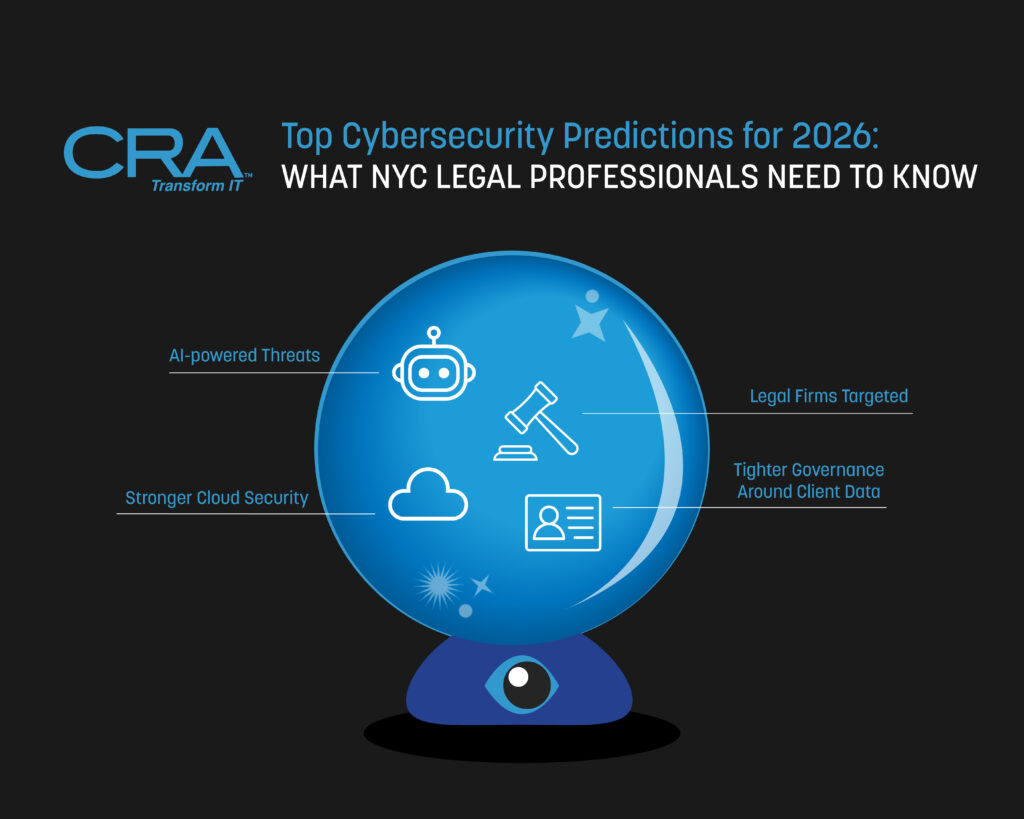
Cybersecurity threats are evolving faster than ever, and legal professionals in New York City face unique risks in 2026. Law firms handle sensitive client data, confidential case files, and protected communications that make them prime targets for cyberattacks. The rise of AI-powered threats, stricter data privacy regulations, and new compliance requirements are changing how legal practices must protect themselves.
AI is now driving both cyberattacks and defense strategies, creating a landscape where legal professionals must understand how automated threats work and how to counter them with intelligent security tools. Your firm's reputation depends on maintaining client trust, which means you need to stay ahead of emerging threats. Understanding the cybersecurity trends for 2026 will help you protect your practice and your clients.
The legal sector cannot afford to treat cybersecurity as an IT problem alone. You need to know what threats are coming, how regulations are tightening, and what steps your firm should take now to build resilience. This guide breaks down the most important predictions and gives you practical ways to prepare.
Key Takeaways
- AI-powered threats are targeting legal firms with more speed and precision while defense tools are becoming smarter at stopping attacks
- Data privacy regulations are getting stricter in 2026 with tighter governance requirements that directly impact how legal professionals handle client information
- Legal firms must adopt continuous monitoring, strengthen cloud security, and build trust through transparent security practices to stay protected
AI-Driven Threats and Defenses Shaping 2026
Artificial intelligence now powers both cyberattacks and security defenses, creating an arms race that will define cybersecurity in 2026. Legal professionals face new risks from autonomous AI agents that adapt attack methods in real-time and sophisticated manipulation techniques that target AI systems themselves.
Rise of Agentic AI and Autonomous Attacks
Agentic AI represents a shift from simple automated tools to systems that make independent decisions during attacks. These AI agents can target your firm's endpoints continuously, adjusting their tactics based on what defenses they encounter. Unlike traditional malware, they don't follow fixed patterns.
The speed and precision of these attacks surpass what human-led efforts can achieve alone. An AI agent conducting reconnaissance on your network can identify vulnerabilities, test multiple exploitation methods, and pivot to new targets within minutes. This creates compressed response windows for your security team.
These autonomous systems reduce the cost and skill level needed to launch sophisticated attacks. Threat actors can now deploy AI-powered tools that previously required expert knowledge. Your firm may face more frequent probing attempts as the barrier to entry drops for cybercriminals.
AI as a Double-Edged Sword in Legal Security
AI-driven defense tools enhance your security operations by identifying threats faster than manual analysis allows. Modern vulnerability management platforms use threat intelligence and global data to predict which security flaws attackers will weaponize before exploits become widespread.
You can implement AI systems that monitor your cloud infrastructure continuously and feed real-time data into adaptive security controls. These tools excel at repetitive tasks like log analysis and routine threat detection. They augment your security team rather than replace human judgment.
However, AI defenses still require human oversight. Your security staff must establish context, assess unknown variables, and make strategic decisions that AI cannot handle independently. The technology works best when your team treats it as a copilot that accelerates analysis while humans maintain final authority over critical security choices.
Prompt Injection and Model Manipulation Risks
Prompt injection attacks exploit how AI systems process input to manipulate their behavior. An attacker might craft specific text that tricks your AI-powered document review system into ignoring security protocols or leaking sensitive client information. These attacks target the AI model itself rather than traditional software vulnerabilities.
Your legal practice management tools may integrate AI features for research, drafting, or case analysis. Each integration point creates potential exposure to model manipulation. Attackers can feed malicious prompts through chatbots, automated intake forms, or any interface where users interact with AI systems.
You need to implement input validation and output monitoring for AI tools handling confidential data. Security operations should include testing your AI systems for manipulation risks just as you would test traditional applications for vulnerabilities. The complexity of large language models makes these attacks difficult to predict or prevent through standard security measures alone.
The Evolving Threat Landscape for Legal Professionals
Cybercriminals now target law firms with precision attacks designed specifically for the legal sector. These threats exploit the unique vulnerabilities in how you handle sensitive client data and communicate with courts and colleagues.
Advanced Phishing and Deepfake Impersonation
Email remains your biggest security risk in 2026. Attackers use AI to create convincing deepfake videos and voice recordings that impersonate partners, clients, or court officials. These sophisticated attacks target wire transfers and trick you into sharing confidential case information.
You need to verify any unusual payment requests through a separate communication channel. Implement SPF, DKIM, and DMARC email authentication protocols to block spoofed sender addresses.
Threat intelligence shows that phishing campaigns now analyze your firm's public information to craft personalized messages. They reference real cases, actual clients, and current court dates to bypass your suspicion. Multi-factor authentication blocks most credential theft attempts even when someone clicks a malicious link.
Sophisticated Supply Chain Attacks
Your firm relies on case management software, e-signature platforms, and cloud storage providers. Each vendor creates a potential entry point for attackers to access your systems.
A breach at your document management provider can expose all your client files. Third-party consultants with remote access can become unwitting channels for malware. Supply chain attacks exploit these trusted relationships to bypass your direct security measures.
You should audit all critical vendors for security certifications like ISO 27001 or SOC 2. Include breach notification requirements in every contract with technology providers. Limit vendor access to only the specific systems they need to perform their services.
Data Exfiltration in Legal Workflows
Attackers now steal data before encrypting it in ransomware attacks. They threaten to publish your client communications, litigation strategies, and personally identifiable information if you refuse to pay. This double extortion creates both operational and reputational damage.
Your most valuable information exists in unstructured formats like Word documents, PDFs, and email threads. Data loss prevention tools must monitor these files as they move between your systems and external recipients.
Implement automatic classification labels based on client matter and sensitivity level. Encrypt documents both at rest and during transmission. Set up alerts for unusual download volumes that might indicate data exfiltration attempts.
Data Privacy and Protection Under Scrutiny
Law firms in NYC face heightened scrutiny over how they protect client data, with new regulations taking effect in 2026 and stricter breach notification timelines. Your firm must balance protecting sensitive information with meeting evolving compliance requirements that affect everything from encryption standards to monitoring systems.
Protecting Sensitive Client and Case Data
Your client files contain some of the most sensitive personally identifiable information imaginable. This includes financial records, medical histories, trade secrets, and confidential communications protected by attorney-client privilege.
You need to implement strong encryption for data at rest and in transit. Many state privacy laws now require specific security measures for law firms handling personal data. California's updated CCPA regulations that took effect January 1, 2026, include cybersecurity audit requirements that your firm may need to comply with if you serve California clients.
Consider these essential protections:
- End-to-end encryption for email and file sharing
- Multi-factor authentication for all system access
- Role-based access controls limiting who sees what data
- Regular security audits of your systems and vendors
Financial sector cybersecurity regulations are becoming more prescriptive across states. If your practice includes financial services clients, you face additional requirements modeled after New York's Department of Financial Services cybersecurity regulation, which became fully effective in 2025.
Emerging Breach Notification Requirements
California's new breach notification deadlines became effective January 1, 2026, requiring faster reporting than before. Other states are following this trend of tightening their notification timelines.
You must now track different notification requirements across multiple jurisdictions. New York, where your firm operates, has its own specific breach notification law. But if you represent clients in other states, you need to comply with their laws too.
Key notification steps you should prepare:
- Detect and investigate the breach immediately
- Notify affected individuals within state-mandated timeframes
- Report to relevant state attorneys general
- Document your response for regulatory review
The right to cure violations that some state privacy laws allowed is expiring in 2026 for Oregon, Minnesota, and New Jersey. This means enforcement actions can proceed faster without giving you time to fix issues first.
Managing Telemetry and Continuous Monitoring
Telemetry data from your systems provides real-time insights into potential security threats. Your firm should deploy monitoring tools that track unusual access patterns, data transfers, and system behaviors.
This continuous monitoring helps you detect breaches faster. The faster you detect a problem, the faster you can respond and meet those tight notification deadlines.
You need monitoring that covers:
- User access logs and authentication attempts
- File access and modification tracking
- Network traffic analysis
- Endpoint device activity
Your monitoring systems will generate significant amounts of data. You must protect this telemetry data itself since it may contain information about your clients and cases. Store monitoring logs securely and limit access to authorized security personnel only.
Consider working with managed security service providers who can monitor your systems around the clock. Many smaller NYC law firms lack the internal resources for 24/7 security monitoring.
Regulatory Compliance and Governance in 2026
Legal professionals in NYC face stricter data governance and expanded compliance requirements this year. Regulators are tightening rules around consumer data, breach reporting, and cybersecurity controls across both US and EU jurisdictions.
Navigating DORA, EU AI Act, and NIS2
If your firm handles EU clients or data, you need to understand three major European regulations that took effect recently. The Digital Operational Resilience Act (DORA) requires financial entities to report cyber incidents within specific timeframes and maintain tested incident response plans. The EU AI Act creates risk categories for AI systems, with high-risk applications facing strict transparency and documentation requirements.
NIS2 expands cybersecurity obligations to more sectors and sizes of organizations. It includes shorter breach notification windows and holds executives personally accountable for security failures. These rules apply to your practice if you process EU personal data or serve European clients.
You should document your AI tools, maintain updated incident response procedures, and ensure your vendors meet the same standards. Many US firms underestimate their EU regulatory exposure until they face enforcement actions.
US and NYC-Specific Legal Compliance Trends
Twenty states now have comprehensive privacy laws, with Indiana, Kentucky, and Rhode Island joining in January 2026. New York has not passed a comprehensive privacy law yet, but you must comply when handling data from residents of states that have these laws.
The FTC is aggressively enforcing the Children's Online Privacy Protection Act (COPPA) with updated rules requiring separate parental consent for third-party data disclosure. State regulators formed the Consortium of Privacy Regulators to coordinate enforcement across jurisdictions. They focus on common requirements like access rights, deletion rights, and opt-out signals.
Financial services face particularly strict requirements, with multiple states adopting New York's DFS cybersecurity regulation as a model.
Converging Security Controls and Compliance Monitoring
Your firm needs to demonstrate measurable security controls, not just deploy security tools. Both compliance auditors and cyber insurance providers now evaluate your security posture through documented, repeatable processes.
Implement these key controls:
- Regular cybersecurity audits documenting your security measures
- Automated compliance monitoring to track policy adherence
- Universal opt-out mechanisms for consumer privacy requests
- Vendor risk management programs with documented assessments
- Incident response plans with defined notification timelines
The Trump administration's national cybersecurity strategy is expected early this year. It will likely affect critical infrastructure providers and federal contractors through harmonized regulations. Various proposed rules await action, including HIPAA Security Rule amendments and cyber incident reporting requirements for government contractors.
You should prepare for stricter governance requirements around consent management, data minimization, and automated decision-making systems. States are no longer offering cure periods for violations, making proactive compliance essential rather than reactive fixes.
Securing Legal Operations: Best Practices and Future Strategies
Law firms need to shift from perimeter-based defenses to layered security models that assume threats already exist within networks. Modern security operations require continuous monitoring and cloud-adapted controls to protect sensitive client data.
Implementing Zero Trust Architectures
Zero trust security assumes no user or device should be automatically trusted, even inside your network. This approach requires verification for every access request, regardless of where it comes from.
You need to implement multi-factor authentication across all systems and applications. This adds a critical layer beyond passwords that hackers can easily steal or guess.
Key Zero Trust Components:
- Identity verification at every access point
- Least privilege access limiting users to only what they need
- Continuous monitoring of all network activity
- Micro-segmentation dividing networks into secure zones
Your firm should verify devices before they connect to any systems. This means checking that laptops and phones meet security standards like updated software and active antivirus protection. You must also monitor user behavior to spot unusual patterns that might signal compromised accounts.
Modernizing SOCs for Real-Time Response
Security operations centers (SOCs) monitor your firm's networks for threats around the clock. Modern SOCs use automated tools to detect and respond to attacks faster than traditional manual methods.
You should deploy security information and event management (SIEM) systems that collect data from all your security tools. These platforms analyze thousands of events per second to identify real threats among false alarms.
Your security operations team needs clear response protocols for different incident types. A phishing attempt requires different actions than a ransomware attack. Automated playbooks help your team respond consistently and quickly.
Consider outsourcing SOC functions if your firm lacks in-house expertise. Many legal practices work with managed security service providers who offer 24/7 monitoring at lower costs than building internal teams.
Cloud-Native Security Controls for Law Firms
Cloud-native security protects data and applications specifically designed for cloud environments. Traditional security tools often fail to address the unique risks of cloud-based legal practice management systems.
You need to encrypt data both in transit and at rest within cloud platforms. This protects client information even if someone intercepts network traffic or breaches storage systems. Your cloud providers should offer built-in encryption features you can enable with minimal configuration.
Essential Cloud Security Measures:
| Control | Purpose |
|---|---|
| Access logging | Track who views or modifies files |
| Data loss prevention | Block unauthorized file sharing |
| Backup automation | Ensure recovery from ransomware |
| Compliance monitoring | Meet regulatory requirements |
You must configure cloud access controls to restrict who can view sensitive case files. Role-based permissions ensure paralegals, attorneys, and administrators only access information relevant to their work. Regular audits of these permissions prevent security gaps from accumulating over time.
Building Trust and Resilience for NYC Legal Firms
NYC law firms face mounting pressure to protect client data while maintaining operational efficiency. Strong vendor oversight, smart use of automation, and proactive threat management separate resilient practices from vulnerable ones.
Managing Third-Party and Supply Chain Risks
Your firm's security controls only work if your vendors maintain the same standards. Cloud storage providers, e-discovery platforms, and case management systems all access sensitive client information. Each connection creates a potential entry point for cybercriminals.
You need to conduct security assessments before signing any vendor contract. Ask for SOC 2 reports, encryption standards, and incident response protocols. Review these documents annually, not just during initial onboarding.
Map all data flows between your systems and third-party tools. Know exactly where client information travels and who can access it. This visibility helps you comply with regulatory frameworks like the New York SHIELD Act and identify weak points in your supply chain.
Build vendor security requirements into your contracts. Include notification timelines for breaches, data deletion procedures, and audit rights. These terms give you legal recourse if a vendor's security failure affects your clients.
Balancing Automation and Human Oversight
Automation speeds up document review and routine compliance checks, but it can't replace human judgment in cybersecurity decisions. You need both working together.
Use automation for repetitive tasks like log monitoring, patch management, and initial threat detection. These tools spot anomalies faster than any person could. However, your IT team or managed service provider must review flagged issues and decide how to respond.
Threat intelligence platforms can automate the collection of current attack patterns targeting law firms. Your staff should analyze this intelligence and adjust your information security policies based on real risks, not automated recommendations alone.
Train your lawyers and staff to recognize phishing attempts and social engineering tactics. Automated email filters catch many threats, but sophisticated attacks often slip through. Your people serve as the last line of defense when technology fails.
Futureproofing Against Emerging Threats
Cybercriminals constantly adapt their methods to bypass standard security controls. Your defenses need to evolve at the same pace.
Start building an incident response plan that addresses AI-powered attacks and deepfake impersonation. These threats will become more common in 2026 as attackers use advanced tools to trick your staff and clients. Practice your response through tabletop exercises every quarter.
Monitor changes to regulatory frameworks affecting legal data handling. New York regularly updates privacy requirements, and federal regulations continue to expand. Subscribe to threat intelligence feeds specific to the legal sector so you receive early warnings about new attack methods targeting firms like yours.
Invest in security tools that can adapt to new threats without complete replacement. Look for platforms that receive regular updates and integrate with emerging technologies. This approach costs less than replacing your entire security stack every few years.