Where Cloud Is Headed in 2026: An Overview for Financial Services Firms
Cloud computing is changing fast. In 2026, the cloud will look different than it does today. Companies that align their cloud strategy with AI automation, multi-cloud flexibility, strong governance, and data sovereignty requirements will lead the next wave of digital transformation.
The shift is already happening. AI is becoming the central force in cloud operations. More businesses are spreading their workloads across multiple cloud providers and edge locations. At the same time, security threats are growing and regulations are getting stricter. This means you need to think about cloud differently.
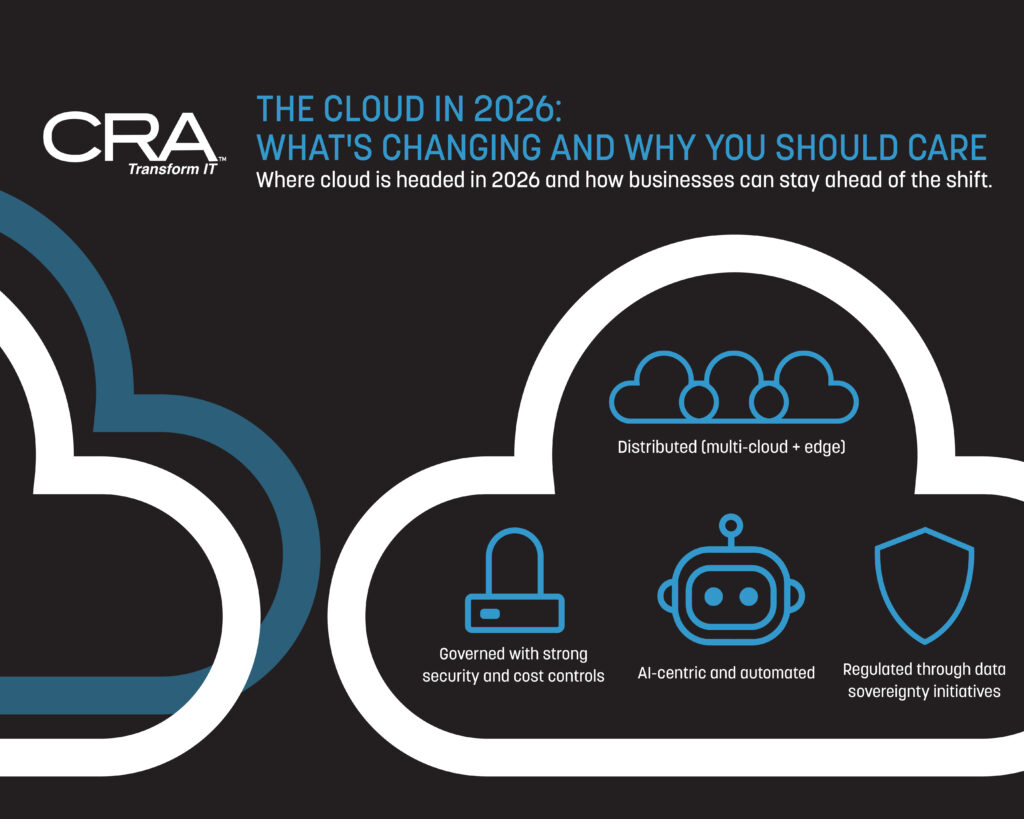
Your cloud strategy for 2026 needs to cover four main areas. You need AI-driven automation to handle complex tasks. You need a distributed approach that uses multiple clouds and edge computing. You need strong security and cost controls to protect your business and manage spending. And you need to follow data sovereignty rules that vary by region. Getting these right now will put you ahead of competitors who wait too long to adapt.
Key Takeaways
- Cloud computing in 2026 will be powered by AI automation and distributed across multiple platforms including edge locations
- Strong governance with zero trust security and active cost management will be critical for cloud success
- Businesses must align their cloud strategy with data sovereignty regulations and sustainability goals to stay competitive
AI-Centric and Automated Cloud Environments
Cloud platforms are becoming AI-first by design, with machine learning and automation built into their core infrastructure. By 2030, over 80% of enterprises will deploy industry-specific AI agents for critical business tasks, compared to less than 10% today.
AI-Native Cloud Platforms and AIaaS
Major cloud providers now offer AI as a service (AIaaS) that lets you access machine learning models without building them from scratch. AWS, Google Cloud, and Azure provide pre-trained models for natural language processing, computer vision, and predictive analytics.
These platforms handle the complex infrastructure needed to run AI workloads. You don't need to manage GPUs, training clusters, or storage systems. The cloud provider takes care of scaling resources up or down based on your needs.
AIaaS also includes tools for model training, deployment, and monitoring. You can experiment with different algorithms and datasets through simple interfaces. This approach cuts down the time from concept to production significantly.
Generative AI and Machine Learning Integration
Generative AI is now embedded directly into cloud services and applications. You can use these tools to create content, generate code, analyze data, and automate customer service tasks.
Cloud platforms integrate both generative AI and traditional machine learning models into their ecosystems. This gives you access to multiple AI capabilities from one environment. You can combine different models to solve complex business problems.
The integration extends to cloud-native development tools. Developers can call AI services through APIs and embed them into applications. This makes it easier to add intelligent features to your products without specialized AI expertise.
AI-Driven Automation and Cloud Management
AI now automates routine cloud management tasks that used to require manual intervention. These systems monitor resource usage, predict future needs, and adjust configurations automatically.
Key automation capabilities include:
- Resource optimization: AI analyzes usage patterns and right-sizes compute instances
- Predictive maintenance: Systems detect potential failures before they impact operations
- AI-powered threat detection: Security tools identify and respond to threats in real-time
- Cost management: Automated systems find and eliminate waste in cloud spending
Companies that don't optimize their AI compute environment will pay over 50% more than those that do by 2030. Automation helps you avoid these extra costs by continuously optimizing your infrastructure.
Industry-Specific AI Workloads
Businesses are moving beyond general AI tools to specialized solutions built for specific industries. Healthcare organizations use AI for diagnosis support. Financial services deploy models for fraud detection and risk assessment.
Cloud platforms now offer industry-tailored AI agents that understand sector-specific data and regulations. These solutions come pre-configured with relevant models and compliance frameworks.
More than 60% of enterprises will run intensive AI model activity across multiple clouds by 2030. This distributed approach lets you choose the best platform for each workload. You might use one cloud for training models and another for running inference at scale.
The shift to industry-specific AI workloads requires careful planning. You need to align your cloud strategy with business objectives and ensure your teams can manage these specialized systems effectively.
Rise of Distributed, Multi-Cloud, and Edge Architectures
Cloud infrastructure is spreading beyond centralized data centers. Businesses are combining multiple cloud providers with edge computing to reduce latency, improve resilience, and meet data sovereignty requirements.
Multi-Cloud Strategies and Interoperability
Multi-cloud strategies let you use services from Amazon Web Services, Google Cloud Platform, and Microsoft Azure at the same time. This approach prevents vendor lock-in and gives you access to the best tools from each hyperscaler.
The main challenge is managing different environments. Each cloud provider has its own console, APIs, and service offerings. AWS Lambda works differently than Google Cloud Functions, even though both offer serverless computing.
Container orchestration tools solve this problem:
- Kubernetes runs consistently across all major cloud platforms
- Docker containers package applications the same way regardless of the cloud provider
- Red Hat OpenShift provides a unified management layer for multi-cloud deployments
You need a single control plane to manage resources across clouds. Distributed cloud platforms let you deploy Kubernetes clusters, update security policies, and monitor performance from one location. This consistency makes it easier for your DevOps team to handle deployments without learning separate tools for each cloud service provider.
Edge Computing for Real-Time Insights
Edge computing processes data close to where it gets created instead of sending everything to a central cloud. This matters when milliseconds count.
Manufacturing plants use edge nodes to monitor equipment and detect problems in real time. Self-driving cars process sensor data instantly because they cannot wait for a round trip to a distant data center. Retail stores analyze customer behavior on-site to adjust inventory immediately.
The pattern combines both approaches. Your edge devices handle local processing while centralized cloud systems manage complex analytics and long-term storage. You get fast response times at the edge plus the computing power of hyperscalers for bigger tasks.
5G networks make edge computing more practical. Faster connectivity lets edge nodes work together and sync with cloud platforms without noticeable delays.
Hybrid Cloud and Vertical Cloud Adoption
Hybrid cloud connects your on-premises systems with public cloud resources. You keep legacy applications in your own data center while running new cloud-native services on platforms like Microsoft Azure or Google Cloud.
This setup gives you flexibility. You can expose high-value on-premises assets to the cloud through APIs without rebuilding everything. Your team experiments with AI and machine learning in the cloud while critical systems stay under your direct control.
Industry-specific cloud platforms are gaining adoption. These vertical cloud solutions come pre-configured for healthcare, financial services, or manufacturing. They include compliance tools and industry-specific features that generic cloud platforms do not offer.
Your choice depends on regulatory requirements and existing infrastructure. GDPR compliance might require keeping certain data on-premises while processing other workloads in the cloud.
Cloud Security, Governance, and Zero Trust Initiatives
Security models are shifting from perimeter-based defenses to continuous verification systems. Organizations are combining zero trust principles with AI-powered tools and unified management platforms to protect distributed cloud environments.
Zero Trust Architectures and AI-Powered Prevention
Zero trust architecture eliminates implicit trust within your network. Every user, device, and application must verify its identity before accessing resources, regardless of location.
The traditional model assumed anything inside your network was safe. That approach fails in cloud environments where workloads move between containers, serverless functions, and multiple providers. Zero trust enforces least privilege access, meaning users only get the minimum permissions they need.
AI-powered threat detection enhances zero trust by identifying unusual behavior patterns. These systems analyze user actions, login locations, and access times to spot potential breaches. When someone tries to access data from an unexpected location or at an odd hour, the system can block access automatically.
Your cloud strategy should include continuous authentication. This means checking credentials throughout a session, not just at login. If risk factors change, the system can require additional verification or revoke access immediately.
Unified Security Management Across Clouds
Managing security across AWS, Azure, and Google Cloud creates complexity. Each provider has different tools, policies, and security controls.
Unified security platforms give you a single view of your entire cloud infrastructure. You can set consistent policies, monitor threats, and enforce compliance rules from one dashboard. This reduces the operational burden on your security teams.
Infrastructure-as-code helps maintain security standards across environments. You define security configurations in code templates that deploy automatically. This ensures every new resource meets your security requirements without manual setup.
Cloud governance frameworks establish rules for resource usage, cost management, and security compliance. These frameworks prevent shadow IT and ensure all cloud deployments follow your standards.
Compliance, Data Security, and Threat Detection
Data security regulations are becoming stricter. You need to know where your data lives, who accesses it, and how it moves between regions.
Confidential computing protects data while it's being processed. The data stays encrypted even during active use, which protects against insider threats and compromised systems. This technology is becoming standard for sensitive workloads.
Extended Detection and Response (XDR) platforms combine security data from multiple sources. They correlate alerts from cloud services, endpoints, and network tools to identify sophisticated attacks. AI models help these systems distinguish real threats from false alarms.
Your compliance requirements depend on your industry and regions of operation. Healthcare organizations need HIPAA compliance. Financial services require SOC 2 certification. Multi-cloud environments make compliance harder because you must meet standards across different platforms.
Data sovereignty laws require storing certain information within specific countries. You need visibility into data location and movement to avoid violations. Cloud management tools can enforce geographic restrictions automatically.
Managing Cloud Costs and Achieving Optimization
Cloud costs in 2026 require real-time control systems rather than periodic reviews, with optimization now measured by cost per business outcome instead of infrastructure savings percentages. Organizations need standardized cost data, AI-driven automation, and FinOps practices that connect spending directly to value creation.
Cloud Cost Management and FinOps
FinOps has evolved from a cost-tracking exercise into a strategic practice that links cloud spending to business results. You need to treat cost data as a system that integrates across multiple providers and platforms.
Your cost data now comes from infrastructure services, AI APIs, managed cloud platforms, and observability tools. Each source uses different billing formats and attribution methods. Without a unified approach, you cannot compare costs or make informed decisions.
The FOCUS specification (FinOps Open Cost and Usage Specification) provides a standardized schema for normalizing cost data across vendors. This enables consistent allocation, unit metric comparisons, and automation that survives billing format changes.
Key FinOps practices for 2026:
- Normalize cost data before analyzing it
- Build continuous control loops that detect and correct cost issues in real time
- Attribute costs to specific features, customers, and teams
- Measure unit economics like cost per customer or cost per AI inference
You should implement real-time anomaly detection that surfaces problems while decisions are still reversible. Monthly reports cannot keep pace with environments where usage patterns change hourly.
Cost Optimization Through AI and Automation
AI workloads create new optimization challenges because costs can spike within minutes rather than gradually increasing over weeks. Traditional methods like rightsizing and reserved instances do not address usage-based pricing or AI-driven growth patterns.
Your optimization strategy needs to focus on marginal costs and cost elasticity. Marginal cost measures what one additional unit of usage actually costs you. A feature that appears efficient at low adoption may destroy margins at scale.
Critical optimization areas:
- AI unit economics: Track cost per AI-powered feature, cost per user, and cost per successful outcome
- Platform overhead: Optimize observability pipelines, data movement, and background services that scale by default
- Resilience costs: Balance redundancy expenses against downtime impact rather than cutting all idle resources
Automation should handle continuous optimization tasks. Set up systems that adjust resources based on actual demand patterns, not just scheduled times. Your AI costs need granular visibility so you can identify which customers or features drive disproportionate spending.
Platform costs often grow faster than customer-facing features. Apply tiered observability where not all logs require the same retention or fidelity. Design cost-aware defaults for internal tooling.
Cloud Economics and Pricing Models
Cloud pricing in 2026 combines commitment-based discounts with usage-based models and AI inference costs. You need to understand how different pricing structures affect your total cost of ownership across multi-cloud environments.
Your pricing strategy should account for how costs respond to usage changes. Some workloads scale smoothly while others scale poorly without caching or batching. Test how your architecture behaves under different load conditions.Calculate your cost per outcome rather than just tracking total spend. You need to know what serving one more customer actually costs or how a new feature deployment changes unit economics.
Cross-cloud pricing varies significantly for similar services. Evaluate workload placement based on performance requirements and cost efficiency. Data transfer fees between clouds and regions add hidden expenses that traditional cost tools miss.
Build cost visibility into your architecture decisions early. The cheapest option today may become expensive as you scale or add resilience requirements.
Data Sovereignty, Compliance, and Regulatory Changes
Organizations now face strict requirements about where data lives and who can access it. Major regulations like NIS2, DORA, and the EU Data Act create immediate compliance obligations that reshape cloud adoption strategies.
Data Governance and Data Sovereignty Programs
Data sovereignty gives you control over your digital assets, infrastructure, and data. This means you decide where and how data is stored, who can access it, and how it's processed.
You need three components working together. Data sovereignty controls data location, access, and processing. Infrastructure sovereignty ensures your computing resources operate independently without foreign dependencies. Technology sovereignty reduces vendor lock-in and gives you control over encryption keys and security protocols.
Strong data governance starts with classification. You must identify which data falls under specific regulations, then implement protection measures that match those requirements. This includes sovereign key management and planning for quantum computing threats through post-quantum cryptography assessment.
Cloud governance frameworks help you maintain control as you scale. You'll need clear policies for data residency, access controls, and audit capabilities before moving sensitive workloads to the cloud.
Navigating Industry and Regional Regulations
Your compliance requirements depend on your industry and where you operate. Financial services organizations must comply with DORA, which took effect in January 2025. This regulation covers ICT risk management, incident reporting, resilience testing, third-party risk management, and information sharing.
Healthcare providers handle sensitive patient data that requires strict residency controls. Government entities face NIS2 requirements that include personal liability for management.
The regulatory landscape varies by region:
- European Union: GDPR, NIS2, DORA, EU Data Act with fines up to €20 million or 4% of global turnover
- Brazil: LGPD applies to any organization processing personal data in Brazil
- United States: CMMC 2.0 applies across the defense industrial base starting November 2025
Multi-cloud strategies complicate compliance. You need to track where data lives across different providers and ensure each location meets local requirements. Cloud security measures must align with the strictest regulations that apply to your operations.
Cloud Sustainability and Green Initiatives
Cloud providers are integrating renewable energy sources and energy-efficient infrastructure to meet growing environmental demands. Businesses adopting green cloud practices can reduce costs while aligning with regulatory requirements and corporate responsibility goals.
Sustainable Cloud Operations and Green Cloud
Green cloud computing focuses on reducing the environmental impact of data centers through energy-efficient hardware, virtualization, and renewable energy integration. Major cloud providers have made significant commitments to sustainability. Google Cloud achieved 100% renewable energy matching for its global operations, while AWS powers its infrastructure with solar and wind farms across multiple regions.
You can reduce your cloud-related emissions by selecting providers with strong sustainability credentials. Look for data centers that use advanced cooling systems, participate in carbon offset programs, and publish transparent sustainability metrics. Virtualization and containerization allow you to consolidate workloads on fewer physical servers, cutting both energy consumption and costs. Edge computing processes data closer to its source, reducing the energy needed to transmit information to centralized facilities.
Energy Efficiency, Carbon Footprint, and ESG Alignment
Cloud sustainability directly supports your Environmental, Social, and Governance (ESG) objectives. Businesses switching to energy-efficient cloud infrastructure can cut energy costs by 20-40% while meeting regulatory compliance standards.
You can track your carbon footprint using tools provided by cloud platforms. Google Cloud offers carbon footprint reporting that shows emissions data for your workloads. AWS provides sustainability dashboards that help you monitor and optimize resource usage. These metrics enable you to set measurable targets, such as reducing emissions by specific percentages annually.
Optimizing your cloud resources through auto-scaling and dynamic allocation prevents over-provisioning and wasted energy. Choosing regions powered by renewable energy for your deployments further reduces your environmental impact. Many governments now offer tax incentives for businesses adopting green cloud technologies, making sustainability both environmentally responsible and financially advantageous.
Strategic Alignment for the Future of Cloud
Businesses must rethink cloud adoption to balance flexibility, automation, and resilience as the global cloud computing market evolves toward AI-driven and distributed architectures.
Avoiding Vendor Lock-In and Enhancing Flexibility
You need to design your cloud strategy around portability and interoperability. This means choosing solutions that work across multiple providers instead of tying your entire infrastructure to one vendor's ecosystem.
Start with infrastructure-as-code practices that let you define and deploy resources using standardized templates. This approach makes it easier to move workloads between cloud providers when business needs change.
Consider these key tactics:
- Use containerization technologies that run consistently across different cloud platforms
- Select tools and services that support open standards and APIs
- Build abstraction layers between your applications and cloud-specific features
- Design data pipelines that can transfer information between environments without significant rework
Your procurement decisions should prioritize vendors that support multi-cloud compatibility. When you evaluate new services, test how easily you can migrate away from them. This preparation gives you negotiating power and protects you from sudden price increases or service changes.
Building Resilience and Self-Optimizing Clouds
Your cloud infrastructure needs to automatically adjust to changing conditions without manual intervention. Self-optimizing cloud systems use machine learning to monitor performance, predict failures, and redistribute workloads based on cost and efficiency.
These systems track resource usage patterns and scale compute power up or down in real time. They also identify underused services and recommend consolidation opportunities.
Key capabilities include automated backup rotation, predictive maintenance alerts, and dynamic load balancing. Your infrastructure should detect performance bottlenecks before they affect users and reroute traffic automatically.
Build redundancy across geographic regions and cloud providers. This protects your operations when one zone experiences outages. Set up automated failover procedures that activate backup systems within seconds of detecting problems.
Transformative Approaches to Digital Transformation
Digital transformation through cloud adoption requires aligning technology decisions with specific business outcomes. You should map each cloud initiative to measurable goals like faster product launches, improved customer experiences, or reduced operational costs.
Start by identifying processes that slow down your business. Look for manual workflows, disconnected systems, or outdated applications that limit growth. Prioritize cloud migrations that eliminate these bottlenecks first.
Your teams need clear ownership of cloud initiatives. Assign cross-functional groups that include IT, finance, and business unit leaders. This ensures technical decisions support actual business needs rather than just technology trends.
Focus on quick wins that demonstrate value. Deploy cloud-based analytics tools that provide immediate insights or migrate customer-facing applications that improve response times. These visible successes build momentum for larger transformation efforts.
Track specific metrics like deployment frequency, system uptime, and cost per transaction. These measurements show whether your cloud strategy actually improves business performance or just shifts spending to different vendors.