Managed IT Services vs. In-House IT: Cost Comparison in NYC for 2026
Manhattan Cost Comparison 2026
Choosing between managed IT services and building an in-house IT team is one of the biggest technology decisions Manhattan businesses face. The wrong choice can cost your company thousands of dollars each year while leaving critical gaps in coverage and expertise.
For most New York City businesses with 20-250 employees, managed IT services cost 50-70% less than an equivalent in-house team while providing broader technical expertise and round-the-clock support.
The salary for a single experienced IT professional in Manhattan starts around $85,000-$120,000 before benefits, taxes, and tools.
This breakdown compares the real costs of both options for Manhattan businesses in 2026. You'll see actual salary figures for New York City IT positions, hidden expenses most companies overlook, and what level of service you can expect from each approach.
Key Takeaways
- Managed IT services typically cost 50-70% less than hiring full-time IT staff for businesses with 20-250 employees
- In-house IT requires significant expenses beyond salary including benefits, training, tools, and coverage gaps during vacations or sick days
- The best choice depends on your company size, technical needs, and whether you need 24/7 support or specialized security expertise
Breaking Down Total IT Costs in New York City
Manhattan businesses face higher IT expenses than most US markets. Understanding the complete cost structure helps you compare managed IT services against building an in-house IT team.
Direct Labor and Staffing Expenses
Salaries for IT professionals in New York City run significantly higher than the national average. A mid-level IT support specialist earns between $75,000 and $95,000 annually in Manhattan. Senior network administrators command $110,000 to $140,000.
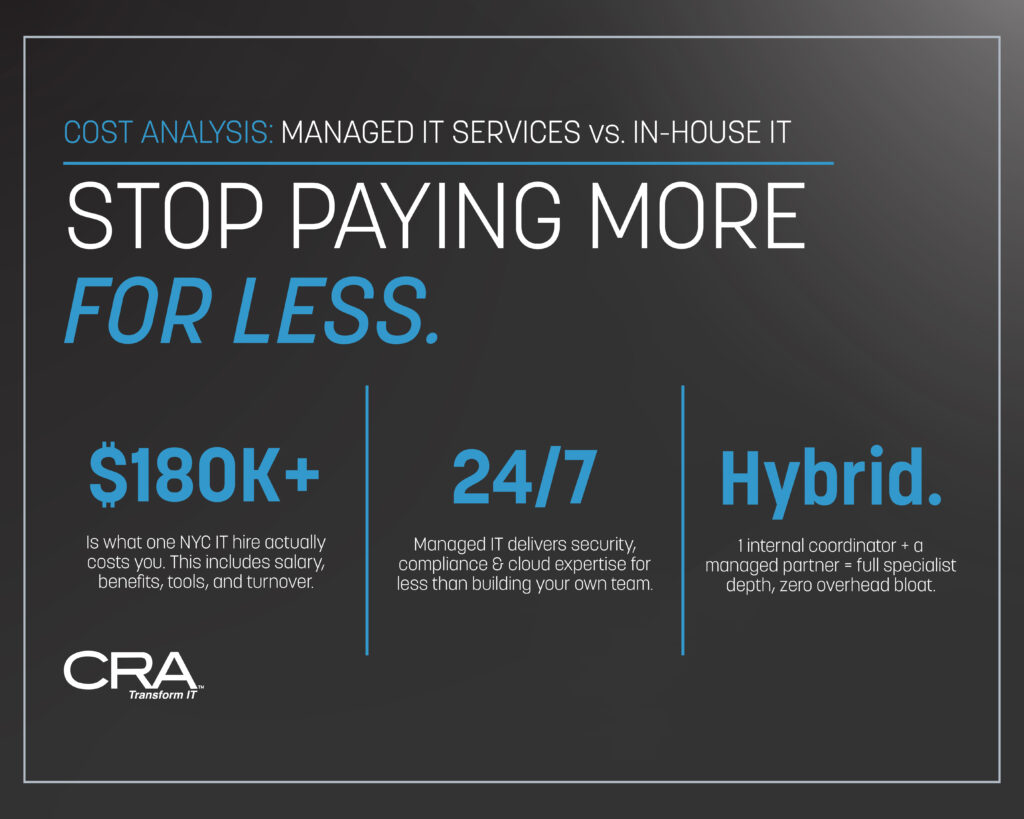
Benefits add another 30% to base salaries. This includes health insurance, paid time off, retirement contributions, and payroll taxes. For a $90,000 IT employee, you pay roughly $27,000 in additional benefits costs each year.
Typical Manhattan IT Staff Costs (2026):
| Role | Base Salary | Benefits (30%) | Total Annual Cost |
|---|---|---|---|
| Help Desk Technician | - $65,000 - $80,000 | - $19,500 - $24,000 | - $84,500 - $104,000 |
| IT Support Specialist | - $75,000 - $95,000 | - $22,500 - $28,500 | - $97,500 - $123,500 |
| Network Administrator | - $110,000 - $140,000 | - $33,000 - $42,000 | - $143,000 - $182,000 |
Turnover creates additional expenses. Replacing an IT employee costs approximately 150% of their annual salary when you factor in recruiting, training, and productivity loss.
Hidden and Indirect Costs
Training requirements add $1,200 to $2,000 per employee annually. Your IT staff needs current certifications and skills to handle evolving security threats and technologies.
Downtime incidents cost money beyond repair time. The average NYC business loses $5,600 per minute of downtime. Your in-house IT team handles an average of 12 to 18 incidents monthly that affect employee productivity.
Office space in Manhattan runs $60 to $90 per square foot annually. Each IT employee needs roughly 150 square feet, adding $9,000 to $13,500 yearly to your real estate costs. Equipment like desks, chairs, and monitors adds another $2,000 to $3,500 per person.
Software Licenses and Infrastructure Investments
Your tool-stack includes multiple software licenses beyond basic productivity tools. Remote monitoring and management platforms cost $3 to $8 per endpoint monthly. Professional support agreement (PSA) software runs $50 to $100 per technician each month.
Essential IT Tool-Stack Costs:
- Antivirus and security software: $40-$90 per user/year
- Backup and disaster recovery: $500-$2,000 monthly for 25-50 employees
- Network monitoring tools: $1,000-$3,000 annually
- Help desk ticketing system: $29-$79 per agent/month
Infrastructure investments require significant upfront capital. Server hardware costs $3,000 to $15,000 per unit with a 3-5 year replacement cycle. Network equipment like switches and firewalls add $2,000 to $8,000 every few years.
Cloud services shift some infrastructure costs to operational expenses. You still pay $15 to $50 per user monthly for cloud storage, email hosting, and collaboration platforms.
Service Delivery: Support, Availability, and Reliability
When comparing IT support options, the differences in service delivery directly impact your daily operations and budget. The way issues get resolved, how quickly help arrives, and what guarantees you have all vary significantly between managed services and in-house teams.
24/7 Monitoring and On-Site Support
Managed IT providers typically offer round-the-clock monitoring of your systems using specialized monitoring tools that track network performance, server health, and security threats. This means someone watches your infrastructure even when your office is closed.
In-house IT teams usually work standard business hours unless you pay overtime or hire staff for multiple shifts. A single IT person costs around $75,000 to $95,000 annually in Manhattan, so covering nights and weekends requires multiple employees, which quickly multiplies your costs.
On-site support differs between models too. Your in-house team is already at your location, but managed service providers often send technicians within agreed timeframes based on issue severity. Many MSPs maintain local teams in Manhattan to provide fast on-site response when remote support isn't enough.
Proactive Maintenance Versus Reactive Troubleshooting
Proactive maintenance means fixing problems before they cause downtime. Managed services focus on this approach by running regular updates, checking system health, and replacing aging equipment before it fails. They use monitoring tools to spot warning signs early.
In-house IT teams can be proactive, but they often spend most of their time on reactive troubleshooting because daily support requests pile up. When your sole IT person handles password resets and printer issues all day, strategic maintenance gets pushed back.
The difference shows up in your operational efficiency. Reactive support means more unexpected outages that disrupt your business and cost you money in lost productivity.
Service Level Agreements and Predictable Costs
Service level agreements (SLAs) are formal guarantees about response times and system uptime. Managed IT providers typically include SLAs in their contracts, promising to respond to critical issues within 15 to 60 minutes depending on your plan. If they miss these targets, you often receive service credits.
In-house teams don't operate under SLAs. If your IT person is sick or on vacation, support stops unless you have backup coverage.
Predictable costs are another major difference. Managed services charge a fixed monthly fee that covers most support needs, making budgeting straightforward. In-house IT costs fluctuate with salaries, benefits, training, unexpected hires, and tool purchases that can spike your budget without warning.
Expertise, Scalability, and Talent Access
Building an IT team with the right skills at the right time presents unique challenges in Manhattan's competitive job market. Managed service providers offer instant access to specialized expertise and flexible scaling options that most internal IT teams struggle to match.
Accessing Specialized Talent and Consulting
Manhattan businesses face steep competition when hiring IT talent. The average salary for a network administrator in NYC exceeds $85,000, while cybersecurity specialists command over $120,000 annually.
An MSP gives you immediate access to multiple specialists without recruitment costs or salary negotiations. You get experts in cloud computing, threat detection, compliance, and emerging technologies as part of your service package.
In-house hiring takes 3-6 months on average in the NYC market. During that time, critical projects stall and security gaps remain open. Outsourcing through a managed service provider eliminates these delays entirely.
IT consulting services from an MSP also mean you benefit from knowledge gained across hundreds of client environments. Your internal IT team only knows what they've experienced within your organization.
Scaling IT Operations to Fit Business Growth
Your IT needs change as your business grows or contracts. An in-house IT team requires months of planning to scale up through hiring, and downsizing means layoffs and severance costs.
Managed service providers adjust resources within days or weeks. Opening a new office? Your MSP can deploy support immediately. Seasonal business fluctuations? Scale services up during peak periods and down during slower months.
Scaling Comparison:
| Growth Scenario | In-House IT Team | Managed Service Provider |
|---|---|---|
| Add 50 users | - Hire 1-2 staff (3-6 months) | - Adjust service tier (1-2 weeks) |
| Open new location | - Recruit local staff | - Extend existing coverage |
| Reduce headcount | - Layoffs and severance | - Lower service level |
Hybrid Model: Combining Internal and External Teams
Many Manhattan businesses find success combining a small internal IT team with outsourced IT support. You keep one or two staff members on-site for immediate hardware issues and user support while your MSP handles monitoring, security, backups, and specialized projects.
This hybrid model costs less than a full in-house IT team while maintaining the direct control and quick response times you value. Your internal staff focuses on day-to-day needs while the MSP provides 24/7 monitoring and expert-level support.
The hybrid approach works especially well for businesses with 25-200 employees. You avoid the overhead of building a complete IT department but still have someone who understands your specific systems and workflows.
Security and Business Continuity
Cybersecurity threats and system downtime cost Manhattan businesses thousands of dollars per incident. The right IT structure determines whether your company detects threats in minutes or discovers breaches weeks later, and whether a server failure means two hours of downtime or two days.
Comprehensive Cybersecurity and Threat Detection
Managed IT services maintain 24/7 Security Operations Centers that monitor your network continuously. These teams use advanced threat detection tools to identify suspicious activity before it becomes a breach. They apply security patches within 48 hours and respond to incidents within 15 minutes.
In-house IT teams typically work business hours only. Your network sits unmonitored nights and weekends when many attacks occur. A single IT manager handles security between other tasks like user support and system updates. Building equivalent security protection requires hiring a dedicated security analyst, which adds $90,000-$120,000 to your annual costs plus the expense of monitoring tools and threat intelligence feeds.
Managed services include regular vulnerability assessments and penetration testing. Some providers offer ethical hacking services to identify weaknesses before attackers do. In-house teams usually conduct security reviews only when budget allows or after an incident occurs.
Data Backup and Disaster Recovery Planning
Managed service providers implement automated backup systems that protect your data every few hours. They store copies in multiple geographic locations and test recovery procedures quarterly. Most guarantee recovery within specific timeframes written into your service contract.
In-house teams often rely on basic backup software that runs overnight. Backup verification happens monthly at best. Many Manhattan businesses discover their backups failed only when they need to restore data. Testing disaster recovery takes time your internal IT staff may not have.
Business continuity planning with managed services includes documented procedures for different failure scenarios. You receive clear escalation paths and regular drills to ensure systems can restart quickly after problems.
Cloud Computing and Compliance Demands
Cloud services create new compliance requirements that change frequently. Managed IT providers maintain certifications across multiple frameworks including HIPAA, SOC 2, and PCI DSS. They update security controls as regulations change and provide audit documentation when needed.
Manhattan businesses in healthcare, finance, and legal sectors face strict compliance demands. Managed services include continuous monitoring that tracks who accessed what data and when. They generate compliance reports automatically and alert you to policy violations in real time.
In-house teams must research compliance requirements themselves and implement controls without specialized training. Cloud computing platforms like AWS and Azure each have hundreds of security settings. Configuring these correctly requires expertise your internal IT staff may lack.
Upgrades, Innovation, and IT Roadmap Alignment
Technology refresh cycles and strategic planning create different cost structures between managed services and in-house teams. Manhattan businesses need to account for both the expense of keeping systems current and the expertise required to plan future technology investments.
Software and Hardware Refresh Cycles
In-house IT teams require dedicated budget allocation for technology refreshes every 3-5 years. Your company must plan for workstation replacements, server upgrades, and software license renewals. These costs hit all at once and often exceed initial projections.
The typical Manhattan business spends $1,200-$2,000 per employee on hardware refreshes. Software licensing adds another $500-$1,500 annually per user depending on your tool stack. Your IT staff must research options, negotiate contracts, and manage implementations.
Managed service providers include upgrades in monthly fees. They handle hardware refreshes, software updates, and security patches as part of standard service agreements. You avoid sudden capital expenditures and get predictable monthly costs instead.
Many managed services contracts include automatic technology refreshes every 36-48 months. Your provider manages the entire upgrade process without pulling internal resources away from daily operations.
IT Strategy and Roadmap Planning
In-house teams struggle with long-term technology planning because they focus on daily IT operations. Your staff handles help desk tickets, system maintenance, and urgent fixes. Strategic planning often gets postponed.
Managed service providers bring outside expertise to IT roadmap development. They work with hundreds of clients and see which technology investments deliver actual business value. Your managed services partner helps align IT infrastructure decisions with business goals rather than just maintaining current systems.
A solid IT roadmap requires understanding emerging technologies, security requirements, and industry-specific compliance needs. Manhattan businesses face unique challenges with data privacy laws and vendor management. Managed providers stay current on these requirements and build them into your technology plan.
Evaluating Cost Efficiency and Long-Term Value
Manhattan businesses face high IT costs due to elevated salaries, expensive office space, and premium tool pricing. Understanding where managed services deliver savings versus where in-house teams provide better value helps you make informed decisions based on your specific business needs and growth plans.
Cost Savings with Managed IT Providers
Managed IT providers typically reduce costs by 30-50% compared to building equivalent in-house capabilities. You avoid direct expenses like salaries, benefits, training, and turnover while gaining access to enterprise-grade tools and expertise.
The cost difference in Manhattan is significant. An in-house IT team often costs $350,000 to $500,000 per year when you factor in competitive NYC salaries, health insurance, paid time off, and ongoing training. A managed IT provider delivers similar or better coverage for a predictable monthly fee.
You also eliminate hidden costs. Downtime, overtime pay, multiple overlapping software subscriptions, and emergency hardware purchases add up quickly with in-house teams. Managed providers include proactive monitoring and maintenance in their service agreements, preventing many of these unexpected expenses.
Manhattan businesses benefit from economies of scale. Managed IT providers spread the cost of specialized security tools, monitoring platforms, and expert certifications across multiple clients. You get access to these resources without paying full ownership costs.
When In-House IT Becomes Cost-Effective
In-house IT makes financial sense when your business needs constant, highly specialized support for custom applications or unique systems. Companies with proprietary software, strict data control requirements, or complex integrations may find in-house teams more cost-effective.
Businesses with 200+ employees and stable IT needs can justify the fixed costs of salaries and infrastructure. At this scale, the per-employee cost of in-house IT decreases while providing immediate, on-site support and deep institutional knowledge.
Many Manhattan businesses choose a hybrid model. They keep strategic functions and core system management in-house while outsourcing routine operations, security monitoring, and specialized projects. This approach balances control with cost efficiency.
The decision depends on your growth stage. Rapidly expanding businesses struggle to scale in-house teams quickly, while stable organizations with predictable IT needs can optimize internal staffing over time.
Choosing Cost-Effective IT Solutions for Manhattan Businesses
Your business size, growth rate, and IT complexity determine which approach delivers better value. Small businesses with 10-50 employees almost always benefit from managed services due to lower overhead and access to specialized expertise.
Evaluate your current IT spending honestly. Include all costs: salaries, benefits, software licenses, hardware, training, recruitment, and lost productivity from downtime. Compare this total to managed service provider quotes that include the same scope of support.
Consider your internal team's capacity. If your IT staff spends most of their time on break-fix tasks instead of strategic projects, outsourcing routine operations creates immediate value. Your team can focus on initiatives that drive revenue and growth.
Manhattan's high cost of living affects IT salaries significantly. Entry-level IT positions start at $60,000-$75,000, while experienced administrators command $90,000-$120,000 or more. Factor in 25-30% additional costs for benefits and employer taxes when calculating total compensation.