
Cybersecurity for New York Law Firms: Best Practices – 2026 Edition
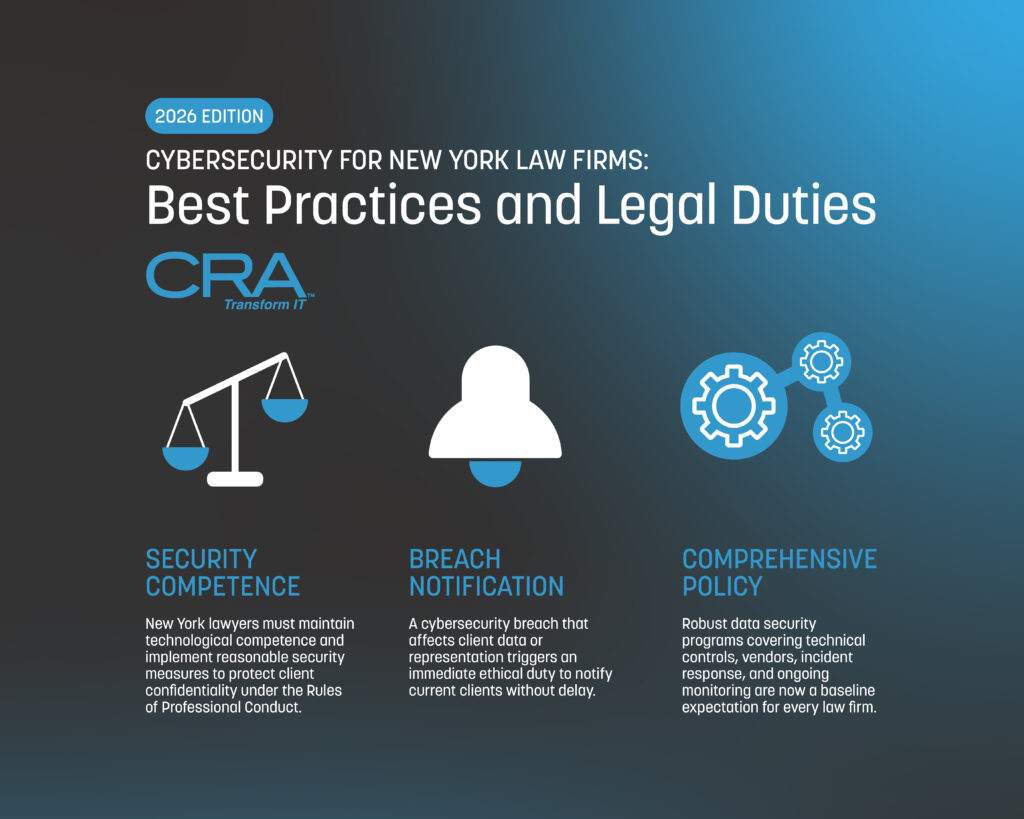
Cybersecurity Best Practices and Legal Duties for Law Offices in NYC - 2026 Edition
Law firms in New York are sitting on a goldmine of confidential client info, which, let’s be honest, makes them a tempting target for cybercriminals after financial records, trade secrets, and all sorts of sensitive legal docs. The sheer volume and value of this data—plus, let’s face it, sometimes less-than-modern security—means there are real vulnerabilities that hackers are eager to exploit. New York law firms really do have to put comprehensive cybersecurity measures in place, covering both the tech side and their ethical responsibilities under the New York Rules of Professional Conduct, especially Rules 1.1, 1.6, and 1.4. These rules are all about staying technologically competent, keeping client info confidential, and letting clients know quickly if there’s a breach.
The cyber risk landscape for law practices isn’t just a tech issue—it spills over into insurance, compliance headaches, and business continuity too. New York actually became the first state to require cybersecurity continuing legal education for attorneys (that started in July 2023), which says a lot about how crucial digital assets and data management have become in the legal world. Law firms are getting hit with over 1,000 cyberattacks every week, with ransomware and data theft topping the list of threats.
When it comes to the ethical side of cybersecurity incidents, things can get tricky. If a breach puts client confidentiality at risk, lawyers have to juggle a bunch of duties: protecting client data, figuring out who needs to be notified, deciding if they should even talk to cyber extortionists, and handling possible conflicts of interest. The Professional Ethics Committee’s Formal Opinion 2024-3 tries to untangle some of these issues, making it clear that, beyond the legal requirements, lawyers have their own ethical duty to let current clients know about anything major that could affect their representation.
Key Takeaways
- New York law firms are expected to stay on top of technology and put reasonable security in place to protect client confidentiality, as required by ethical rules
- Lawyers have an ethical obligation to notify current clients quickly if a cybersecurity incident is a material development in their representation or if it compromises data
- Law firms need thorough data security policies—think technical controls, vendor management, incident response plans, and constant monitoring—to keep cyber risks in check
Unique Cyber Threats Facing New York Law Firms
Law firms in New York have a pretty rough cyber risk profile. High-value clients, a tangle of regulations, and some of the most sophisticated cybercriminals around make the legal sector here a prime target. Let’s not forget, the state’s status as a global financial and legal center just puts a bigger target on the back of every law firm—ransomware, phishing, and supply chain attacks are all in play.
Ransomware and Data Breach Trends
Ransomware is honestly one of the most pressing threats for New York law firms right now. Hackers are zeroing in on legal practices, not just because of the sensitive data, but also because they think firms will pay big to get their files back. According to the ABA’s 2023 Cyber Security Report, 29% of law firms surveyed said they’d already been hit by at least one data breach.
The financial fallout can be brutal. Just look at Gunster, a business law firm in Florida—they agreed to cough up $8.5 million to settle a proposed class action after a 2022 data breach. That’s the kind of liability any firm would want to avoid.
Firms dealing with corporate mergers, IP, or high-net-worth estate planning are especially juicy targets. Criminals know that threatening to leak confidential info or disrupt operations pressures firms to pay up. With valuable digital assets and sometimes shaky data management, law firms become perfect entry points for international cybercrime groups.
Phishing and Social Engineering Risks
Phishing is still the go-to attack method for breaking into law firm systems. It’s less about hacking tech and more about tricking people. Scammers are getting better at crafting emails that impersonate clients, courts, or trusted vendors—just enough to fool even sharp staff into handing over credentials or opening malware-laced attachments.
Law firms have their own set of social engineering headaches. Attorneys get unexpected emails from new clients, scramble to meet tight court deadlines, and deal with tons of outside contacts. All that back-and-forth creates a perfect cover for attackers to sneak in their malicious messages.
Some of the most common phishing tactics aimed at legal pros:
- Fake court notices with nasty attachments
- Spoofed client emails asking for wire transfers
- Phony vendor invoices sent from hacked accounts
- Fake legal document sharing requests
If firms aren’t constantly training staff to spot these scams, even seasoned attorneys can get caught off guard. And the fallout isn’t just about losing money—it can mean leaking attorney-client privileged info or exposing clients’ personal data.
Third-Party and Supply Chain Vulnerabilities
Third parties are a sneaky cyber risk that a lot of New York law firms don’t fully appreciate. Vendors, contractors, and service providers with access to firm networks or client data can open the door to attackers, even if the firm’s own security is solid.
Law practices share sensitive info all the time—with accountants, expert witnesses, court reporters, document review shops, you name it. Every one of those connections is a possible weak spot if the third party isn’t up to snuff on security. Firms should be asking for and reviewing vendor cybersecurity policies before signing any contracts, and then actually checking on compliance now and then.
Cloud providers and legal tech vendors need extra scrutiny. Sure, 256-bit encryption and SSL sound good, but firms have to check that these providers have strong intrusion detection and incident response in place, too. The reality is, if a single vendor gets breached, it can ripple out to every firm using that service.
Emerging Challenges From AI and Shadow IT
AI tools and unauthorized software (“shadow IT”) are creating cyber risks that older security protocols just aren’t built to handle. Generative AI platforms can boost productivity, but if lawyers plug in case details without thinking about data retention, they might be leaking confidential info without even realizing it.
Shadow IT is when staff use tech that the IT department hasn’t approved—personal file-sharing, unapproved chat tools, even AI assistants that sidestep firm security and encryption. It’s a blind spot that’s tough to fix if you don’t know it’s there.
And then there’s deepfakes. The tech is still new, but it’s already possible for criminals to fake an attorney’s voice or video to authorize payments or trick clients and staff into sharing sensitive info. Firms working on high-stakes litigation or big corporate deals are especially exposed as deepfake tech gets cheaper and easier to use for bad actors.
Legal, Ethical, and Regulatory Obligations
New York law firms have to juggle a maze of ethical obligations, state and federal breach notification laws, international privacy rules, and regulatory enforcement. Attorneys are on the hook to protect client confidentiality while navigating all the rules around professional conduct and data protection.
Ethical Duties Under ABA and State Rules
The ABA’s Opinion 483 basically says lawyers need to understand the tech they use and keep it up to date to reasonably safeguard client info. That’s rooted in the competence requirement under Rule 1.1 and confidentiality under Rule 1.6.
New York’s Rules of Professional Conduct line up with this. Comment 8 to Rule 1.1 says lawyers should keep up with the risks and benefits of the tech they use for client services or storing confidential info. Rule 1.6(c) requires “reasonable efforts” to prevent accidental or unauthorized disclosure.
The NYC Bar’s Formal Opinion 2024-3 makes it clear: lawyers have to tell current clients, promptly, when a cybersecurity incident is a material development in their case—even if there’s no specific law saying so. Lawyers also need to investigate what was compromised and take steps to reduce harm.
Rules 5.1 and 5.3 put the onus on law firms to make sure all lawyers and staff follow cybersecurity policies, including due diligence on vendors who handle client info.
Compliance With Breach Notification Laws
Under New York’s SHIELD Act, organizations have to notify people if their private info is breached. That includes data tied to things like Social Security numbers, driver’s license numbers, or bank account info. Law firms with this kind of data have to follow the notification rules on timing and what to include.
The SHIELD Act also says covered entities need “reasonable” security—admin, tech, and physical. So, risk assessments, staff training, encrypting sensitive data, and multi-factor authentication for systems with private info are all on the checklist.
Depending on the client, federal laws might kick in too. Healthcare practices have to comply with HIPAA. Firms working with financial institutions might have to deal with Gramm-Leach-Bliley.
Timing is critical. New York wants notice given “without unreasonable delay” after a breach is discovered. Firms have to balance investigating what happened with the need to tell people quickly.
GDPR, CCPA, and Global Standards
Firms working with EU residents’ data are on the hook for GDPR compliance. That can mean appointing a data protection officer, keeping records of what data is processed, and reporting breaches to authorities within 72 hours. GDPR’s definition of personal data is broad and the penalties for messing up are steep.
The California Consumer Privacy Act (CCPA) applies to firms that meet certain revenue or data thresholds and handle info about California residents. CCPA gives people the right to know what’s collected, ask for deletion, and opt out of sales. Firms have to set up systems to handle these requests.
Both GDPR and CCPA require collecting only what’s needed (“data minimization”) and only for specific purposes. Firms should not hang on to personal data any longer than necessary. Cross-border transfers to the US need safeguards like Standard Contractual Clauses.
Other states—Virginia, Colorado, Connecticut, Utah—now have their own privacy laws, each with their own quirks that might hit law firm operations.
Regulatory Enforcement and Client Disclosure
The NY State Department of Financial Services enforces 23 NYCRR Part 500 for covered financial entities. This regulation requires annual certifications, incident response plans, and specific technical controls. Law firms that count as covered entities or service providers have to meet these standards.
If lawyers drop the ball on cybersecurity and break ethical rules, state bar authorities can step in. There have been cases where lawyers got sanctioned for not having reasonable safeguards, botching their response to incidents, or failing to notify affected clients. Penalties range from a slap on the wrist to suspension, depending on how bad the harm was.
Disclosure to clients can get thorny, especially with conflicts of interest under Rule 1.7. If a firm’s interest in limiting its own liability clashes with a client’s right to pursue claims over a breach, the firm might actually have to withdraw. Formal Opinion 2024-3 points out that lawyers can’t advise clients on matters where the firm itself might face malpractice exposure.
It’s smart for firms to carry cyber liability insurance to cover breach response costs and possible claims. Insurers usually offer access to forensic experts, legal counsel, and notification services. But policy terms vary a lot when it comes to fines and ransomware payments, so it’s worth reading the fine print.
Developing and Implementing Security Policies
New York law firms need to put real, comprehensive security policies in place—covering governance, incident response, and third-party risks. These written policies are the backbone of a firm’s cybersecurity setup and help show regulators the firm is taking things seriously.
Written Security Policies and Governance
Firms should have formal, documented policies that spell out who’s responsible for what when it comes to protecting client data. These policies need to cover access controls, encryption standards, employee duties, and what’s okay (or not) when using firm systems. Someone qualified should be in charge of cybersecurity and report up to senior leadership.
Policies can’t just sit on a shelf—they need regular updates to keep up with new threats and changes in how the firm operates. New York’s cybersecurity rules expect firms to have policies that reflect current best practices and address risks found in security audits. Keeping track of versions and approvals helps show ongoing compliance.
Everyone on staff needs training on these policies, and they should sign off to show they understand. Policies should be easy to find and should clearly state what happens if someone breaks the rules.
Incident Response Plan Requirements
An incident response plan lays out how to spot, contain, and recover from a data security incident. The plan should list who’s on the response team, what their roles are, and how communication will work during a breach. Firms need to define what counts as a reportable incident and set clear timelines for taking action.
Response plans should also cover when and how to notify clients, meet regulatory reporting requirements, and work with law enforcement if needed. The plan should include contact details for key people, forensic experts, and legal advisors who can help during a crisis.
It’s important to test these plans regularly—tabletop exercises or simulations can reveal gaps and make sure everyone knows what to do when things get real.
Vendor and Third-Party Risk Management
Vendors and other third parties with access to client data are a big security risk and need formal oversight. Firms should vet vendors’ security practices before giving them access, and contracts should spell out data protection requirements. Due diligence means checking vendor certifications, security policies, and their history with incidents.
Ongoing monitoring is key—firms should audit critical vendors’ security controls to spot vulnerabilities that could put client data at risk. Contracts need to cover how data should be handled, what happens if there’s a breach, and the firm’s right to audit the vendor’s security.
Written policies should also spell out how to bring new vendors on board, how often to assess their risk, and how to cut off access when the relationship ends.
Technical Controls for Data Protection
New York law firms have to put specific technical safeguards in place to protect client data and stay compliant. This means using authentication, access restrictions, network security tools, and ongoing system monitoring—all working together to keep out unauthorized users and prevent breaches.
Multifactor and Multi-Factor Authentication
Multi-factor authentication (MFA) isn’t just a best practice anymore—it’s a must-have under New York’s cybersecurity rules. The New York State Department of Financial Services says MFA is required for anyone accessing internal networks from the outside and for all privileged accounts. For law firms, that means rolling out MFA everywhere: email, document management, any app that touches client data, you name it.
MFA basically forces users to prove who they are using at least two different things. Usually, that’s something you know (like a password), something you have (say, your phone or a security token), and sometimes something you are (biometrics—think fingerprints or facial recognition). Most folks are familiar with apps like Google Authenticator or Microsoft Authenticator, which spit out those one-time codes you enter along with your password.
Ideally, MFA should kick in every single time attorneys or staff try to connect remotely. This isn’t just for your own people, either—third-party vendors who tap into your network need to be covered too. It’s an extra hurdle, sure, but it makes it way harder for hackers to get in, even if they snag someone’s password.
Access Controls and Privilege Management
Access controls decide who gets to see, change, or delete data inside a law firm’s systems. You’ll want to set things up so people only see what they need for their jobs. For example, a corporate attorney shouldn’t just automatically get access to family law files—that’s asking for trouble.
Privileged accounts (the ones with admin rights) are an even bigger deal. These can tweak system settings, install new software, and poke around in sensitive databases. It’s crucial to keep a tight list of who has these powers, and to review it regularly. Don’t let old accounts or long-gone staffers linger with admin access.
The “least privilege” rule is pretty simple: give people the bare minimum access they need, nothing more. When someone changes roles or leaves, yank or adjust their permissions right away. If you don’t, old access just piles up, and that’s a recipe for risk. Regular permission audits help catch this before it bites you.
Intrusion Detection Systems and Firewalls
Firewalls are your first line of defense—they control what comes in and goes out based on security rules you set. Law firms really need both network firewalls (at the edge) and host-based ones (on individual computers). These keep out unwanted connections while letting normal business traffic through.
Intrusion detection systems (IDS) watch network traffic for anything fishy—maybe a cyberattack, maybe just weird activity. If they spot something off, they’ll ping your IT team to take a closer look. Some tools go further: intrusion prevention systems can actually block threats automatically, no waiting for a human.
Modern firewalls can do deep packet inspection, which means they look inside data, not just at the envelope. This helps catch malware that might be hiding in what looks like normal traffic. It’s smart to have firewalls log every blocked attempt, too—it’s useful for both security checks and compliance paperwork.
Continuous Monitoring and Secure Backups
Continuous monitoring gives you a live window into network activity and system health. Law firms need to track things like logins, file changes, data transfers, and any system tweaks—basically, anything that could signal trouble. Automated alerts will flag your IT folks if something strays from the norm.
Security information and event management (SIEM) platforms pull logs from everywhere into one dashboard. They’re good at spotting patterns that might slip through if you’re only looking at one system at a time. Regular log reviews are a must if you want to catch security holes before the bad guys do.
Backups need to be encrypted—both while they’re moving and when they’re just sitting there. Keep multiple copies in different places, with at least one totally offline so ransomware can’t touch it. Test your restore process every few months; you don’t want to find out your backups are useless when it’s too late. The classic 3-2-1 rule: three copies, two types of media, one offsite. It’s boring, but it works.
Safeguarding Client and Firm Data in Practice
Protecting client data isn’t just about tech—it’s about having the right habits and procedures, too. Law firms have to be careful at every step: collecting info, sending it around, storing it, and making sure everyone who touches it knows the drill. It’s a lot, honestly, but there’s no shortcut.
Data Collection, Handling, and Storage
Only gather what you need for legal work and client service—no more, no less. The less you have, the less you can lose if something goes sideways.
Classify your data by how sensitive it is, then lock it down accordingly. Stuff like client emails, case files, and financials need to be encrypted, whether they’re stored or in transit. New York’s financial regulators require encryption for nonpublic info, and that’s a solid baseline for any firm handling similar data.
Keep both physical and digital access on a need-to-know basis. Use role-based permissions so staff can only get to what’s relevant for their jobs. And check access logs regularly to spot anything weird or unauthorized.
If you’re using cloud storage, make sure your provider’s security is up to snuff—encryption, regular audits, compliance certs, all of it. Don’t just take their word for it; ask for proof before trusting them with sensitive data.
Secure File Sharing and Communication
When you’re sending sensitive info, encrypted channels are non-negotiable. Email encryption tools keep messages safe from prying eyes while they’re in transit. Never send unencrypted attachments with client data over regular email—it’s just not worth the risk.
Client portals are a way better option for exchanging documents. They let you control access, track who’s seen what, and make sure everything’s encrypted. Make MFA mandatory for these portals, too.
Look for file sharing platforms with features like expiring access, download limits, and watermarking. And set clear rules: no using personal Dropbox or Google Drive accounts for client files, period.
For video calls and messaging with clients, insist on end-to-end encryption. Always double-check the security settings before discussing anything sensitive over these channels.
Password Hygiene and Security Awareness Training
Strong password rules are still a basic defense. Go for at least 12 characters with a mix of upper/lowercase, numbers, and symbols. Password managers are lifesavers—they help people keep unique passwords everywhere, so they’re not tempted to reuse the same one over and over.
MFA isn’t just a box to check—it’s a real extra layer of security, especially for anything touching client data, remote access, or admin accounts.
Security awareness training should be a regular thing, not a one-off. Cover the usual suspects: phishing, social engineering, how to handle data, and how to report problems. New hires should get this training before they ever log in to the firm’s systems.
It’s smart to run phishing simulations now and then. These catch folks who might need a refresher and help everyone get better at spotting sketchy emails. It’s one of those things that pays off in the long run.
Testing, Auditing, and Continuous Improvement
Cybersecurity isn’t set-it-and-forget-it. Law firms need to keep testing their defenses and bring in outside auditors to find weak spots before attackers do. It’s an ongoing process, and honestly, it never stops—because the threats keep changing, and so does the tech.
Penetration Testing and Vulnerability Management
Penetration testing is basically hiring pros to try and break into your systems the way real hackers would. They use the same tricks criminals do, poking at your apps, OS configs, and network setup to see what holds and what gives.
Firms should do these tests at least once a year, and definitely after any major changes. Don’t forget to include everything that touches client data: public-facing systems, internal networks, Wi-Fi, and web apps. The end result? A list of vulnerabilities, ranked by how bad they could be if exploited.
But don’t stop there. Vulnerability management means running scans all the time to catch new flaws as they pop up—outdated software, bad configs, missing patches, you name it.
Here’s the kicker: lots of firms test, but then drag their feet fixing what’s found. Critical stuff needs to be fixed ASAP; less urgent issues can go on a schedule. The key is actually doing it, not just talking about it.
Regular Security Audits and Gap Analysis
Security audits are your reality check. External auditors come in and review your policies, controls, encryption, and how you handle incidents, measuring you against industry standards.
If you’re a New York firm under 23 NYCRR Part 500, audits are also about proving you’re compliant. Auditors will look at your paperwork, talk to staff, and test your controls. Gap analysis helps pinpoint where you’re falling short, so you know exactly what to fix.
Internal audits matter too. Every quarter, review your logs, access records, and system settings. You want to catch unauthorized changes or policy violations before they turn into real problems.
Audit results should lead to action. Document what’s wrong, assign someone to fix it, and follow up until it’s done. Otherwise, what’s the point?
Adapting to New Threats and Technology
Threats evolve constantly. Attackers come up with new tricks, and new tech brings its own risks. Law firms should keep an eye on threat intelligence feeds and tweak defenses as needed. The NY Department of Financial Services often sends out alerts about specific threats—don’t ignore them.
New tools like cloud services, mobile devices, and AI are double-edged swords. They can boost productivity but also open new security holes. Always assess the risks before rolling out anything new.
Staff training can’t stay static either. Annual refreshers aren’t enough anymore—phishing and social engineering change too fast. Update your training every few months to keep everyone sharp.
Policies should get a regular overhaul, too. What worked two years ago might be useless now. Update your cybersecurity plan at least once a year, using lessons from audits, incidents, and whatever’s happening in the industry.
Frequently Asked Questions
New York law firms deal with a unique set of cybersecurity headaches—regulatory hoops, ethical duties, and the fact that client data is so sensitive. Here are some questions that come up a lot, plus practical answers for staying secure and compliant.
What cybersecurity controls should a New York law firm implement to protect client confidential information?
MFA should be turned on for every system with client data—email, practice management tools, document storage, the works.
All data should be encrypted, whether it’s sitting on a server, laptop, phone, or flying through the internet. Any message or file with client info deserves that extra protection.
Access controls are key—only let people see what they actually need for their job. Password management tools help enforce strong, regularly changed passwords.
Network security basics: firewalls, intrusion detection, and constant monitoring. Remote access should always go through a VPN with solid authentication.
Don’t skip security awareness training. Teach attorneys and staff how to spot phishing, avoid social engineering, and handle data the right way. Do it when people start, and at least once a year after that.
How can law firms meet New York State SHIELD Act and other privacy obligations through their security program?
The SHIELD Act calls for “reasonable safeguards” for New Yorkers’ private info. Appoint someone to run the security program and do regular risk assessments to spot vulnerabilities.
Set up access controls and authentication so only authorized users touch private data. You’ll also need written policies for training, vendor management, and how you’ll respond if things go wrong.
Have solid data disposal procedures—shred paper, securely wipe or destroy electronic files when you no longer need them.
Test and monitor your security setup regularly. Keep records of everything—program details, assessments, updates—so you can show you’re compliant if anyone asks.
If there’s a breach, the SHIELD Act says you must notify affected people and the Attorney General quickly. Make sure you have a written plan for who does what and when if a breach happens.
What steps should a firm take to prevent, detect, and respond to ransomware attacks targeting legal practices?
Start with the basics: keep all software and systems patched and up-to-date. Turn off macros in office apps unless absolutely necessary, and limit user permissions so no one can install software unless they should.
Email filters help block sketchy attachments and links, while web filters keep users away from known bad sites.
Back up everything—offline or in a separate cloud environment—so you can recover without paying up. Test your backups every quarter to make sure they actually work.
Endpoint detection and response (EDR) tools watch for odd behavior that might signal ransomware. If something’s off, they can isolate affected devices before the infection spreads.
Your incident response plan should spell out who can pull the plug on systems, contact law enforcement, and get in touch with your cyber insurance. Have clear steps for letting clients know if their data might be at risk.
Run tabletop exercises where you walk through a ransomware scenario. These drills help you spot holes in your plan and make sure everyone knows what to do if the worst happens.
How should law firms assess and manage cybersecurity risks from vendors, cloud providers, and other third parties?
Assessing third-party risk really starts before you ever let a vendor anywhere near your firm’s data or systems. It’s smart to have vendors fill out security questionnaires—ask about how they handle data, what kind of encryption they use, and how they’d respond if something goes sideways.
Due diligence isn’t just a buzzword here; you’ll want to actually look at things like SOC 2 Type II reports or whatever certifications the vendor claims to have. And don’t forget about contracts—they need to spell out exactly what’s expected when it comes to security, how data should be handled, and what happens if there’s a breach.
Cloud providers are a bit of a different beast. You’ve got to wrap your head around the shared responsibility model—basically, where their job ends and yours begins. Service level agreements should nail down things like uptime, how fast you’ll get your data back if something goes wrong, and where exactly your data lives.
But it’s not “set it and forget it.” Ongoing monitoring matters—a lot. Keep tabs on your vendors’ security posture with regular check-ins or reassessments, and make sure they actually tell you if anything changes or if there’s a security incident on their end.
When it comes to access, stick to “least privilege”—just give vendors the bare minimum permissions they need, nothing more. And don’t be shy about reviewing and yanking access that’s no longer necessary.
Oh, and the DFS Cybersecurity Regulation? It’s technically for financial institutions, but the frameworks there are pretty useful for law firms too—worth a look if you haven’t already.
What incident response plan elements are essential for a law firm to minimize downtime and legal exposure after a breach?
Your incident response team needs to have clear roles—think incident commander, technical lead, legal counsel, and someone to handle communications. Make sure everyone’s contact info is up-to-date and easy to find, even if your systems are down.
Detection and analysis—this is where you lay out how the firm spots possible incidents and figures out what’s actually going on. Decide ahead of time what kinds of events trigger your response plan, and who’s supposed to get the first call.
Containment is all about damage control. You want to isolate affected systems ASAP to stop things from getting worse, but you also need to preserve evidence for later. Sometimes it’s as simple as unplugging a device, but long-term you might have to rebuild systems from scratch.
Speaking of evidence, chain of custody is huge—if you ever need to go to court, you’ll want that trail to be airtight. It’s a good idea to have forensic investigators lined up in advance so you’re not scrambling when time is tight.
Communications can get tricky. Your plan should lay out when and how to tell clients, law enforcement, regulators, and your cyber insurance folks what’s happened. Having some pre-approved message templates on hand isn’t a bad idea—it helps keep things clear and consistent when everyone’s stressed out.
Recovery is about getting back on your feet—restoring clean backups, tightening up security, and making sure the same thing doesn’t happen again. And don’t skip the post-incident review. Take a hard look at what went wrong, how your response held up, and what you’ll do differently next time.
How can law firms align cybersecurity policies with attorney ethics rules, client security requirements, and cyber insurance expectations?
Ethics rules expect attorneys to provide competent representation—which, these days, definitely means understanding technology risks and taking reasonable steps to keep client data safe. Rule 1.6 of the ABA Model Rules, for example, says lawyers have to make reasonable efforts to prevent unauthorized disclosure of client information. That’s a pretty tall order in the digital age.
Cybersecurity policies really have to cover attorney responsibilities, like evaluating tech tools before using them and keeping up with new security threats. Training programs shouldn’t just be a checkbox—they need to actually address the ethical duties around confidentiality in digital communications. Honestly, it’s easy to overlook the basics when tech changes so fast.
Clients are getting more demanding about security, too. It’s not uncommon now for them to ask about specific technical controls or even require compliance certifications. So, firms need a process for reviewing those client security questionnaires and showing they’re actually meeting the standards clients want.
When it comes to cyber insurance, applications have to be accurate—insurance companies expect firms to be honest about what security controls are really in place. If a policy is based on wishful thinking instead of reality, that could spell trouble if there’s ever a claim. No one wants to find out after an incident that their coverage is in jeopardy.
Insurers are also getting more specific about what they require—things like multi-factor authentication, endpoint detection and response (EDR) software, and regular backups aren’t just nice-to-haves anymore. Firms should probably review these insurance requirements every year and tweak their security programs so they don’t accidentally lose coverage.
Engagement letters are another spot where cybersecurity can be addressed. Explaining what security measures are in place, the limits of electronic communications, and what clients need to do to protect shared info—all of that helps manage expectations and sets a baseline for reasonable care. It’s not just boilerplate anymore; it matters.
At the end of the day, documentation is key. It shows the firm isn’t just talking the talk—they’re actually doing what’s needed to meet ethical, client, and insurance requirements. Regularly reviewing and updating policies isn’t glamorous, but it’s the only way to keep up as things keep changing.
Cybersecurity for New York Law Firms: Top 5 Essential Protection Strategies in 2026
Law firms in New York handle sensitive client data, privileged communications, and confidential case files that make them high-value targets for cybercriminals. The legal industry faces unique regulatory requirements and ethical obligations to protect attorney-client privilege, which means standard cybersecurity measures often fall short of what these practices actually need.
Protecting a law firm requires a combination of specialized managed services, authentication protocols, endpoint protection, insurance coverage, and incident response planning tailored specifically to legal practice requirements. The right mix of these solutions addresses both the technical vulnerabilities common to modern law offices and the compliance standards set by New York's regulatory environment.
This guide examines five essential cybersecurity options that New York law firms can implement to defend against data breaches, ransomware attacks, and unauthorized access while maintaining their professional responsibilities to clients.
1) Engage a New York–based MSP with legal-specialty services (e.g., Computer Resources of America | CRA)
Law firms handle sensitive client data and confidential case information that require specialized IT protection. A managed service provider with legal industry expertise understands the specific compliance requirements and security challenges unique to legal practices.
New York–based MSPs that focus on law firms typically offer tailored cybersecurity solutions addressing attorney-client privilege protections and bar association guidelines. These providers implement security measures designed for legal workflows and document management systems.
Computer Resources of America | CRA represents one strong option among MSPs serving the legal sector in New York. Firms should evaluate providers based on their track record with law practices and understanding of legal-specific regulations.
An MSP with legal specialization can deliver proactive threat monitoring, encrypted communications, and secure file sharing configured for legal environments. They maintain familiarity with court filing systems and legal software platforms commonly used in New York practices.
Local presence matters for law firms requiring rapid on-site response during security incidents or technology failures. A New York–based provider offers proximity advantages and knowledge of regional business requirements that affect legal operations.
2) Adopt multi-factor authentication (MFA) with hardware tokens (YubiKey) for attorney accounts
Law firms handle sensitive client information that requires protection beyond traditional passwords. Multi-factor authentication adds a second verification step to prevent unauthorized access, even when passwords are compromised.
Hardware tokens like YubiKey provide physical authentication that attackers cannot replicate remotely. The device plugs into a USB port, and users tap a button when prompted during login. This method proves more secure than SMS codes or authenticator apps because the key must be physically present.
YubiKey devices generate one-time passcodes that work with most authentication systems used by law firms. The hardware token stays with the attorney, making it difficult for cybercriminals to access accounts from external locations.
Firms should prioritize deploying hardware tokens for attorney accounts first, as these users access the most confidential client data. The authentication process adds minimal time to login procedures while substantially increasing account security.
YubiKey works with major platforms and services that law firms use daily. Implementation requires initial setup and enrollment for each user, but the device then functions consistently across multiple applications and systems.
3) Implement endpoint protection and EDR (CrowdStrike Falcon) across firm devices
Law firms in New York handle sensitive client data across laptops, desktops, and mobile devices. Each endpoint represents a potential entry point for cyber threats. Traditional antivirus software no longer provides adequate protection against sophisticated attacks targeting legal practices.
Endpoint Detection and Response (EDR) solutions monitor devices continuously for suspicious activity. CrowdStrike Falcon stands out as a leading platform that combines endpoint protection with AI-driven threat detection. The solution uses a lightweight agent that doesn't slow down devices while providing real-time monitoring.
CrowdStrike Falcon detects threats at the endpoint level and enables security teams to investigate incidents quickly. The platform extends protection to both desktop systems and mobile devices running Android and iOS. This comprehensive coverage ensures all firm devices maintain consistent security standards.
The system prioritizes alerts using artificial intelligence to help IT teams focus on genuine threats. Law firms benefit from faster threat detection and response capabilities without maintaining complex infrastructure. CrowdStrike Falcon's cloud-based architecture simplifies deployment across multiple office locations and remote work environments common in New York legal practices.
4) Purchase professional cyber insurance tailored for law firms (PrivaSafe/USI Affinity policies)
Law firms handling confidential client data face significant cyber threats that require specialized insurance coverage. Professional cyber liability policies designed for legal practices provide protection beyond standard business insurance.
USI Affinity offers PrivaSafe, a cyber liability solution developed specifically for law firms in partnership with NAS Insurance and a Lloyd's of London syndicate. This program addresses the unique risks attorneys face when managing privileged client information and financial transactions.
The coverage typically includes protection against data breaches, ransomware attacks, email scams, and social engineering incidents. These policies help law firms meet their ethical obligations to safeguard client information while managing financial exposure from cyber incidents.
USI Affinity's program comes endorsed by numerous bar associations, including a partnership with the American Bar Association. Their specialty focus on legal practices means the policies account for industry-specific vulnerabilities that general cyber insurance might overlook.
Law firms should evaluate their current coverage gaps and consider whether their existing policies adequately address cyber risks specific to legal practice. A dedicated cyber liability policy provides targeted protection for the digital threats law firms encounter daily.
5) Contract third‑party breach readiness and incident response retainer (Mandiant/IBM X‑Force IR)
Law firms handling sensitive client data should consider securing an incident response retainer before a breach occurs. This arrangement establishes pre-negotiated terms with specialized cybersecurity firms, enabling immediate access to expert assistance when an incident is detected.
Mandiant, now part of Google Cloud, offers incident response retainers that provide firms with standby expertise in detection, investigation, analysis, and remediation. The retainer model significantly reduces response time compared to searching for help during an active crisis. IBM X‑Force also provides similar services with established protocols for rapid deployment.
These retainers typically include defined service-level agreements for response times. Some vendors promise remote response within two hours and on-site arrival within 24 hours, which aligns with cyber insurance policy requirements.
The proactive approach demonstrates due diligence to regulators and insurance carriers. Firms gain access to specialists who understand the legal sector's unique compliance obligations and confidentiality requirements. The cost of a retainer is predictable, unlike emergency rates charged during active incidents.
For New York law firms, having a pre-established relationship with incident response specialists provides peace of mind and operational continuity when facing potential data breaches.
Disclaimer: The products listed here are featured as examples only, and are not in any way endorsed by CRA. Their example is exclusively for educational use only and our recommendations in real world scenarios are customized based on each client’s unique needs and subject to change without notice.
Unique Cybersecurity Challenges Faced by New York Law Firms
New York law firms operate under stringent state-specific regulations, handle exceptionally sensitive client matters, and face elevated cyber threats due to their concentration in a major metropolitan area. These factors create a distinct cybersecurity environment that requires specialized approaches beyond standard legal industry practices.
Regulatory Compliance Pressures
New York law firms must comply with the New York Department of Financial Services (NYDFS) Cybersecurity Regulation when handling financial services clients. This regulation mandates specific security controls, risk assessments, and annual certifications. Law firms serving financial institutions must implement multi-factor authentication, encryption protocols, and comprehensive incident response plans.
The New York Rules of Professional Conduct Rule 1.6(c) explicitly requires attorneys to make reasonable efforts to prevent unauthorized access to client information. This elevates data security from an IT concern to a professional ethical obligation. Violations can result in disciplinary action, malpractice claims, and reputational damage.
State data breach notification laws add another compliance layer. New York's SHIELD Act requires firms to implement reasonable safeguards and notify affected parties within specific timeframes following a breach. Firms must maintain documentation demonstrating compliance efforts, which adds administrative burden beyond technical implementation.
Client Confidentiality Concerns
Attorney-client privilege demands absolute protection of communications and work product. Law firms in New York often handle high-value corporate transactions, intellectual property matters, and sensitive litigation that attract sophisticated threat actors. A single breach can expose trade secrets, merger negotiations, or privileged legal strategies.
Large New York firms frequently represent Fortune 500 companies, foreign governments, and high-net-worth individuals. These clients expect military-grade security measures and conduct thorough vendor security assessments before engagement. Firms that cannot demonstrate robust cybersecurity capabilities lose competitive positioning.
Key confidentiality risks include:
- Unauthorized access to privileged communications
- Exposure of client financial data during transactions
- Leakage of litigation strategies to opposing parties
- Theft of intellectual property contained in patent filings
Remote work arrangements have expanded the attack surface for confidentiality breaches. Attorneys accessing case files from home networks or public Wi-Fi create vulnerability points that threat actors actively exploit.
Urban Cyber Threat Landscape
New York's status as a global financial and legal center makes its law firms prime targets for nation-state actors, organized cybercrime groups, and corporate espionage operations. The concentration of high-value targets in Manhattan creates an intensified threat environment compared to firms in smaller markets.
Firms face frequent phishing campaigns specifically designed to exploit legal industry workflows. Attackers impersonate clients, courts, or opposing counsel to trick attorneys into revealing credentials or transferring funds. The sophistication of these attacks continues to increase with AI-generated content.
Ransomware groups specifically target law firms for their sensitive data and ability to pay substantial ransoms. New York firms have experienced attacks that encrypted client files and threatened public release of privileged information unless payment was made within hours.
The city's dense business ecosystem creates supply chain vulnerabilities. Law firms share networks with building management systems, use local IT vendors, and connect with numerous third-party service providers. Each connection represents a potential entry point for attackers using lateral movement techniques.
Evaluating Security Solutions for Legal Practices
Law firms must assess cybersecurity providers based on their ability to protect client data while seamlessly fitting into daily operations. The right solution balances robust security features with practical implementation that doesn't disrupt legal work.
Criteria for Selecting Cybersecurity Providers
New York law firms should prioritize providers with specific legal industry experience and knowledge of attorney-client privilege requirements. Vendors must demonstrate compliance with New York State cybersecurity regulations and ABA ethics rules regarding data protection.
Key evaluation factors include:
- Encryption standards for data at rest and in transit
- Access controls with multi-factor authentication capabilities
- Incident response times and 24/7 monitoring availability
- Data backup and recovery procedures with documented protocols
- Vendor certifications such as SOC 2, ISO 27001, or similar credentials
Firms should request detailed security assessments and references from other legal practices. The provider's track record in handling data breaches matters significantly. Transparent reporting mechanisms and clear service level agreements protect firms from ambiguous responsibilities during security incidents.
Cost structures need careful review. Some solutions charge per user while others bill based on data volume or features accessed.
Integration with Firm Workflows
Security solutions must work with existing legal practice management software, document management systems, and communication tools without creating bottlenecks. Lawyers cannot sacrifice efficiency for security, so solutions requiring excessive manual steps or complicated processes face resistance and poor adoption rates.
The best platforms connect directly with common tools like Clio, MyCase, NetDocuments, or iManage through native integrations or APIs. Single sign-on capabilities reduce password fatigue while maintaining security. Cloud-based solutions often integrate more smoothly than on-premises systems, though some firms prefer hybrid approaches.
Training requirements deserve attention during evaluation. Solutions with intuitive interfaces and minimal learning curves prevent productivity losses during implementation. Support staff should have easy access to technical assistance when attorneys encounter issues.
Mobile access has become essential for attorneys working remotely or meeting clients outside the office. Security solutions must extend protection to smartphones and tablets without compromising usability or creating separate workflows for mobile users.
Additional Frequently Asked Questions
New York law firms face specific cybersecurity challenges tied to state regulations, client confidentiality obligations, and the high value of legal data to attackers. Understanding compliance requirements, vendor selection criteria, incident response planning, and realistic budget expectations helps firms build defensible security programs.
What cybersecurity protections should New York law firms prioritize to reduce data breach risk?
Multi-factor authentication stands as the most critical first-line defense for attorney accounts. Hardware tokens like YubiKey provide stronger protection than SMS codes because they cannot be phished or intercepted remotely.
Endpoint detection and response tools such as CrowdStrike Falcon monitor devices for suspicious behavior in real time. These systems detect ransomware encryption attempts, credential theft, and lateral movement across the network before damage spreads.
Email security measures deserve equal priority since phishing remains the primary attack vector. Advanced filtering that analyzes sender behavior patterns, link destinations, and attachment anomalies blocks threats that traditional spam filters miss.
Encrypted backups stored offline or in immutable cloud storage ensure data recovery after ransomware incidents. Firms should test restoration procedures quarterly to verify backup integrity and measure recovery time objectives.
Which cybersecurity service providers are most trusted by New York law firms for managed security and monitoring?
Managed security providers with legal-industry expertise understand attorney workflow requirements and confidentiality obligations better than general IT vendors. New York–based MSPs like Computer Resources of America | CRA offer localized support teams familiar with state bar ethics rules and DFS cybersecurity regulations.
24/7 security operations center monitoring detects threats outside business hours when attacks frequently occur. Providers that staff SOCs with in-house analysts rather than outsourcing to offshore contractors deliver faster incident response and clearer communication during breaches.
Incident response retainer agreements with specialized firms such as Mandiant or IBM X-Force provide immediate access to forensic investigators when breaches occur. These retainers eliminate procurement delays during emergencies and often include preferred pricing compared to on-demand rates.
What compliance requirements and data privacy laws most commonly impact cybersecurity programs at New York law firms?
New York's SHIELD Act requires reasonable safeguards for any business holding private information of state residents. The law mandates specific technical controls including multi-factor authentication, encryption of data at rest and in transit, and secure disposal procedures.
ABA Model Rule 1.6(c) obligates attorneys to make reasonable efforts to prevent unauthorized access to client information. State bar associations evaluate reasonableness based on the sensitivity of data, the likelihood of disclosure, the cost of additional safeguards, and the difficulty of implementing protections.
DFS cybersecurity regulations apply when law firms provide services to regulated financial institutions or hold significant financial data. Covered entities must implement risk assessments, access controls, audit trails, and penetration testing programs that meet specific technical standards.
HIPAA compliance becomes mandatory for law firms handling health information during medical malpractice, personal injury, or healthcare regulatory matters. These requirements demand business associate agreements, breach notification procedures, and technical safeguards that exceed general confidentiality standards.
How should a New York law firm evaluate and compare cybersecurity vendors for cost, coverage, and response capabilities?
Service level agreements define response time commitments for different severity levels. Firms should verify whether vendors guarantee 15-minute response for critical incidents or simply promise "best effort" support that may take hours.
Insurance carrier requirements often specify minimum security controls and approved vendor certifications. Checking whether a cybersecurity provider meets these standards before signing contracts prevents coverage disputes after breaches.
Reference checks with other legal practices of similar size reveal how vendors perform under pressure. Asking specific questions about breach response experiences, communication quality during incidents, and hidden fees provides insight beyond marketing materials.
Proof of vendor cybersecurity measures protects firms from supply chain attacks. Requesting SOC 2 Type II reports, cyber insurance certificates, and background check policies ensures service providers maintain the same security standards they implement for clients.
What incident response steps should a New York law firm have in place before a ransomware or data breach event?
A documented incident response plan assigns specific roles to partners, IT staff, outside counsel, and forensic investigators before panic sets in. The plan should include decision trees for common scenarios, contact lists with after-hours phone numbers, and authority matrices defining who can approve payments or authorize system shutdowns.
Retainer agreements with breach response vendors eliminate procurement delays when speed matters most. Pre-negotiated rates and established communication protocols allow firms to activate expert help within hours rather than days.
Client notification templates prepared in advance and reviewed by legal counsel ensure compliance with bar ethics rules and breach notification laws. Templates should include blanks for incident-specific details while preserving legally vetted language about firm obligations and client rights.
Cyber insurance policy reviews confirm coverage triggers, notification deadlines, and approved vendor lists. Many policies require notification within 24 hours and mandate use of insurer-selected forensic firms to maintain coverage.
What is the typical cost range for cybersecurity programs at small to mid-sized New York law firms?
Managed security services for firms with 10-25 attorneys typically range from $3,000 to $7,000 monthly. This includes 24/7 monitoring, endpoint protection licensing, email security, vulnerability scanning, and help desk support.
Cyber insurance premiums for law firms cost between $2,000 and $15,000 annually depending on firm size, practice areas, and security controls already implemented. Policies covering $1 million in breach response costs and $5 million in liability represent common coverage levels.
Incident response retainer fees start at $15,000 to $50,000 annually for priority access to forensic teams. These retainers typically include a set number of prepaid investigation hours with discounted rates for additional services needed during actual incidents.
Hardware token deployment adds approximately $50-75 per attorney for YubiKey devices plus ongoing licensing costs. This one-time expense provides substantially stronger authentication than app-based solutions at minimal incremental cost.
Top 3 Cybersecurity Issues Facing Law Firms in New York.
Section 1: The 2026 Mandatory Cyber CLE: Moving Past "Box-Checking" — How New York Attorneys Can Transform a Compliance Requirement Into a Competitive Weapon
Table of Contents
- Introduction: The Hard Stop That Changed Everything
- Understanding New York's Mandatory Cyber CLE Requirement
- The Competence Gap: Where Most Firms Are Failing
- Rule 1.1 and Rule 1.6: The Ethical Stakes of Cybersecurity Ignorance
- From Passive Awareness to Active Threat Modeling
- Why Standard Phishing Tests Are Failing in the Age of AI
- The AI-Driven Social Engineering Threat Landscape in 2026
- Building a Firm-Wide Cyber Competence Culture
- Winning Security-Conscious Corporate Clients Through Advanced Cyber Competence
- Designing a Cyber CLE Program That Actually Works
- Practical Implementation Framework for Law Firms of Every Size
- Key Metrics: How to Measure Real Cyber Competence
- The ROI of Advanced Cybersecurity Competence
- Conclusion: The Attorneys Who Will Win the Next Decade
1. Introduction: The Hard Stop That Changed Everything
Picture this scenario: It is late January 2026. A senior partner at a mid-sized New York litigation firm attempts to renew her biennial registration with the New York State Unified Court System. She has logged hundreds of CLE credits over a distinguished career. She has completed ethics credits, diversity credits, and enough substantive law programming to fill a small library. But when her renewal portal loads, she encounters something she has never seen before — a hard stop.
The portal will not let her proceed.
Not because of unpaid fees. Not because of a disciplinary matter. Because she is missing one credit. One single, specific credit in cybersecurity and data protection.
This is not a hypothetical. As of the compliance updates now fully in effect for New York attorneys' 2024–2026 biennial registration cycle, the Empire State's cybersecurity CLE requirement has evolved from a recommended best practice into a mandatory, non-waivable prerequisite for license renewal. Under the rules governing New York's Continuing Legal Education program, attorneys cannot complete biennial registration without satisfying the 1-credit cybersecurity and data protection requirement. The system enforces this as a categorical hard stop — meaning that no amount of other CLE credits, no professional history, and no appeals to administrative discretion will allow an attorney to bypass it.
Every managing partner, general counsel, and firm administrator in New York is paying attention. The consequences of non-compliance are not merely bureaucratic — they are existential. An attorney who cannot renew their registration cannot practice law.
But here is where the conversation needs to shift dramatically.
The legal profession's response to this mandate has been, almost universally, to find the fastest, cheapest, most painless path to the checkbox. Type "New York cybersecurity CLE" into any search engine, and you will encounter a cascade of one-hour webinars, on-demand modules, and rapid-completion courses, many of them offering little more than a surface-level review of phishing emails and password hygiene dressed up in enough legalese to qualify for CLE credit.
This approach is dangerously shortsighted — and not just because it fails to make attorneys meaningfully safer. It is shortsighted because it misses what may be one of the most significant competitive differentiation opportunities available to law firms in the current market.
This article makes a different argument: The mandatory cyber CLE is not a burden to be minimized. It is an invitation — perhaps the most formally structured invitation the profession has ever received — to build genuine cybersecurity competence across the legal workforce. Firms that accept that invitation will be better positioned to protect their clients, satisfy their ethical obligations, and win the growing segment of corporate work where security vetting of outside counsel has become a standard part of the procurement process.
Firms that treat it as a box to check will eventually find themselves on the wrong side of a breach, an ethics complaint, or a client audit — and they will have no one to blame but themselves.
2. Understanding New York's Mandatory Cyber CLE Requirement
The Regulatory Foundation
New York's mandatory cybersecurity CLE requirement did not emerge from a vacuum. It is the product of a years-long evolution in how regulators, bar associations, and the judiciary have come to understand cybersecurity not as a purely technical matter but as a core component of legal professional competence.
The path to the current hard-stop requirement runs through several key developments:
The ABA's Technology Amendments to the Model Rules (2012): When the American Bar Association amended Comment 8 to Model Rule 1.1 in 2012 to specify that attorney competence includes understanding "the benefits and risks of relevant technology," it laid the intellectual and ethical groundwork for what was to come. That amendment transformed cybersecurity from an IT department concern into a professional responsibility issue.
New York's Cybersecurity CLE Adoption: New York's CLE Board incorporated a cybersecurity and data protection credit requirement into the state's CLE framework, recognizing the growing relevance of digital security to the daily practice of law. What began as a relatively modest requirement has been progressively strengthened in both its specificity and its enforcement mechanism.
The Hard-Stop Enforcement Mechanism: The critical evolution in the current biennial cycle is the implementation of the hard-stop mechanism in the registration portal. This is not merely a policy statement — it is a technical enforcement barrier that makes non-compliance an automatic blocker for license renewal. The severity of this enforcement posture reflects a regulatory judgment that cybersecurity competence is no longer optional for practicing attorneys.
What the Requirement Actually Covers
Under New York's CLE requirements, the cybersecurity and data protection credit must cover material that addresses attorney obligations and competencies in the areas of cybersecurity and data protection as they relate to legal practice. Qualifying content typically includes:
- Cybersecurity threats relevant to law firm environments
- Data protection obligations under applicable law
- Best practices for securing client data and confidential communications
- Incident response planning and breach notification obligations
- Ethical obligations intersecting with cybersecurity under the Rules of Professional Conduct
The 1-credit requirement means that approved programming must be at least 50 minutes in length (under New York's standard that one CLE credit equals 50 minutes of instruction).
Why "Just One Credit" Is Misleading
The framing of this requirement as "just one credit" can be misleading in two opposite directions.
On one hand, it may suggest to some attorneys that the requirement is trivial — something to dispatch quickly and forget. On the other hand, those who understand the actual scope of cybersecurity threats facing law firms may find it frustratingly inadequate.
Both reactions miss the point. The one-credit requirement is best understood not as a comprehensive training mandate but as a minimum floor — a regulatory signal that every attorney must have at least some formal engagement with cybersecurity topics as a condition of practice. Sophisticated firms and individual attorneys who understand the threat environment know that one credit is a starting point, not a destination.
The attorneys who will gain competitive advantage from this requirement are not those who meet the floor. They are those who use the floor as a springboard.
3. The Competence Gap: Where Most Firms Are Failing
The Illusion of Security Awareness
Walk into almost any law firm in New York today and ask about cybersecurity training, and you will hear variations on the same answer: "We do annual security awareness training. We run phishing simulations. We have IT policies. We're covered."
This answer reflects a near-universal conflation of two very different things: security awareness and security competence.
Security awareness means knowing, in the abstract, that cybersecurity threats exist. It means having watched a video about phishing, having been told not to share passwords, and having clicked through an annual compliance module that concludes with a short multiple-choice quiz.
Security competence is something entirely different. It means understanding threat vectors with enough specificity to recognize novel attacks. It means knowing not just that phishing exists, but how to evaluate a suspicious communication in real time, including the sophisticated, contextually tailored attacks that now characterize the state of the art in social engineering. It means understanding the firm's data environment well enough to know what is most at risk and why. It means having internalized — not merely read — the professional responsibility dimensions of a potential security incident.
The gap between these two states is enormous, and most law firms are firmly on the awareness side of the divide.
Quantifying the Problem
The data on law firm cybersecurity is sobering. According to the American Bar Association's annual Legal Technology Survey Report, a significant percentage of law firms report having experienced a security breach at some point — and the numbers have been trending upward consistently. The 2024 and 2025 editions of the survey reflected continued elevated rates of security incidents across firms of all sizes, with particular vulnerability concentrated in small and mid-sized firms that lack dedicated security infrastructure.
Notably, the legal sector remains a high-value target for threat actors precisely because of the nature of the data law firms hold. Law firms routinely possess:
- Privileged attorney-client communications
- Pre-litigation strategy and case assessments
- M&A transaction documents prior to public announcement
- Regulatory investigation materials
- Trade secrets and intellectual property shared during due diligence
- Personal financial and health information about clients and matters
- Sensitive government and national security-adjacent materials in some practice areas
This combination of high-value data and historically lower security maturity than other regulated industries (such as financial services or healthcare) makes law firms what security researchers have described as "soft targets with hard assets."
The competence gap is not merely about technical knowledge. It runs through the profession's fundamental understanding of its ethical obligations.
The Training Approach That Isn't Working
The dominant model of cybersecurity training in law firms — generic annual awareness sessions supplemented by periodic phishing simulations — was designed for a threat environment that no longer exists. It was designed for an era when the primary risk was an employee clicking on an obvious spam link or reusing a weak password across accounts.
That era is over.
Today's threats are characterized by:
Specificity: Modern attackers conduct extensive reconnaissance before engaging a target. They know the firm's clients, its key personnel, its ongoing matters (from public court filings), and its operational patterns. Their attacks are tailored accordingly.
Sophistication: AI-generated content has eliminated the grammatical and stylistic tells that characterized the phishing emails of the early 2010s. The poorly spelled Nigerian prince has been replaced by flawlessly written communications that replicate the exact tone and style of known correspondents.
Patience: Advanced persistent threats (APTs) targeting law firms are not smash-and-grab operations. They involve extended periods of reconnaissance, access, and exfiltration — sometimes lasting months — before detection.
Scope: The attack surface for modern law firms has expanded dramatically with the adoption of cloud-based document management systems, remote work infrastructure, mobile device access to firm systems, and the proliferation of third-party vendor relationships, each of which represents a potential entry point.
Standard awareness training addresses none of these realities with the specificity or depth required. This is the core of the competence gap.
4. Rule 1.1 and Rule 1.6: The Ethical Stakes of Cybersecurity Ignorance
Competence Is Not Optional — And It Includes Technology
New York Rule of Professional Conduct 1.1 sets the baseline: A lawyer shall provide competent representation to a client. Competent representation requires the legal knowledge, skill, thoroughness, and preparation reasonably necessary for the representation.
Comment 8 to the ABA Model Rule equivalent — which New York's jurisprudence and bar guidance have broadly adopted in interpretive context — makes explicit that competence in 2026 includes staying current with "changes in the law and its practice, including the benefits and risks of relevant technology." This is not a suggestion. It is not a best practice. It is an enumerated component of the competence obligation.
What does this mean concretely? It means that an attorney who lacks the knowledge to make reasonable judgments about how client data is being transmitted, stored, and protected — or who cannot recognize a sophisticated social engineering attempt targeting their client's matter — is at risk of falling short of the competence standard.
Bar ethics opinions across multiple jurisdictions have progressively fleshed out this obligation. The consensus that has emerged holds that attorneys must:
- Understand the data security implications of the technologies they use in practice
- Have reasonable policies and practices in place for protecting client information
- Exercise appropriate oversight of subordinates and third-party vendors with access to client data
- Stay reasonably current with evolving threats and security best practices as they relate to legal practice
- Know enough to ask the right questions of IT professionals and vendors, even if they are not expected to be technical experts themselves
The critical word in most formulations is "reasonable." Attorneys are not expected to become certified information security professionals. But "reasonable" in 2026 means something considerably more demanding than it did in 2012, because the threat environment has changed dramatically and the legal profession's awareness of that threat environment is now well-documented.
An attorney who completes a 50-minute on-demand module, clicks through a quiz, and considers their cybersecurity obligation discharged is not, by any serious analysis, meeting the standard of reasonable technological competence that Rule 1.1 now requires. They have met the regulatory minimum. They have not met the ethical standard.
Rule 1.6: Confidentiality in the Digital Age
If Rule 1.1 establishes the competence obligation, Rule 1.6 establishes what is at stake when that obligation is not met.
New York Rule of Professional Conduct 1.6 requires attorneys to protect confidential information relating to the representation of a client — and critically, it requires attorneys to make reasonable efforts to prevent the inadvertent or unauthorized disclosure of such information.
The word "reasonable" appears again, and again its content has evolved with the threat environment. What constitutes a reasonable effort to prevent unauthorized disclosure of client information has been materially affected by:
The Scale of Modern Data Breaches: When a law firm's document management system is compromised, the breach is not limited to a single file or a single client. Modern breaches are wholesale — they expose everything that was accessible in the compromised environment. A firm that has not taken reasonable precautions to segment, encrypt, and protect its data is not making reasonable efforts to prevent unauthorized disclosure.
The Attorney-Client Privilege Intersection: A cybersecurity incident that exposes privileged communications does not merely create a regulatory problem — it can have catastrophic consequences for ongoing litigation, transaction negotiations, and regulatory matters. Courts have grappled with whether privilege survives inadvertent disclosure through cybersecurity incidents, and the outcomes are not uniformly favorable to attorneys who failed to take reasonable precautions.
Third-Party Vendor Obligations: New York ethics guidance has made clear that an attorney's Rule 1.6 obligations extend to the vendors and service providers they engage to handle client data. Cloud storage providers, e-discovery vendors, legal research platforms, and practice management software companies all potentially touch client data — and the attorney retains responsibility for ensuring that reasonable protections are in place. This requires enough technical understanding to evaluate vendor security representations meaningfully.
Breach Notification: When a security incident does occur, Rule 1.6 and its accompanying ethics guidance impose obligations around client notification. Understanding when and how to fulfill these obligations requires attorneys to have a working knowledge of what a breach is, what it encompasses, and what its potential consequences are — knowledge that goes well beyond awareness-level training.
The Ethics Complaint Risk Is Real
It is tempting to treat the ethical dimensions of cybersecurity as theoretical — the kind of issue that generates law review articles but rarely results in actual disciplinary proceedings. This is increasingly not true.
State bar disciplinary bodies have begun addressing cybersecurity failures as professional responsibility matters. While overt disciplinary prosecutions for cybersecurity failures remain relatively rare compared to the frequency of actual incidents, the trend line is clear. As cybersecurity obligations have become more clearly articulated, as the regulatory minimum for law firm security has been progressively elevated, and as the consequences of security failures have become more visible and more severe, the gap between a firm's actual security posture and the standard of reasonable competence becomes increasingly legible as a professional responsibility matter.
Attorneys and firms that have made a genuine effort to build real cybersecurity competence — not just satisfy the minimum CLE requirement — are in a fundamentally different position when a security incident occurs. They can demonstrate that they took reasonable precautions. They have documentation of their efforts. They have a defensible posture under Rules 1.1 and 1.6.
Attorneys who checked the box and moved on have none of that.
5. From Passive Awareness to Active Threat Modeling
Understanding the Distinction
The most important conceptual shift that law firm cybersecurity education needs to make in 2026 is the shift from passive awareness to active threat modeling. This is not merely a semantic distinction — it represents a fundamentally different relationship with cybersecurity risk.
Passive awareness is reactive and generic. It teaches people to recognize a category of threat (phishing, malware, social engineering) and respond with a prescribed behavior (don't click, report to IT, change your password). It is designed to create behavioral guardrails around known, catalogued threats. It is better than nothing, but only marginally.
Active threat modeling is proactive and specific. It teaches people — in this case, attorneys and firm staff — to think systematically about the particular risks that apply to their specific environment, their specific clients, their specific practice areas, and their specific operational patterns. It builds the cognitive capacity to recognize novel threats, not just familiar ones. It creates genuine judgment, not just conditioned reflexes.
For law firms, active threat modeling begins with a set of questions that most firms have never formally asked:
- What is the most valuable data our firm holds, and where does it live?
- Who are the threat actors most likely to target our firm, and what are their motivations and methods?
- What are the specific pathways by which those threat actors could gain access to our most valuable data?
- Which of those pathways are currently most exposed, and why?
- What specific mitigations would most reduce our exposure to our most significant threats?
These are not questions that a 50-minute awareness module can answer. They require substantive engagement with the firm's actual environment — its clients, its matters, its technology stack, its personnel patterns, and its vendor relationships.
Threat Actors Targeting Law Firms: A 2026 Taxonomy
Effective threat modeling requires understanding who is actually coming after law firms and why. The threat landscape in 2026 is not monolithic — it encompasses several distinct categories of threat actors with different motivations, capabilities, and methods.
Nation-State Actors and Their Proxies: Law firms handling matters with national security implications, cross-border transactions, or clients in strategically sensitive industries face a category of threat that is qualitatively different from opportunistic cybercrime. Nation-state-affiliated threat actors operate with substantial resources, sophisticated capabilities, and strategic patience. They are not looking for quick financial payoffs — they are looking for intelligence, competitive advantage, and strategic positioning. Firms handling significant international transactions, firms representing companies in sensitive regulated industries, and firms with government-adjacent practices face elevated exposure from this category.
Ransomware Groups: The ransomware ecosystem targeting professional services firms has evolved substantially. The current model favors double extortion — attackers exfiltrate data before encrypting it, then threaten both to maintain the encryption (disrupting operations) and to publish or sell the stolen data (exposing confidential information) unless a ransom is paid. For law firms, this creates an agonizing dilemma that intersects directly with Rule 1.6 obligations. Paying the ransom may protect client confidentiality in the short term but funds criminal enterprises and provides no guarantee of data security. Not paying exposes client information publicly. The only good answer is to not be in this position — which requires proactive security measures that genuine competence supports.
Business Email Compromise (BEC) Specialists: BEC attacks targeting law firms focus on the firm's role as a trusted intermediary in financial transactions. Real estate closings, M&A transaction wire transfers, settlement payments, and escrow disbursements all represent high-value targets for BEC. The attacks typically involve compromising or spoofing the email account of a trusted party — the client, opposing counsel, or a financial institution — and then manipulating the wire transfer instructions. The losses from successful BEC attacks can be catastrophic and are rarely recoverable.
Opportunistic Attackers: Not every threat actor targeting law firms is sophisticated or nation-state-adjacent. A significant proportion of law firm breaches result from opportunistic attacks — automated scanning for known vulnerabilities, credential stuffing attacks using leaked username/password combinations, and exploitation of unpatched systems. These attacks succeed against firms with poor security hygiene regardless of the sophistication of the attacker.
Insider Threats: Departing attorneys, disgruntled employees, and staff with access to sensitive systems represent an underappreciated threat vector in legal environments. The legal industry's culture of lateral mobility — where attorneys move between firms while representing similar clients — creates specific risks around data portability and inappropriate retention of client information.
The Threat Modeling Process for Legal Environments
Translating threat modeling concepts into legal practice requires adapting frameworks developed in the corporate security context to the specific characteristics of law firm environments. The following framework provides a structure that attorneys and firm leaders can use:
Step 1: Asset Identification and Valuation
Before you can protect your most valuable assets, you need to know what they are. For law firms, this means creating a clear inventory of:
- Active client matters and associated data, ranked by sensitivity and value
- Archived matter files that still contain sensitive information
- Internal communications about client strategy and firm business
- Financial records including trust accounts and billing information
- Vendor relationships with access to any of the above
Many firms discover through this process that they have far less visibility into where their sensitive data actually lives than they assumed. Data that attorneys believe is safely housed in the firm's document management system may also exist in email attachments, on personal devices, in cloud storage accounts established by individual attorneys for convenience, and in the hands of third-party vendors — each representing a distinct exposure.
Step 2: Threat Actor Identification
Given the firm's client base, practice areas, and geographic scope, which categories of threat actors represent realistic risks? A boutique immigration practice faces a different threat landscape than a firm handling large-cap M&A transactions for Fortune 500 companies. A firm with significant international arbitration practice faces different nation-state exposure than a domestic personal injury firm.
This step requires honest engagement with what the firm actually does and who might want access to that information. It is often the step that produces the most uncomfortable realizations.
Step 3: Attack Vector Analysis
For each identified threat actor category, what are the most likely pathways to the firm's valuable assets? This analysis should cover:
- Email-based vectors: Phishing, spear phishing, BEC, malicious attachments
- Network-based vectors: Exploitation of vulnerabilities in internet-facing systems, lateral movement within the network once initial access is gained
- Credential-based vectors: Password attacks, credential stuffing, session hijacking
- Physical vectors: Tailgating into secure areas, device theft, visual surveillance of screens
- Supply chain vectors: Compromise of trusted vendors or software suppliers
- Social engineering vectors beyond email: Voice phishing (vishing), SMS phishing (smishing), in-person manipulation
Step 4: Control Gap Assessment
For each identified attack vector, what controls does the firm currently have in place, and how effective are those controls against the specific threats identified? This is where the gap between what firms think they have and what they actually have most often becomes apparent.
Step 5: Prioritized Mitigation Planning
Based on the combination of asset value, threat actor likelihood, attack vector exposure, and current control gaps, what are the highest-priority mitigations? This produces a ranked list of specific actions — not generic "improve security" recommendations, but concrete steps tied to specific risks.
Why Attorneys — Not Just IT — Need to Understand Threat Modeling
A common objection to this level of cybersecurity engagement from attorneys is that it is the IT department's job. Attorneys practice law; security is a technical function.
This objection misunderstands both the nature of modern legal practice and the nature of modern threats.
Many of the most consequential security decisions in a law firm are made not by IT but by attorneys. The decision to communicate sensitive strategy over a particular channel. The decision to share documents with a particular third party. The decision about how to respond to what appears to be an urgent client request received outside normal channels. The decision about what to tell a client after a potential security incident.
These are not technical decisions. They are professional judgment calls — and they require the attorney making them to have enough security knowledge to make them well. Threat modeling, at the attorney level, means building the cognitive framework to make these judgment calls correctly, even in novel situations that no compliance training has specifically addressed.
This is what genuine competence looks like. And this is what the mandatory CLE requirement, properly implemented, should be building toward.
Section 2: The "Shadow AI" Trap in Document Review and Automation: How Well-Meaning Attorneys Are Creating Catastrophic Data Leaks — And What Firms Must Do Right Now
Table of Contents
- Introduction: The Invisible Breach Already Happening in Your Firm
- Defining Shadow AI: The Problem You Cannot See on Your Network Logs
- How Sensitive Legal Data Ends Up Inside Consumer AI Models
- The Data Leakage Risk Matrix: What Inputs Actually Go When You Hit "Send"
- Real-World Scenarios: The Shadow AI Vulnerabilities Playing Out in Legal Workflows
- Professional Responsibility at the Breaking Point: Rules 1.1, 1.6, and 5.3
- The Consumer vs. Enterprise AI Divide: Why the Gap Is Everything
- Building Ironclad Ethical Walls for AI Data Governance
- Multi-State Regulatory Scrutiny: The Expanding Legal Framework Around AI and Data
- Algorithmic Profiling and Data Broker Transparency in Legal Contexts
- Building a Firm-Wide Shadow AI Policy That Actually Works
- Secure Legal Tech Ecosystems: The Vetted Alternatives
- Training Associates and Paralegals: The Human Layer of AI Governance
- Implementation Roadmap: From Shadow AI Exposure to Controlled AI Integration
- Conclusion: The Firms That Get This Right Will Define the Next Era of Legal Practice
1. Introduction: The Invisible Breach Already Happening in Your Firm
It begins with the best of intentions.
A second-year associate is working against a midnight deadline on a complex commercial contract review. She has forty-seven documents to summarize, a partner waiting for a redline analysis, and approximately three hours of actual working time left in the day. She has used ChatGPT before — in law school, for brainstorming, for drafting outlines. It is fast, it is fluent, and it is free. So she opens a browser tab, navigates to the consumer interface, pastes in a twelve-page supply chain agreement that includes detailed pricing structures, proprietary manufacturing processes, and the identities of her client's confidential vendor relationships, and types: "Summarize the key obligations and flag any unusual risk provisions."
Thirty seconds later, she has a clean, well-organized summary. The partner is pleased. The deadline is met. Nobody knows it happened.
Except, in a meaningful technical and legal sense, somebody does know. Or rather, something does. The text of that confidential agreement — its pricing data, its parties, its risk allocations, its proprietary operational details — has now been transmitted to and processed by servers operated by a consumer technology company whose terms of service explicitly reserve the right to use submitted inputs to improve their models. Depending on the specific platform, the specific account type, and the specific settings in use at the time, that data may now exist in a training pipeline, a usage log, a human review queue, or some combination of all three.
No firewall in the firm caught it. No DLP (data loss prevention) system flagged it. No IT alert was triggered. From the firm's network perspective, an employee visited a website. From a professional responsibility perspective, confidential client information was transmitted to an unauthorized third party without client consent.
This is Shadow AI. And it is happening, right now, at virtually every law firm in the country — including, with very high probability, yours.
This article is not a counsel of technophobia. Generative AI represents a genuine transformation in the efficiency and capability of legal work, and firms that categorically refuse to engage with it will be at a serious competitive disadvantage. The argument here is not "do not use AI." The argument is: the difference between AI as a competitive asset and AI as an existential liability runs entirely through governance — and most firms have essentially no governance in place for the AI tools their people are already using today.
The window for proactive action is narrowing. Multi-state regulatory frameworks around AI data transparency are accelerating. Bar ethics guidance on AI use in legal practice is proliferating. And the consumer AI platforms that have become the default tools for millions of legal professionals are, by their fundamental design and business model, incompatible with the confidentiality obligations that define legal practice.
Understanding why — and what to do about it — is now a matter of professional survival.
2. Defining Shadow AI: The Problem You Cannot See on Your Network Logs
What Shadow AI Is — and Is Not
The term "shadow IT" has existed in enterprise security parlance for years. It refers to the use of technology systems, software, and services by employees without explicit organizational approval or oversight — the personal Dropbox account used to share work files, the WhatsApp group where project teams coordinate sensitive decisions, the personal Gmail account used to send documents for "convenience."
Shadow AI is the generative AI iteration of this phenomenon, and it is categorically more dangerous than its predecessors for several reasons that are specific to how large language models work.
Shadow AI encompasses any use of AI tools — particularly large language model (LLM)-based generative AI systems — that occurs outside the firm's sanctioned technology environment, without appropriate data governance controls, and without the attorney or staff member having made an informed assessment of where the input data goes and what happens to it.
Critically, Shadow AI does not require any intent to circumvent security. It does not require technical sophistication. It does not require the use of obscure or fringe tools. The most dangerous Shadow AI in legal environments today involves the most mainstream, most widely marketed, most user-friendly consumer AI products in the world — tools that millions of people use every day for entirely benign purposes, but which were not designed with the confidentiality requirements of legal practice in mind.
The Scope of the Problem in Legal Environments
The scale of Shadow AI adoption in legal practice has outpaced virtually every projection made even eighteen months ago. The combination of genuinely impressive capability improvements, zero marginal cost for basic access, and zero friction for adoption — no IT request, no approval process, no training requirement — has made consumer AI tools the path of least resistance for time-pressured legal professionals.
Survey data from multiple legal technology research organizations consistently shows that a substantial majority of legal professionals report using AI tools in their work — and that a significant proportion of that use occurs through consumer-grade, non-enterprise platforms rather than through firm-sanctioned systems. When surveys ask specifically about whether respondents have submitted client-specific or matter-specific information to consumer AI tools, the affirmative response rates, while lower, remain concerningly high.
The pattern is remarkably consistent across firm sizes and practice areas. It is not limited to junior associates unfamiliar with security protocols. Partners use consumer AI tools. Paralegals use them. Litigation support staff use them. In-house counsel at corporate clients use them and then share the outputs with outside counsel. The behavior is pervasive, normalized, and almost entirely ungoverned.
Why Shadow AI Is Categorically Different From Shadow IT
Understanding why Shadow AI poses a qualitatively different risk than previous shadow IT phenomena requires understanding something fundamental about how large language models work and how their operators monetize them.
When an employee used a personal Dropbox account to store work files, the risk was primarily unauthorized access — if the account were compromised, the files could be exposed. The files themselves, however, remained discrete and identifiable objects. If a breach occurred, you could identify what was taken.
When an employee pastes confidential information into a consumer AI interface, the dynamics are fundamentally different:
The data does not stay discrete. Depending on the platform's data practices, the input may be used to train or fine-tune the model — meaning the content of the confidential document becomes, in some probabilistic sense, part of the model's learned representations. This is not the same as a file being stored somewhere retrievable, but it represents a form of data persistence that is irreversible and largely invisible.
The exposure is not to a single point of compromise. The data is transmitted to, processed by, and potentially retained by a large commercial enterprise with its own complex data governance, vendor relationships, security posture, and regulatory obligations — none of which are calibrated to legal professional responsibility requirements.
The exposure is essentially impossible to remediate. If a file is improperly stored on a personal cloud account, you can delete it. If confidential information has been submitted to a consumer AI platform's training pipeline, there is no "delete" option that restores the prior state. The exposure, whatever its ultimate form, cannot be fully undone.
The behavior is invisible to standard security monitoring. Data loss prevention systems look for specific patterns — Social Security numbers, credit card numbers, known confidential file identifiers. They are not equipped to identify the submission of confidential narrative text, contract language, or strategic communications to a web-based AI interface. From a network monitoring perspective, this traffic is indistinguishable from any other HTTPS web browsing.
These characteristics make Shadow AI a unique category of risk that demands a unique governance response.
3. How Sensitive Legal Data Ends Up Inside Consumer AI Models
The Technical Reality of LLM Data Practices
To understand the risk, you need to understand — at a level that goes beyond marketing language — what actually happens when you submit text to a consumer AI platform.
Large language models are trained on massive datasets of text. The initial training of models like GPT-4 and its successors used text scraped from the internet, licensed datasets, and other sources. But model training is not a one-time event. Models are continuously refined, fine-tuned, and updated — and the inputs submitted by users during normal operation can, depending on the platform's specific policies, become part of that ongoing refinement process.
The key variables that determine whether your input contributes to model training are:
Account Type: Consumer accounts (free or standard paid tiers) typically operate under terms of service that are less protective of input data than enterprise accounts with negotiated data processing agreements. Many consumer-tier terms of service explicitly reserve the right to use inputs for model improvement unless the user has taken specific opt-out steps — steps that most users have never taken and are not aware they can take.
Opt-Out Status: Most major consumer AI platforms offer some mechanism to opt out of having your conversations used for training. However, these opt-out mechanisms are typically buried in account settings, not prominently disclosed, not enabled by default, and not configured by default on accounts created through casual sign-up processes. An associate who creates a free account and immediately starts using the platform has almost certainly not located and enabled the relevant opt-out settings.
Session Retention: Even for platforms that do not use inputs for model training, conversations are typically retained in server-side logs for extended periods — sometimes for weeks or months — for purposes including safety monitoring, abuse detection, and service improvement. These retained logs represent a data exposure risk independent of training data use.
Human Review: Some platforms explicitly disclose that a subset of conversations may be reviewed by human employees or contractors for quality assurance or safety evaluation purposes. For legal professionals, this is particularly significant — it means that confidential client information submitted to a consumer AI platform may be read by a human being who is not subject to any confidentiality obligation toward the law firm or its clients.
API vs. Interface: Developers and technically sophisticated users accessing AI models through API connections often operate under different (sometimes more protective) terms than users of consumer-facing web interfaces. This distinction is largely invisible to the typical legal professional using a browser-based interface.
The Terms of Service Nobody Reads
The legal profession — which exists in large part to draft, interpret, and advise on contracts — has collectively failed to read the contracts governing the AI tools it is using.
A careful review of the terms of service and privacy policies of the major consumer AI platforms reveals language that should alarm any attorney familiar with their Rule 1.6 obligations. While specific platform policies change and evolve, the following types of provisions have characterized consumer AI terms of service at various points:
- Explicit reservation of the right to use conversation content to improve AI models
- Broad grants of license to process and analyze submitted content
- Disclosure that conversations may be reviewed by human employees
- Extended data retention periods with limited user control
- Integration with parent company data ecosystems and advertising infrastructure
- Cross-product data sharing within platform families
None of these provisions are hidden in the sense of being deliberately obscured. They are disclosed in publicly available terms of service documents. But they are written for a general consumer audience, not for professionals with specific confidentiality obligations, and the specific implications for legal practice are not flagged.
The result is a systematic gap between what legal professionals assume is happening with their inputs and what is actually happening.
The Compounding Problem of Metadata and Context
The risk extends beyond the explicit content of what attorneys paste into consumer AI interfaces. Modern AI interactions carry context that can be as sensitive as the content itself.
An attorney who asks a consumer AI platform to "help me prepare for a deposition of the CFO of [Company X]
regarding the revenue recognition irregularities we've identified in Q3" has disclosed:
- The identity of a client or adverse party
- The existence of ongoing litigation or investigation
- The specific subject matter of the legal strategy
- The identity of a key witness and their role
- The nature of the alleged wrongdoing under investigation
None of that information appeared in a pasted document. All of it was disclosed in a natural language prompt that felt, to the attorney typing it, like thinking out loud. But it was not thinking out loud — it was transmitting specific, sensitive, potentially privileged strategic information to a third-party commercial platform.
This is the metadata and context problem, and it is arguably more dangerous than the document-pasting problem because it is even less visible. Attorneys who have been cautioned about pasting documents into consumer AI tools may still freely discuss case strategy, client identities, and matter specifics in their prompts, not recognizing that the prompt itself is the disclosure.
The combination of document content and conversational context creates a remarkably rich picture of a firm's active matters, client relationships, and strategic positions — a picture that exists, in fragmented form, across millions of interactions logged on commercial AI platform servers.
4. The Data Leakage Risk Matrix: What Inputs Actually Go When You Hit "Send"
Mapping the Exposure Landscape
Not all Shadow AI use creates equivalent risk. Understanding the actual risk gradient requires mapping the type of information being submitted against the platform characteristics and the specific data practices in effect. The following matrix provides a framework for this assessment.
Tier 1: Catastrophic Exposure Risk
What it involves: Submission of documents or prompts containing any of the following to consumer-grade, non-enterprise AI platforms without verified data protection agreements:
- Privileged attorney-client communications
- Pre-announcement M&A transaction details
- Regulatory investigation strategy and materials
- Sealed court filings or materials subject to protective orders
- Trade secrets and proprietary technical information shared in confidence
- Personal health information about clients or parties
- Personal financial information identifying clients or transaction parties
- National security-adjacent materials in regulated practice areas
- Grand jury materials or other materials subject to specific confidentiality orders
Why it is catastrophic: The combination of the sensitivity of the information, the breadth of the potential harm from disclosure, and the irreversibility of the exposure once it has occurred places this category in a class by itself. A single incident of this type can expose the firm to disciplinary proceedings, malpractice liability, client loss, and reputational damage that no subsequent remediation can fully address.
Real-world examples of how this happens: A partner asks a consumer AI tool to draft talking points for a client meeting about a pending government investigation. A litigation associate pastes deposition transcripts into a summarization tool. A transactional attorney submits a draft merger agreement to an AI contract review tool to identify missing provisions.
Tier 2: Severe Exposure Risk
What it involves: Submission of documents or prompts containing:
- Non-public corporate financial information
- Ongoing negotiation strategy and positions
- Client identity in combination with matter description
- Opposing party vulnerabilities or strategic assessments
- Internal firm financial, personnel, or strategic information
- Billing records that reveal the nature and scope of representation
Why it is severe: While the immediate harm potential may be somewhat lower than Tier 1, the exposure is still clearly incompatible with Rule 1.6 obligations and creates significant client relationship and malpractice risk. The information in this tier is also particularly attractive to competitive intelligence operations and sophisticated threat actors who may specifically seek to access consumer AI platform data for this purpose.
Tier 3: Significant Exposure Risk
What it involves: Submission of documents or prompts containing:
- General legal research with client-identifying context
- Contract templates with client-specific customizations
- Matter-specific correspondence with identifying information redacted but context preserved
- Internal memoranda with identifying information removed but strategic content retained
Why it is significant: Even where direct client identification has been attempted, the combination of practice area, matter type, strategic approach, and temporal context can often enable re-identification of the client and matter through cross-referencing with public information. The belief that redacting names makes confidential content safe for consumer AI submission is a dangerous oversimplification.
Tier 4: Moderate Exposure Risk
What it involves: Use of consumer AI tools for:
- Generic legal research questions with no client-specific context
- Publicly available information analysis
- General writing assistance on non-matter-specific content
- Administrative tasks with no confidential content
Why it is still notable: Even in this tier, the use of consumer AI tools creates risks around data retention, account security, and the gradual normalization of platform use that facilitates higher-risk behavior over time. The moderate-risk uses of today create the behavioral patterns and the open browser tabs that enable the catastrophic-risk uses of tomorrow.
The Aggregation Problem
One dimension of risk that the tiered matrix above does not fully capture is the aggregation problem — the risk that individually innocuous disclosures combine to create a sensitive composite picture.
An attorney who uses a consumer AI platform repeatedly over the course of a year, never submitting explicitly confidential documents but regularly discussing their work in natural language prompts, may have collectively disclosed:
- The identities of their major clients
- The general nature and status of significant matters
- Their firm's approach to particular types of transactions or disputes
- Their personal assessment of client positions, opposing counsel, and matter outcomes
- The identity of key personnel, witnesses, and counterparties across multiple matters
Each individual interaction might fall into Tier 4 of the risk matrix. The cumulative picture is firmly in Tier 1.
This aggregation dynamic is not hypothetical. It is a known characteristic of how AI platforms accumulate contextual understanding of their users over time — it is, in fact, a feature from the platform's perspective, enabling more personalized and contextually relevant responses. From a legal confidentiality perspective, it is an ongoing and expanding disclosure.
5. Real-World Scenarios: The Shadow AI Vulnerabilities Playing Out in Legal Workflows
Scenario 1: The Document Review Acceleration
A litigation paralegal working on a large document review project has been given a set of custodian emails to review for responsiveness and privilege. The volume is substantial — several hundred documents — and the deadline is aggressive. Having heard that AI can dramatically accelerate document review, she begins copying batches of emails into a consumer ChatGPT interface, asking it to identify responsive documents and flag potential privilege issues.
The emails include internal communications about the client's pre-litigation knowledge of the alleged product defect at issue in the case. They include attorney-client communications that have been mixed into the custodian's email files — communications that are almost certainly privileged. They include the names and roles of key witnesses, the specific technical issues at the heart of the litigation, and the client's internal strategic assessments.
Every one of those batches has been transmitted to a consumer AI platform. The paralegal has no awareness that this creates any problem — she has used AI tools throughout her career and considers herself technologically sophisticated. Nobody at the firm has told her that this behavior is prohibited, because the firm has no policy addressing it.
Scenario 2: The Brief-Writing Shortcut
A third-year associate is working on a response to a motion for summary judgment in a complex securities case. She needs to characterize the plaintiff's expert witness testimony in a way that is both accurate and strategically favorable to her client. She opens a consumer AI interface and pastes in extended excerpts from deposition transcripts — including the deposition of her client's CFO discussing internal communications about the alleged misrepresentations.
She uses the AI output as the basis for her brief section. The brief is excellent. The partner is pleased. The client wins the motion.
And the CFO's testimony about the client's internal communications about alleged securities fraud — testimony taken under oath, containing potentially privileged matter, reflecting the client's most sensitive strategic vulnerabilities — has been processed by a consumer AI platform whose terms of service allow for human review of submitted content.
Scenario 3: The Contract Analysis Pipeline
A transactional associate at a mid-sized firm handling a significant private equity acquisition has been tasked with reviewing the target company's material contracts — a set of sixty-three agreements ranging from supplier contracts to customer agreements to intellectual property licenses. He discovers a free AI contract analysis tool that promises to extract key terms, identify unusual provisions, and flag potential issues automatically.
He uploads all sixty-three contracts to the tool. The tool delivers an impressive analysis in minutes rather than the days the manual review would have required. He builds his due diligence memo from the AI outputs.
What he does not know: the contract analysis tool is a consumer-grade product backed by a startup with a consumer terms of service that includes broad rights to use submitted documents for model improvement. He has just uploaded the complete commercial contract portfolio of a confidential acquisition target — including its pricing with major customers, its exclusivity arrangements, its IP licensing terms, and its change-of-control provisions — to a third-party platform with no data protection agreement.
Scenario 4: The Cumulative Context Disclosure
A senior partner at a boutique firm has been using a consumer AI assistant for eighteen months for a wide range of tasks — drafting emails, preparing for client meetings, brainstorming arguments, summarizing news articles about her clients' industries. She has been careful never to paste confidential documents.
But over eighteen months of daily use, logged on a persistent account with conversation history enabled, she has:
- Referenced her major clients by name in dozens of interactions
- Described the nature and status of significant ongoing matters
- Discussed her strategic approach to negotiations and litigation
- Identified key opposing counsel and their tendencies
- Noted her assessments of judge preferences in specific courts
- Described internal firm dynamics and personnel matters
The platform has a detailed, contextually rich picture of her practice. She has never thought of any individual interaction as a disclosure. The aggregate is an extraordinarily detailed profile of her clients, her matters, and her firm.
6. Professional Responsibility at the Breaking Point: Rules 1.1, 1.6, and 5.3
The Convergence of Three Rules
Shadow AI in legal practice does not create a single professional responsibility problem. It creates the simultaneous convergence of obligations under at least three distinct rules — a convergence that, taken together, represents one of the most significant professional responsibility challenges the legal profession has faced in the technology era.
Rule 1.1: The Competence Dimension of AI Use
The competence obligation under Rule 1.1 cuts in two directions with respect to AI.
On one hand, an attorney who uses AI tools without understanding their data practices, their limitations, or their potential for hallucination may be failing the competence standard. The ABA's Formal Opinion 512 on Generative AI, issued in 2024, makes clear that attorneys using AI in legal practice must understand enough about how AI systems work to use them competently — including understanding the confidentiality implications of their use. Using a consumer AI tool without knowing whether it trains on your inputs, retains your data, or allows human review of your conversations is not competent use of technology. It is uninformed use of technology, which is a different thing entirely.
On the other hand, an attorney who categorically refuses to engage with AI tools — or who has no policy framework for evaluating which AI tools are appropriate for which tasks — may also be failing the competence standard as AI capabilities become integrated into baseline expectations for legal service delivery. The competence obligation is not satisfied by avoidance any more than it is satisfied by uninformed adoption.
The narrow path between these failure modes runs through genuine understanding — understanding of what AI tools can and cannot do, how their data practices work, and how to match tool selection to task requirements while maintaining confidentiality obligations. This is exactly the kind of understanding that most firm-level AI governance has not yet built.
Rule 1.6: The Confidentiality Dimension
Rule 1.6's prohibition on unauthorized disclosure of confidential client information and its requirement of reasonable efforts to prevent unauthorized disclosure apply directly and unambiguously to Shadow AI behavior.
When an attorney submits confidential client information to a consumer AI platform, they are disclosing that information to a third party. Whether that disclosure constitutes a "violation" of Rule 1.6 in any specific case depends on the specific platform's data practices, the specific content disclosed, the specific harm that results, and the specific regulatory and ethics authority governing the jurisdiction. But the framework is clear: an attorney who does not understand what happens to data submitted to an AI platform cannot have made a "reasonable effort" to prevent unauthorized disclosure, because they have not made any effort at all.
Ethics opinions from multiple state bars have begun addressing this issue with increasing specificity. The emerging consensus holds that:
- Attorneys must review and understand the terms of service and privacy policies of AI platforms before using them with client data
- Consumer-grade AI platforms without appropriate data protection agreements are generally inappropriate for use with confidential client information
- Attorneys must inform clients of material AI use in their representation in contexts where that use involves client data, and must obtain consent where required
- Attorneys retain responsibility for ensuring that AI outputs are reviewed for accuracy and do not result in disclosure of confidential information to unauthorized parties
Rule 5.3: Supervision of Nonlawyer
Assistance and the AI Accountability Gap
Rule 5.3 of the New York Rules of Professional Conduct addresses the responsibilities of partners and supervising attorneys with respect to the conduct of nonlawyer assistants. It requires that partners make reasonable efforts to ensure that the firm has measures in place giving reasonable assurance that nonlawyers' conduct is compatible with the professional obligations of the lawyer.
The application of Rule 5.3 to Shadow AI creates a specific and underappreciated accountability structure that most firm leaders have not yet internalized.
When a paralegal uses a consumer AI tool to process confidential documents, the professional responsibility analysis does not stop with the paralegal. It travels up the supervision chain. The supervising attorney, and in the broader governance sense the firm's partners, have an obligation under Rule 5.3 to have reasonable measures in place to ensure that nonlawyer conduct — including the use of technology tools — is compatible with the firm's professional obligations.
A firm that has no AI use policy, no training on the confidentiality implications of AI tools, and no monitoring or governance mechanism for how AI is being used in its workflows cannot claim to have reasonable measures in place. The paralegal who pastes confidential documents into a consumer AI interface is the visible actor in the scenario, but the supervising attorney and the firm's leadership bear professional responsibility exposure for the absence of governance that made the behavior possible.
This supervisory dimension of the Shadow AI problem is critical for several reasons:
It scales the liability. The most senior people in the firm — partners, managing partners, general counsel of corporate clients — bear exposure for the AI behavior of every person they supervise. In a large firm, this means that a single partner's failure to implement adequate AI governance creates exposure that touches dozens or hundreds of matters across the partnership.
It creates an affirmative obligation. Rule 5.3 is not merely a prohibition on ignoring known misconduct. It imposes an affirmative obligation to have reasonable measures in place. This means that the absence of a policy is itself a potential violation, independent of whether any specific harmful incident has occurred.
It connects to the broader governance imperative. The Rule 5.3 analysis makes clear that AI governance is not an IT matter or a technology matter — it is a professional responsibility matter that belongs at the partnership level. Partners who delegate AI governance entirely to their IT departments and consider the matter handled have misunderstood where the professional responsibility obligation lives.
Bar Ethics Opinions: The Rapidly Evolving Guidance Landscape
State bar associations across the country have been issuing ethics opinions on AI use in legal practice at an accelerating pace since 2023. The cumulative picture that emerges from these opinions is remarkably consistent across jurisdictions and can be summarized in several core principles:
Disclosure and Transparency: Multiple bar opinions have concluded that attorneys must disclose material AI use to clients, particularly where that use involves processing of client-specific information. The scope of this disclosure obligation varies by jurisdiction and by the nature of the AI use, but the general direction is toward greater transparency rather than less.
Competence in Tool Selection: Opinions consistently emphasize that using AI tools requires understanding those tools — including their data practices, their limitations, and their potential for error. Selection of an AI tool without investigating its data handling practices is inconsistent with the competence standard.
Confidentiality Primacy: Every opinion addressing the confidentiality dimension has concluded that an attorney's Rule 1.6 obligations are not suspended or modified by the use of AI tools. The attorney retains full responsibility for ensuring that confidential information is protected, and cannot delegate that responsibility to a technology platform.
Supervision Obligations: Opinions addressing the supervision dimension have uniformly held that attorneys retain full supervisory responsibility for AI-assisted work product, including responsibility for reviewing AI outputs for accuracy, ensuring that AI use has not resulted in inappropriate disclosures, and maintaining oversight of how AI tools are used by supervised personnel.
Jurisdiction-Specific Variations: While the core principles are consistent, specific requirements — particularly around client disclosure and consent — vary meaningfully across jurisdictions. Firms with multi-jurisdictional practices need to map the most protective requirements across their operating jurisdictions and apply them as the baseline standard.
7. The Consumer vs. Enterprise AI Divide: Why the Gap Is Everything
The Fundamental Architectural Difference
The difference between consumer-grade AI tools and enterprise-grade, legally appropriate AI solutions is not primarily a difference in capability. In many cases, the underlying AI models are identical or closely related. The difference is architectural — it concerns how data is handled, where it goes, who can access it, and what contractual protections exist around it.
Understanding this distinction is essential for firm leaders making AI procurement decisions and for attorneys evaluating whether a particular tool is appropriate for use with client data.
Consumer AI: The Business Model Problem
Consumer AI platforms — the free and low-cost versions of tools like ChatGPT, Claude, Gemini, and their competitors — operate under a business model that is fundamentally incompatible with legal confidentiality obligations.
The consumer AI business model works as follows: The platform provider offers powerful AI capabilities at zero or low cost to individual users. In exchange, the platform uses the interaction data generated by those users to improve its models, personalize its services, and in some configurations, target advertising or develop commercial intelligence products. The user's inputs are not incidental to the business — they are, in a meaningful sense, part of the value exchange.
This is not a criticism of the business model in the general consumer context. For a person using AI to help write a birthday message or plan a vacation, the trade-off between data use and free service is entirely reasonable. For an attorney submitting confidential client information, the trade-off is categorically impermissible regardless of its reasonableness in other contexts.
The specific features of consumer AI platforms that create confidentiality problems include:
Training Data Use: As discussed above, consumer platform terms of service typically reserve rights to use conversation content for model training and improvement, subject to opt-out mechanisms that are not enabled by default and not widely understood.
Extended Data Retention: Consumer platforms typically retain conversation logs for extended periods. The specific retention periods vary by platform and have changed over time as platforms have responded to regulatory and user pressure, but the baseline retention posture for consumer accounts is significantly less protective than enterprise contracts that specify strict data retention limits.
No Data Processing Agreements: Consumer platforms do not offer data processing agreements — the contractual instruments through which enterprises establish the specific terms under which a vendor may process their data. Without a data processing agreement, the attorney has no contractual basis for controlling what the platform does with submitted data, no remediation rights in the event of a breach or misuse, and no audit rights to verify compliance with data handling representations.
Cross-Product Data Integration: Consumer AI platforms operated by large technology companies are often integrated with broader data ecosystems that include advertising networks, analytics platforms, and other commercial data products. The specific scope of cross-product data sharing varies by platform and has been the subject of significant regulatory scrutiny, but the general risk of integration with commercial data infrastructure is present for consumer-grade tools in ways that enterprise solutions specifically prohibit.
Shared Infrastructure: Consumer platforms typically operate on shared infrastructure where multiple users' data is processed in the same environment. Enterprise solutions typically offer — and for sensitive legal use cases, should require — dedicated infrastructure, private cloud deployment, or on-premises options that provide stronger isolation guarantees.
Enterprise AI: The Protected Alternative
Enterprise AI solutions address each of these structural problems through a combination of contractual protections, technical architectures, and operational policies specifically designed for organizations with data protection obligations.
The key characteristics of enterprise-grade AI solutions that make them appropriate for legal use include:
Zero Training Data Use: Enterprise contracts universally include provisions specifying that customer data will not be used to train or improve the vendor's AI models. This is the single most important contractual protection for legal users and should be treated as a non-negotiable requirement in any enterprise AI procurement for legal applications.
Strict Data Retention Limits: Enterprise agreements specify retention periods and deletion obligations for customer data. Appropriate legal-use contracts will typically specify very short retention windows — often measured in hours or days rather than months — for conversation data, and will provide audit rights to verify compliance.
Data Processing Agreements: Enterprise AI vendors provide data processing agreements that establish the specific terms of data handling, allocate liability for breaches, specify data subject rights, and provide contractual remediation in the event of unauthorized use or disclosure. These agreements are essential for any AI use involving client data and should be reviewed by attorneys with data privacy expertise before execution.
Geographic Data Residency Controls: Enterprise solutions typically allow customers to specify where their data is processed and stored — a critical consideration for firms with international clients or matters subject to specific data localization requirements under GDPR, China's PIPL, or other data sovereignty frameworks.
Dedicated or Private Infrastructure: Enterprise AI deployments can be configured to run on dedicated cloud infrastructure, private cloud environments, or in on-premises installations that eliminate shared infrastructure risks. For the most sensitive legal applications, on-premises or private cloud deployment provides the strongest isolation guarantees.
Access Controls and Audit Logging: Enterprise solutions provide granular access controls — allowing firms to specify which personnel can access AI capabilities for which types of matters — and comprehensive audit logging that creates a record of AI use for compliance and investigation purposes. Consumer platforms provide essentially no visibility into usage patterns at the organizational level.
The Legal-Specific AI Ecosystem
Beyond general-purpose enterprise AI, a growing ecosystem of legal-specific AI tools has been developed with the confidentiality requirements of legal practice as a core design principle rather than an afterthought.
These tools include AI-powered document review platforms, contract analysis tools, legal research systems, and workflow automation products built specifically for the legal market, with data handling architectures and contractual frameworks designed to address attorney professional responsibility obligations from the ground up.
The key advantages of legal-specific AI tools over general-purpose enterprise AI include:
Purpose-Built Data Architectures: Legal AI platforms are designed with matter-specific data segregation, privilege logging, and confidentiality controls as core features rather than add-ons. The data architecture reflects an understanding of legal workflow requirements that general-purpose enterprise AI tools do not have.
Professional Responsibility Alignment: The leading legal AI vendors have invested in understanding and addressing the specific professional responsibility implications of AI use in legal practice. Their terms of service, data processing agreements, and security architectures are designed to support, rather than conflict with, attorneys' ethical obligations.
Integration with Existing Legal Technology: Legal AI platforms are typically designed to integrate with the document management systems, practice management platforms, and e-discovery tools that law firms already use — maintaining the data governance structures those systems provide rather than creating parallel, ungoverned data flows.
Jurisdiction-Specific Compliance Features: The more sophisticated legal AI platforms include features specifically designed to support compliance with jurisdiction-specific data protection requirements — privilege logging, work product designation, confidentiality classification, and similar capabilities that general-purpose AI tools do not provide.
The cost differential between consumer AI and enterprise or legal-specific AI solutions is real but must be evaluated against the actual risk of consumer AI use. A single significant data breach, ethics complaint, or client loss resulting from inadequate AI governance will dwarf the cost of an enterprise AI contract many times over.
Section 3: Beyond the Firewall: The SHIELD Act and the EDR Imperative — Why New York's Data Security Law Has Permanently Redefined "Reasonable" Cybersecurity for Law Firms
Table of Contents
- Introduction: The Perimeter Is Gone — And Most Firms Haven't Noticed
- The SHIELD Act: What New York's Data Security Law Actually Requires
- The Death of the Perimeter: How Hybrid Legal Work Destroyed the Traditional Security Model
- Why Legacy Antivirus Cannot Stop Modern Attacks
- Endpoint Detection and Response: The Architecture of Continuous Monitoring
- Fileless Ransomware and Living-off-the-Land Attacks: The Threats Your Antivirus Will Never See
- Mobile Device Management: Securing the Dispersed Legal Workforce
- The Courthouse, the Coffee Shop, and the Client Site: Real-World Attack Scenarios
- Building a Defensible Security Posture Under NY Law
- The Legal and Reputational Fallout of Security Posture Failures
- The Intersection of SHIELD Act Obligations and Professional Responsibility
- Operationalizing the Shift: From Reactive to Proactive Security
- Implementation Roadmap for Law Firms of Every Size
- Conclusion: Reasonable Has Been Redefined — The Question Is Whether Your Firm Has Kept Up
1. Introduction: The Perimeter Is Gone — And Most Firms Haven't Noticed
There is a mental model of law firm cybersecurity that persists in the minds of many managing partners, firm administrators, and senior attorneys — a model that was probably adequate in 2008, was becoming strained by 2015, and is now not just outdated but affirmatively dangerous.
The model looks like this: the firm's office is a fortress. Inside the fortress, the network is trusted. The computers inside the fortress are protected by antivirus software that catches malware before it can cause damage. The firewall at the perimeter keeps the bad actors outside. Employees inside the fortress can work safely because they are inside the fortress. The IT department manages the fortress. Security means maintaining the fortress walls.
This model has a name in the security industry. It is called perimeter security, or sometimes castle-and-moat security. And in 2026, it describes almost nothing about how law firms actually operate or how the threats targeting them actually work.
Consider the reality of a typical day in legal practice today:
A partner reviews a client's draft acquisition agreement on her iPad during the train commute from Westchester. An associate connects to the firm's document management system from a café near the courthouse where she is waiting for a hearing to begin. A paralegal accesses a client's e-discovery platform from her home office in New Jersey, on a home network that also connects to her children's gaming consoles, her smart home devices, and her spouse's work laptop. A senior associate takes a call with opposing counsel while logged into the firm's VPN on a personal MacBook. A client uploads documents to a shared portal through a link sent via email, from a device the firm has never seen and cannot assess.
In not one of these scenarios is the firm's firewall — the centerpiece of the perimeter security model — providing meaningful protection. The data is not inside the fortress. The devices are not inside the fortress. The network traffic is not confined to the fortress. The perimeter, in any meaningful operational sense, no longer exists.
And yet, the legal standard for what constitutes a "reasonable" cybersecurity program has not stood still while legal practice dispersed across living rooms, courthouses, hotel rooms, and client sites. New York's SHIELD Act — the Stop Hacks and Improve Electronic Data Security Act — establishes affirmative data security obligations for any entity that owns or licenses private information of New York residents. Its standard of reasonable security is not anchored to the perimeter model that many firms still operate. It is calibrated to the actual threat environment and the actual operational reality of organizations that handle sensitive data.
The gap between what the SHIELD Act requires and what most law firms actually have in place is, for a significant proportion of the profession, substantial. Understanding that gap — and what it takes to close it — is the subject of this article.
2. The SHIELD Act: What New York's Data Security Law Actually Requires
Legislative History and Scope
New York's SHIELD Act was signed into law in July 2019 and became fully effective in March 2020. It represents a significant expansion and modernization of New York's data security framework, updating the state's existing data breach notification law while imposing new affirmative data security obligations that go well beyond simple breach notification.
The SHIELD Act's reach is deliberately broad. It applies to any person or business that owns or licenses computerized data that includes private information of a resident of New York state — regardless of whether that business is located in New York. For law firms, this scope is essentially universal. Any firm that has represented a New York resident, employed a New York resident, or handled a matter involving a New York party owns or licenses private information of New York residents and falls squarely within the SHIELD Act's ambit.
The Definition of Private Information
The SHIELD Act's definition of "private information" — the category of data whose protection is required — is broader than many attorneys assume and has been expanded to reflect the modern data environment.
Private information under the SHIELD Act includes:
- Social Security numbers
- Driver's license or non-driver identification card numbers
- Account numbers, credit or debit card numbers combined with security codes, access codes, or passwords
- Account numbers or credit or debit card numbers alone where those numbers could permit access to an account without additional information
- Biometric information — a significant addition that captures fingerprint data, voice prints, retina or iris scans, and other biometric identifiers increasingly used in authentication systems
- Username or email address combined with a password or security question and answer — capturing the credential data that is among the most commonly exposed categories in breaches
- Financial account information — account numbers combined with any required security code, access code, or password
For law firms, the scope of private information they routinely handle is extensive. Client personal data, billing records, matter files that include personal financial information, HR records for firm employees, and trust account information all fall within categories protected by the SHIELD Act's definition.
The Reasonable Security Requirement: What the Statute Actually Says
The heart of the SHIELD Act's data security obligations is its requirement that covered businesses implement and maintain reasonable safeguards to protect private information. The statute does not leave "reasonable safeguards" entirely undefined — it provides a framework of specific administrative, technical, and physical safeguards that a reasonable security program should include.
Administrative Safeguards under the SHIELD Act:
- Designating one or more employees to coordinate the security program
- Identifying reasonably foreseeable internal and external risks
- Assessing the sufficiency of existing safeguards for controlling identified risks
- Training and managing employees in security program practices and procedures
- Selecting and retaining service providers capable of maintaining appropriate safeguards
- Adjusting the security program in light of business changes and new circumstances
Technical Safeguards under the SHIELD Act:
- Assessing network and software design risks
- Assessing information processing, transmission, and storage risks
- Detecting, preventing, and responding to attacks or system failures
- Regularly testing and monitoring the effectiveness of key controls, systems, and procedures
Physical Safeguards under the SHIELD Act:
- Assessing risks of information storage and disposal
- Detecting, preventing, and responding to intrusions
- Protecting against unauthorized access to or use of private information during or after the collection, transportation, and destruction or disposal of the information
- Disposing of private information within a reasonable amount of time after it is no longer needed for business purposes
Several aspects of this framework deserve specific emphasis for law firms.
The requirement to regularly test and monitor the effectiveness of key controls is not satisfied by installing security software and assuming it works. It requires ongoing, active verification — penetration testing, vulnerability scanning, security control validation, and monitoring of security telemetry. This is a proactive posture, not a passive one.
The requirement to detect, prevent, and respond to attacks or system failures explicitly encompasses detection capabilities — the firm must be able to identify when an attack is occurring or has occurred. A security architecture that lacks detection capabilities is not a reasonable security program under the SHIELD Act, regardless of how sophisticated its prevention capabilities are.
The requirement to assess network and software design risks requires ongoing evaluation of the firm's technology environment — including the explosion of endpoints, cloud services, and remote access vectors that characterize the modern hybrid legal practice model.
Safe Harbor for Covered Businesses
The SHIELD Act provides a safe harbor for businesses that are already subject to, and comply with, data security requirements under other applicable law or regulation. For law firms, the relevant question is whether compliance with other frameworks — HIPAA, if the firm handles protected health information; the Gramm-Leach-Bliley Act, if applicable; or other sector-specific frameworks — satisfies the SHIELD Act's reasonable security standard.
The answer is nuanced. Compliance with HIPAA's Security Rule, for example, can serve as a safe harbor for HIPAA-covered entities. But the safe harbor requires actual compliance with the applicable framework — not merely nominal compliance or good-faith effort. And for law firms that are not subject to a specific alternative framework that provides equivalent protection, the SHIELD Act's own reasonable security standard applies directly.
Enforcement and Penalties
The SHIELD Act is enforced by the New York Attorney General, who has the authority to bring civil actions for violations. Penalties for failure to implement reasonable safeguards can reach $5,000 per violation, with violations potentially defined at the per-record level in egregious cases. For firms handling the volume of private information typical in legal practice, the potential aggregate exposure from systematic failure to maintain reasonable safeguards is substantial.
Beyond the statutory penalties, SHIELD Act violations create a documented record of regulatory non-compliance that is directly relevant in civil litigation arising from data security incidents — a point addressed in detail in the legal and reputational fallout section below.
3. The Death of the Perimeter: How Hybrid Legal Work Destroyed the Traditional Security Model
The Pre-Pandemic Model and Its Assumptions
The traditional perimeter security model was built on a set of assumptions that were never entirely accurate but were close enough to functional in an era when legal work was predominantly office-based:
- Most work happened on firm-owned, firm-managed devices within the physical office
- Network traffic between those devices and the firm's servers stayed within the firm's controlled infrastructure
- External access was exceptional rather than routine, and could be managed through VPN connections that extended the trusted perimeter
- The primary threat vectors were inbound — malicious emails and websites that employees might encounter and interact with
- Physical security of the office provided a meaningful layer of protection for devices and data
COVID-19 did not create hybrid legal work — it accelerated a transition that was already underway and made it permanent in ways that have not reversed. By 2026, the hybrid legal work model is not a temporary accommodation to exceptional circumstances. It is the baseline operational reality of legal practice.
The implications for the perimeter security model are decisive. Each element of the traditional model's assumptions has been negated:
Devices: Attorneys and staff work on a mix of firm-managed laptops, personal computers, tablets, and smartphones. The proportion of work conducted on unmanaged personal devices is substantial and, at many firms, growing. Personal devices that access firm systems are outside the firm's security perimeter by definition and may carry any number of security vulnerabilities, malware infections, or misconfigurations that the firm cannot assess or remediate.
Network Traffic: Work product, communications, and client data now traverse a vast array of network environments that the firm does not control — home broadband networks, public Wi-Fi at courthouses and coffee shops, cellular data connections, hotel networks, and the networks of client offices and co-working spaces. Each of these environments has a different security posture, and most of them are significantly less secure than the firm's managed office network.
External Access: What was once exceptional is now the norm. A firm whose attorneys routinely access client files, document management systems, and practice management platforms from outside the office — which is virtually every firm — has made the concept of "external access" essentially meaningless. There is no meaningful distinction between internal and external when most access is external.
Threat Vectors: Modern attacks targeting law firms do not primarily work by pushing malware through inbound connections that a firewall can inspect. They work through social engineering of users, exploitation of vulnerabilities in applications, abuse of legitimate credentials, and techniques that operate entirely within trusted processes. A firewall that inspects network packets cannot stop an attack that uses legitimate user credentials to access legitimate systems through legitimate network pathways.
Physical Security: The physical security of the office — access controls, locked server rooms, secured workstations — provides meaningful protection only for assets that are actually in the office. When the work is distributed across dozens or hundreds of home offices, the physical security of the firm's premises protects a diminishing fraction of the firm's actual attack surface.
The Attack Surface Explosion
The combination of hybrid work patterns, personal device use, and cloud service adoption has produced what security professionals call an attack surface explosion — a dramatic and largely uncontrolled expansion of the points at which an adversary can attempt to gain access to the firm's systems and data.
Consider the attack surface of a fifty-attorney firm operating under a hybrid work model in 2026:
- Fifty-plus laptops, many personally owned, connecting to firm systems from dozens of different network environments daily
- A hundred-plus smartphones and tablets with access to firm email, calendars, and potentially document management systems
- Multiple cloud-based practice management, document management, billing, and communication platforms, each representing a potential access point
- VPN infrastructure that, if compromised, provides authenticated access to the firm's internal network
- Email systems that receive millions of messages from external parties, each a potential phishing or malware delivery vector
- Video conferencing platforms with screen-sharing capabilities that can expose sensitive documents
- Client portals and file-sharing platforms that extend data access beyond the firm's direct control
- Home network infrastructure — routers, smart devices, and other connected equipment — that shares network access with firm devices
No firewall protects this attack surface. No perimeter encompasses it. The firm's security posture is only as strong as the weakest device, the least secure network connection, and the most susceptible user — across the entire distributed enterprise.
The Adversarial Response to Perimeter Security
It is worth noting that the obsolescence of perimeter security is not merely a consequence of changed work patterns. It is also the result of deliberate adversarial adaptation. The threat actors targeting law firms — ransomware operators, nation-state espionage groups, financially motivated cybercriminals — have been studying and defeating perimeter security controls for years. They have specifically developed attack techniques designed to bypass perimeter defenses and operate inside the trusted network without triggering traditional security controls.
The sophistication of these attacks has increased dramatically as the financial rewards of targeting the legal profession have grown. Law firms hold extraordinarily valuable data — M&A transaction details, litigation strategy, client financial information, intellectual property — and they have historically been less well-defended than the financial institutions and government agencies that adversaries also target. This combination of high-value targets and lower defenses has made law firms a preferred target category for sophisticated threat actors.
The adversarial techniques most commonly deployed against law firms in 2026 are specifically engineered to defeat the perimeter security model. Understanding why requires understanding how those techniques work — which is the subject of the next two sections.
4. Why Legacy Antivirus Cannot Stop Modern Attacks
How Legacy Antivirus Actually Works
To understand why legacy antivirus fails against modern threats, it is necessary to understand what legacy antivirus actually does — and what it does not do.
Traditional antivirus software operates primarily on a principle called signature-based detection. The antivirus vendor maintains a database of known malware — specific files, code sequences, and behavioral patterns that have been identified as malicious. When the antivirus software scans a file or monitors a download, it compares what it finds against this database of known threats. If there is a match, the software flags or quarantines the threat.
This approach was reasonably effective in an era when malware was relatively static — when attackers created a piece of malicious software, deployed it broadly, and moved on. In that environment, antivirus vendors could identify the malware, add its signature to the database, and protect most users before the malware spread too widely.
The modern threat environment bears almost no resemblance to that model. Today's sophisticated attackers have systematically engineered their techniques to defeat signature-based detection at every stage of the attack lifecycle.
The Signature Evasion Problem
Modern malware is specifically designed to evade signature-based detection through several mechanisms that have become standard practice among professional threat actors:
Polymorphic Malware: Polymorphic malware automatically modifies its own code each time it propagates, generating a new variant with a different signature at every infection. An antivirus database that contains the signature of the original sample provides no protection against the modified variant — and by the time the vendor identifies and adds the new signature, the malware has already moved on to its next modification cycle.
Metamorphic Malware: More sophisticated than polymorphic variants, metamorphic malware rewrites its entire code structure between iterations — not just modifying individual bytes but fundamentally restructuring the program logic while maintaining its functionality. The result is that successive variants of the same malware share no code similarity that signature-based tools can detect.
Obfuscation and Packing: Attackers routinely obfuscate malicious code — encoding it, compressing it, or encrypting it in ways that make the underlying malicious content invisible to signature scanning. The obfuscated code is unpacked and executed only at runtime, after it has already passed through static scanning.
Custom Malware Development: Sophisticated threat actors targeting specific high-value organizations — a category that increasingly includes law firms handling sensitive matters — develop custom malware specifically for each attack campaign. Custom malware has no signature in any antivirus database because it has never been encountered before. Against custom malware, signature-based detection provides zero protection.
The Zero-Day Problem
A zero-day vulnerability is a software vulnerability that is unknown to the software vendor and for which no patch exists. Zero-day exploits — attack code that weaponizes zero-day vulnerabilities — are among the most powerful tools in a sophisticated attacker's arsenal precisely because they defeat not just antivirus but all defensive measures that depend on known vulnerability databases.
Zero-day exploits targeting commonly used legal technology platforms — Microsoft Office, PDF readers, video conferencing software, VPN clients — are developed and traded in criminal and nation-state markets. Their value lies entirely in their novelty. Once a zero-day is identified and patched, it loses its value as an attack tool. Sophisticated attackers hoard zero-days and deploy them selectively against high-value targets — a category that includes law firms holding commercially or strategically sensitive information.
Against a zero-day exploit, legacy antivirus provides no protection. The vulnerability is unknown. The exploit has no signature. The attack proceeds without any alert, any warning, or any indication that anything unusual is occurring.
The Credential Abuse Problem
A significant proportion of successful attacks against law firms in 2026 involve no malware at all. They involve credential abuse — the use of stolen, purchased, or socially engineered legitimate user credentials to authenticate to firm systems and access data as an authorized user.
Credential theft occurs through multiple vectors: phishing attacks that convince users to enter their credentials on fake login pages, password databases from previous breaches that are tested against law firm systems where users have reused passwords, and social engineering attacks that manipulate help desk personnel into resetting passwords for attackers.
Once an attacker has valid credentials, they can log into the firm's email, document management system, or remote access infrastructure without triggering any signature-based detection. They are, from the perspective of legacy antivirus, just another authorized user. The antivirus software has nothing to scan, no signature to match, and no mechanism to detect that anything is wrong.
This is the fundamental failure mode of the legacy security model: it is designed to detect malware, but a significant and growing proportion of successful attacks do not use malware in any form that legacy tools can recognize.
5. Endpoint Detection and Response: The Architecture of Continuous Monitoring
What EDR Actually Is
Endpoint Detection and Response is a security technology category that represents a fundamental departure from the signature-based detection model. Rather than maintaining a database of known threats and scanning for matches, EDR solutions operate on a continuous monitoring model: they observe everything that happens on an endpoint — every process execution, every network connection, every file access, every registry modification, every user authentication event — and use behavioral analysis, machine learning, and threat intelligence to identify anomalous activity that may indicate an attack in progress.
The critical distinction is that EDR does not need to have seen a threat before to detect it. It detects threats by recognizing that something unusual is happening — even if that something unusual is being done by a completely novel piece of malware, a custom attack tool, or a legitimate system utility being abused for malicious purposes.
The Four Pillars of EDR Capability
Modern EDR solutions are built around four core capabilities that together provide comprehensive visibility into endpoint activity and the ability to detect, investigate, and respond to threats at any stage of the attack lifecycle.
Pillar 1: Continuous Endpoint Telemetry Collection
EDR agents installed on endpoints continuously collect detailed telemetry about every significant event on the system. This telemetry stream includes:
- Process creation and termination events, including the full command line and parent-child process relationships
- Network connections, including source and destination addresses, ports, and protocols
- File system activities, including file creation, modification, deletion, and access
- Registry modifications on Windows systems
- User authentication events and privilege escalation activities
- Memory allocation and modification events
- Script execution events across PowerShell, JavaScript, Python, and other interpreters
This telemetry is typically streamed to a cloud-based analysis platform in real time, creating a continuous, searchable record of everything that has happened on every endpoint in the organization.
For law firms, this telemetry record serves dual purposes: it enables real-time detection of active threats, and it provides the forensic foundation for understanding what happened in the event that a breach occurs and needs to be investigated.
Pillar 2: Behavioral Analysis and Threat Detection
The raw telemetry collected by EDR agents is analyzed against behavioral detection models — models that encode known attacker techniques, tactics, and procedures (TTPs) derived from threat intelligence and security research. When endpoint behavior matches patterns associated with malicious activity, the EDR platform generates an alert for investigation.
Critically, behavioral analysis detects attacks based on what is happening, not what file is present. An attack that uses a legitimate Windows administrative tool — PowerShell, Windows Management Instrumentation, or the Windows Command Processor — to execute malicious commands generates behavioral telemetry that an EDR platform can detect as anomalous, even though the tool itself is a legitimate, unsigned, signature-free component of the operating system.
This behavioral detection capability is the direct answer to the fileless attack problem — an attack type so significant for law firms that it receives its own detailed treatment in the following section.
Pillar 3: Threat Hunting and Investigation
Beyond automated detection, EDR platforms provide security teams — or the managed security service providers that most law firms rely on in lieu of internal security operations teams — with the tools to proactively hunt for threats that may be present on the network without having triggered automated detections.
Threat hunting uses the EDR platform's telemetry database to search for indicators of compromise — specific behaviors, network patterns, or system artifacts associated with known attacker techniques. A threat hunter can query the telemetry database across the entire endpoint fleet to ask questions like: "Has any process on any endpoint in the last thirty days made a connection to this known malicious IP address?" or "Has any endpoint executed a PowerShell command that attempts to disable Windows Defender?" or "Has any user account authenticated from both a U.S. IP address and a foreign IP address within the same hour?"
These questions cannot be asked — let alone answered — by legacy antivirus or firewall-based security architectures. They require the continuous telemetry collection and searchable data platform that EDR provides.
Pillar 4: Automated Response and Containment
When an active threat is detected, EDR platforms provide automated and analyst-driven response capabilities that can contain the threat before it spreads. These capabilities include:
- Isolating a compromised endpoint from the network — severing its network connections while maintaining the EDR agent's connection to the management console, allowing investigation and remediation without allowing the threat to propagate
- Terminating malicious processes in real time
- Quarantining malicious files and preventing their execution
- Rolling back malicious changes to the file system and registry
- Forcing reauthentication for compromised user accounts
The speed of containment is critical in ransomware attacks, where the difference between a contained incident affecting a handful of endpoints and a catastrophic firm-wide encryption event is often measured in minutes. EDR's automated containment capabilities can stop ransomware propagation at the initial infected endpoint before it has the opportunity to spread — a capability that fundamentally changes the outcome of ransomware attacks compared to environments relying on legacy security tools.
EDR Deployment Considerations for Law Firms
Deploying EDR in a law firm environment requires addressing several considerations that are specific to the legal practice context.
Coverage Completeness: EDR is only effective on endpoints where the agent is installed. A deployment that covers firm-managed laptops but not mobile devices, personal computers used for work, or remote servers provides only partial visibility and leaves significant blind spots. Achieving complete coverage in a hybrid work environment — where the device inventory includes personally owned equipment — requires a combination of technical controls and policy requirements addressing BYOD scenarios.
Privacy and Monitoring Disclosure: EDR agents collect detailed telemetry about everything that happens on the endpoints they monitor. In a law firm context, this creates potential tension between security monitoring and attorney-client privilege for communications that traverse monitored endpoints. Firms should work with privacy counsel to ensure that EDR deployment is accompanied by appropriate monitoring disclosure policies and that the telemetry collection configuration is calibrated to capture security-relevant events without unnecessarily collecting privileged communications content.
Managed Detection and Response: Most law firms — even large ones — do not have the internal security operations capability to monitor and respond to EDR alerts around the clock. The value of EDR is substantially reduced if alerts generated during evenings, weekends, and holidays sit unreviewed until the following business day. Firms should consider pairing EDR deployment with a Managed Detection and Response (MDR) service — a third-party security operations provider that monitors EDR telemetry continuously and provides expert response capability when alerts are generated.
Integration with Identity and Network Security: EDR is most powerful when its endpoint telemetry is correlated with identity telemetry — authentication logs, privileged access events, and credential usage patterns — and network telemetry from firewalls, DNS logs, and web proxies. This correlation, typically achieved through a Security Information and Event Management (SIEM) platform, provides the complete picture of attack activity that endpoint-only visibility cannot supply.
6. Fileless Ransomware and Living-off-the-Land Attacks: The Threats Your Antivirus Will Never See
Understanding Fileless Attack Techniques
The term "fileless malware" is something of a misnomer — most fileless attacks do involve some files at some stage of the attack chain. The more precise description is memory-resident or living-off-the-land attacks, and understanding why they are so effective against legacy defenses requires understanding the specific techniques involved.
Traditional malware works by dropping an executable file onto the target system and running it. The file can be scanned, its hash can be compared to signature databases, and behavioral monitoring can watch what the process does. This is exactly the attack pattern that legacy antivirus was designed to detect.
Fileless attacks deliberately avoid dropping executable files. Instead, they use legitimate tools and processes that are already present on every Windows system — PowerShell, Windows Management Instrumentation (WMI), the Windows Script Host, the Microsoft Office macro engine, and similar built-in capabilities — to execute malicious code directly in memory without ever writing a malicious executable to disk.
The PowerShell Attack Vector
PowerShell is the most commonly abused tool in fileless attacks against Windows-based law firm environments. It is present on every modern Windows system, it is trusted by the operating system, and it provides powerful capabilities for downloading and executing code, modifying system configurations, accessing sensitive data stores, and communicating with remote servers.
A typical fileless ransomware attack chain using PowerShell works as follows:
Stage 1 — Initial Access: The attacker delivers a phishing email containing a Microsoft Word document with a malicious macro. The macro, when enabled by the recipient, executes a small piece of code that launches a PowerShell command. No malicious executable file is involved at this stage — only the Office document and a built-in Windows tool.
Stage 2 — Payload Retrieval: The PowerShell command connects to an attacker-controlled server and downloads the ransomware payload. Critically, the payload is downloaded directly into memory — it is never written to disk as a file. The downloaded code exists only as data in the PowerShell process's memory space.
Stage 3 — Execution: The in-memory payload executes directly from within the PowerShell process. It begins enumerating accessible file systems, identifying documents, spreadsheets, database files, and other high-value targets. At this stage, there is still no malicious file on disk for antivirus to scan.
Stage 4 — Privilege Escalation and Lateral Movement: Before beginning encryption, sophisticated ransomware operators often spend time — sometimes days or weeks — expanding their access within the victim network. They use additional living-off-the-land techniques to harvest credentials, move laterally to additional systems, and identify the most valuable data stores to target. This dwell period is when double-extortion operators identify and exfiltrate data before encryption begins.
Stage 5 — Encryption: Once the attacker has achieved the desired level of access and has completed any data exfiltration, the encryption phase begins. Files across every accessible system are encrypted using strong cryptographic algorithms. Ransom notes are deposited. Shadow copies are deleted to prevent recovery. At this point — and only at this point — does the attack become visible to users and administrators.
Against this attack chain, legacy antivirus provides protection at essentially none of the critical stages. The initial document may or may not be detected depending on its specific macro content. The PowerShell execution of a download command is not inherently malicious. The in-memory payload has no signature to scan. The lateral movement uses legitimate tools. The encryption itself may trigger a late-stage behavioral detection, but by that point the dwell period is over and the damage is being done.
WMI Persistence and Its Implications
Windows Management Instrumentation is another legitimate Windows component that sophisticated attackers abuse extensively. WMI provides deep integration with the Windows operating system, allowing programmatic access to system information, configuration, and management functions.
Attackers use WMI to achieve persistence — the ability to survive system reboots and maintain access to compromised systems over time. A WMI event subscription can be configured to execute arbitrary code in response to system events — including system startup events. This means an attacker can establish persistence on a compromised system without creating any files in the standard locations that antivirus software monitors, and without making any changes to the Windows registry locations that startup monitoring tools typically watch.
WMI-based persistence is effectively invisible to legacy antivirus and to most endpoint monitoring tools that do not specifically instrument WMI event subscriptions. An EDR platform that monitors WMI activity as part of its continuous telemetry collection can detect and alert on the creation of suspicious WMI event subscriptions — providing the visibility that legacy tools structurally cannot.
The Law Firm Ransomware Landscape in 2026
The ransomware threat targeting law firms has evolved significantly from the early generation of spray-and-pray campaigns that encrypted files indiscriminately and demanded modest ransoms. The current threat landscape is characterized by:
Ransomware-as-a-Service Operations: Professional ransomware groups operate as businesses, licensing their ransomware technology to affiliate operators who conduct the actual intrusions. This model has dramatically lowered the technical barrier to entry for ransomware attacks and has produced a proliferation of well-resourced, operationally sophisticated attack campaigns targeting law firms.
Double and Triple Extortion: The standard ransomware model — encrypt data and demand payment for decryption — has been augmented with data exfiltration. Attackers now routinely exfiltrate sensitive data before encryption and threaten to publish it on data leak sites if ransom is not paid. This double-extortion model means that even firms with robust backup and recovery capabilities face extortion pressure based on the confidentiality of exfiltrated data. Triple extortion adds direct threats to notify clients whose data was stolen — a particularly potent pressure point for law firms whose clients include high-profile individuals and corporations.
Targeted Reconnaissance: Modern ransomware operators conduct extensive pre-attack reconnaissance to identify high-value targets, understand the victim's cyber insurance coverage, assess the likely ransom payment capacity, and identify the most sensitive data for exfiltration. Law firms are attractive targets precisely because their client data is sensitive enough to make the double-extortion threat credible and their ransom payment capacity — often backed by cyber insurance — is substantial.
Extended Dwell Times: The average dwell time — the period between initial compromise and ransomware deployment — for sophisticated ransomware operations targeting law firms can extend to weeks or months. During this period, attackers are conducting reconnaissance, stealing credentials, expanding access, and exfiltrating data. Extended dwell times mean that backups taken during the dwell period may themselves contain compromised data or attacker persistence mechanisms — complicating recovery even for firms with good backup practices.
7. Mobile Device Management: Securing the Dispersed Legal Workforce
The Mobile Device Problem in Legal Practice
The proliferation of mobile devices in legal practice has created a security challenge that is both urgent and underappreciated. Attorneys and staff use smartphones, tablets, and laptops to access firm systems in environments that range from modestly risky to genuinely hostile — courthouse public Wi-Fi, airport terminals, hotel business centers, and client office networks.
The scale of mobile device use in legal practice makes this not a peripheral concern but a central one. In many firms, mobile devices account for a majority of email access, a significant proportion of document review, and increasingly, access to practice management and court filing systems. The security posture of these devices directly determines the security posture of the firm's most sensitive data.
The specific security risks that mobile devices introduce in the legal practice context include:
Unmanaged Device Risk: Personally owned devices that access firm systems are typically not subject to the firm's security controls — they may run outdated operating systems, lack adequate encryption, use weak or no screen lock PINs, and connect to a wide variety of networks without any security filtering. The firm cannot assess the security state of these devices, cannot remediate vulnerabilities on them, and cannot enforce security policies on them without a Mobile Device Management solution.
Lost and Stolen Device Risk: Mobile devices are lost and stolen at rates far exceeding desktop and laptop computers. A lost smartphone containing cached firm email, downloaded client documents, or saved credentials for firm systems is a direct confidentiality risk and potentially a SHIELD Act reportable incident. Without remote wipe capabilities — which require MDM deployment — the firm has no ability to protect the data on a lost or stolen device.
Network-Level Attack Risk: Mobile devices connecting to public Wi-Fi networks are exposed to network-level attacks including man-in-the-middle attacks that intercept and potentially modify encrypted communications, rogue access points that mimic legitimate Wi-Fi networks to capture authentication credentials, and network-level injection attacks that compromise browsing sessions and application communications.
Application Security Risk: The mobile application ecosystems for both iOS and Android include applications with poor security practices, excessive data collection, and vulnerabilities that can be exploited to access data stored on or transmitted through the device. Personal applications installed alongside firm applications on the same device can access shared storage, clipboard content, and in some configurations other applications' data.
Bring-Your-Own-Device Complexity: The BYOD reality of most law firms means that the device population is heterogeneous, uncontrolled, and constantly changing. New devices are added, old devices are replaced, attorneys leave and take their devices with them — potentially retaining cached firm data. Without MDM, the firm has no visibility into this device population and no ability to manage its security posture.
What Mobile Device Management Actually Provides
Mobile Device Management is a technology category that provides centralized management, security policy enforcement, and monitoring capabilities for mobile devices — both firm-owned and personally owned — that access firm systems.
Modern MDM solutions, often now described as Unified Endpoint Management (UEM) platforms to reflect their coverage of both mobile devices and traditional endpoints, provide the following core capabilities relevant to law firm security:
Device Enrollment and Inventory: MDM creates a comprehensive, real-time inventory of every device authorized to access firm systems, including device type
operating system version, security patch level, and compliance status. This inventory — which most firms currently lack entirely — is the foundational requirement for managing mobile device security. You cannot secure what you cannot see.
Security Policy Enforcement: MDM allows the firm to define and enforce security policies across the enrolled device fleet. Relevant policies for law firm environments include minimum PIN or passcode requirements, biometric authentication requirements, automatic screen lock after a defined idle period, encryption requirements for device storage, prohibition on jailbroken or rooted devices, and operating system version minimums that ensure devices are running patched, supported software.
Containerization and Work Profile Separation: For personally owned devices operating under a BYOD model, modern MDM platforms provide containerization capabilities that create a secure, encrypted workspace for firm data that is logically separated from personal applications and data on the same device. The firm's email, documents, and applications operate within the managed container. Personal applications and data remain outside it. The firm can manage, monitor, and remotely wipe the container without touching personal data — addressing both the security requirement and the privacy concern that makes attorneys resistant to MDM deployment on personal devices.
Remote Wipe and Lock: When a device is lost, stolen, or when an attorney leaves the firm, MDM enables immediate remote wipe of firm data — either a selective wipe of the managed container in a BYOD scenario, or a full device wipe for firm-owned devices. This capability directly addresses the lost and stolen device risk that is among the most common sources of law firm data incidents.
Conditional Access Integration: MDM compliance status can be integrated with identity and access management platforms to enforce conditional access policies — ensuring that only devices that meet the firm's security requirements can access firm systems. A device that has fallen out of compliance — because its operating system is out of date, because its encryption has been disabled, or because it has been jailbroken — can be automatically blocked from accessing firm email and applications until compliance is restored.
Application Management: MDM provides the ability to deploy, configure, and manage applications on enrolled devices — ensuring that firm-approved applications are present and properly configured, that applications with known security vulnerabilities are updated or removed, and that sensitive firm data is not accessible through applications that do not meet the firm's security requirements.
VPN and Network Security: MDM can enforce the use of VPN connections when accessing firm systems from untrusted networks, ensuring that traffic between mobile devices and firm infrastructure is encrypted even on hostile public Wi-Fi environments. Per-application VPN configurations can route only firm application traffic through the VPN while allowing personal traffic to use the local network directly — addressing the performance concerns that cause attorneys to disable firm-wide VPN requirements.
8. The Courthouse, the Coffee Shop, and the Client Site: Real-World Attack Scenarios
Scenario One: The Courthouse Wi-Fi Compromise
An associate at a mid-sized litigation firm arrives at the federal courthouse for a motion hearing. She connects her firm-issued laptop to the courthouse public Wi-Fi network to review her argument outline and check her email before the hearing begins. What she does not know is that a threat actor — specifically targeting attorneys who frequent this courthouse — has set up a rogue Wi-Fi access point with an SSID identical to the courthouse's legitimate network.
Her laptop automatically connects to the rogue network, which the attacker controls. The attacker intercepts her VPN authentication attempt and, using a technique called SSL stripping, downgrades her encrypted connection to an unencrypted one. Her VPN credentials are captured in plaintext. Over the following two weeks, the attacker uses those credentials to access the firm's network after business hours, conducting reconnaissance and identifying the highest-value client matter files before deploying ransomware.
What Legacy Security Missed: The firewall at the firm's office perimeter had no visibility into the associate's connection to the rogue access point. The antivirus on her laptop had nothing to scan — the attack was entirely network-based. The VPN logs showed a successful authentication from the associate's credentials and raised no alerts.
What EDR and MDM Would Have Caught: An MDM solution enforcing certificate-pinned VPN connections would have prevented the SSL stripping attack by refusing to connect to a VPN endpoint that did not present the expected certificate. EDR telemetry would have flagged the anomalous after-hours access patterns and the lateral movement behavior during the attacker's reconnaissance phase, enabling containment before ransomware deployment.
Scenario Two: The Coffee Shop Shoulder Surf and Credential Harvest
A partner at a boutique M&A firm is working from a coffee shop near a client's offices, preparing for an afternoon negotiation session. He is reviewing a draft merger agreement on his personal MacBook — a device that the firm has not enrolled in any MDM solution — and accessing the firm's document management system through a web browser. An individual at an adjacent table, equipped with a directional camera and specialized screen capture software, photographs his login credentials as he types them.
Over the following month, the attacker uses the stolen credentials to conduct a methodical review of the firm's document management system, identifying and downloading deal documents, financial models, and board presentations for the pending transaction. The exfiltrated information is sold to a party with an interest in the transaction outcome. The breach is not discovered until regulatory inquiry many months later reveals suspicious trading patterns that trace back to information that was exclusively in the firm's possession.
What Legacy Security Missed: The credential theft was entirely physical — no network monitoring or antivirus capability would have detected it. The subsequent document access used legitimate credentials through legitimate access pathways, generating no alerts in any system.
What a Comprehensive Security Posture Would Have Caught: Multi-factor authentication — enforced through conditional access policies tied to MDM compliance — would have rendered the stolen password alone insufficient for access. EDR telemetry and user behavior analytics would have flagged the anomalous access patterns — unusual access times, unusual document access volumes, and access from a previously unseen device — for investigation. A complete security posture would have prevented the breach entirely or detected it within days rather than months.
Scenario Three: The Phishing Attack on a Remote Paralegal
A paralegal working from her home office receives an email that appears to come from the firm's IT department, advising her that her password has expired and directing her to a linked page to reset it. The page is a convincing replica of the firm's actual password reset portal. She enters her current password and chooses a new one. Both are captured by the attacker.
The attacker now has valid credentials for the firm's systems. Over the following seventy-two hours — a long weekend — the attacker accesses the firm's practice management system, identifies the matters with the highest settlement values, downloads relevant documents, and deploys fileless ransomware using PowerShell commands that execute entirely in memory. The attack is not discovered until Tuesday morning when attorneys arrive to find encrypted workstations and a ransom demand.
What Legacy Security Missed: The phishing email may or may not have been caught by email filtering — sophisticated phishing campaigns specifically test their emails against major filtering platforms before deployment. The credential entry on the fake portal generated no security event. The PowerShell-based ransomware had no file signature to detect. The seventy-two-hour weekend window provided ample time for encryption to complete before any human review of security alerts could occur.
What a Comprehensive Security Posture Would Have Caught: Security awareness training would have reduced the probability of the paralegal falling for the phishing attempt. Multi-factor authentication would have prevented credential use even after successful phishing. EDR behavioral detection would have identified the anomalous PowerShell execution pattern and triggered automated containment — isolating affected endpoints before full encryption could occur. A Managed Detection and Response service monitoring EDR telemetry continuously would have escalated the alert within minutes rather than allowing the attack to proceed uninterrupted through the weekend.
9. Building a Defensible Security Posture Under NY Law
What "Defensible" Actually Means
In the context of the SHIELD Act and the broader legal framework surrounding law firm data security, a defensible security posture is one that can withstand scrutiny — from regulators, from opposing counsel in litigation, from clients conducting security assessments, and from cyber insurers evaluating coverage applications and claims.
Defensibility is not the same as perfection. The SHIELD Act's reasonable security standard does not require that firms prevent every possible attack. It requires that firms implement safeguards that are reasonable given the nature of the information protected, the size and complexity of the business, and the cost of implementing the safeguards relative to the risks.
What defensibility does require is the ability to demonstrate, with documentation and evidence, that the firm:
- Conducted a genuine risk assessment that identified its actual threat environment
- Implemented security controls proportionate to the identified risks
- Monitored those controls for effectiveness on an ongoing basis
- Responded appropriately when security incidents occurred
- Updated its security program as the threat environment and the firm's operations evolved
A firm that can produce this documentation — risk assessments, security policies, EDR deployment records, MDM enrollment statistics, incident response logs, penetration testing reports, and security training completion records — is in a fundamentally different legal and regulatory position than a firm that cannot, regardless of whether a breach has occurred.
The Documentation Imperative
Cybersecurity documentation serves multiple purposes in the law firm context that go beyond its operational value. It is simultaneously a compliance record demonstrating SHIELD Act reasonable safeguards, a professional responsibility record demonstrating competent handling of client data, a malpractice defense record demonstrating that the firm met the applicable standard of care, and a cyber insurance record supporting coverage claims and renewals.
Firms should maintain contemporaneous documentation of the following elements of their security program:
- Annual or more frequent security risk assessments with identified findings and remediation tracking
- Security policy documents with version history and approval records
- Security awareness training completion records for all personnel
- EDR deployment scope and configuration records
- MDM enrollment records and compliance status reporting
- Penetration testing reports and remediation documentation
- Vendor security assessments and data processing agreement records
- Incident response plan with tabletop exercise records
- Security incident log including near-misses and contained incidents
This documentation library is the firm's evidence base for defensibility. Its absence, in the event of a regulatory inquiry or litigation arising from a security incident, is itself evidence of an inadequate security program.
Conclusion: The New Standard of Reasonable — Why "We Have Antivirus" Is No Longer an Answer
The three pillars addressed across this series — the SHIELD Act's affirmative data security obligations, the obsolescence of perimeter-based security in hybrid legal work environments, and the imperative to adopt EDR and MDM as the foundation of a modern security program — are not independent concerns. They are facets of a single, unified reality that every law firm operating in New York in 2026 must confront directly.
That reality can be stated plainly: the legal profession's traditional approach to cybersecurity is no longer legally sufficient, operationally adequate, or professionally defensible.
It is not legally sufficient because the SHIELD Act's reasonable safeguards standard is calibrated to the actual threat environment, not to the security practices of a prior decade. A firm that cannot detect a fileless ransomware attack in progress, cannot remotely wipe a stolen device containing client data, and cannot demonstrate that it has conducted a genuine risk assessment and implemented proportionate controls is not operating a reasonable security program under New York law — regardless of how robust its firewall is or how recently its antivirus definitions were updated.
It is not operationally adequate because the perimeter that traditional security was designed to protect no longer exists in any meaningful sense. The attorney reviewing documents on her iPad at the courthouse, the associate accessing the document management system from a coffee shop, the paralegal working from a home network shared with a dozen other connected devices — none of these scenarios are edge cases or exceptions. They are the daily operational reality of legal practice in 2026. A security architecture designed around the assumption that work happens inside a trusted office network is not merely imperfect in this environment. It is functionally blind to the attack surface that adversaries are actively exploiting.
And it is not professionally defensible because the standard of care for attorney competence in handling client data has evolved alongside the technology and the threat landscape. The attorney who tells a client that their confidential information is protected by a desktop antivirus product is not providing reassurance — they are demonstrating a gap in understanding that, in the event of a breach, will be difficult to defend before a disciplinary body, a jury, or a regulatory investigator.
What the Path Forward Actually Requires
The transition from legacy security to a defensible modern security posture is not primarily a technology purchase. It is an organizational commitment — a decision by firm leadership that cybersecurity is a professional obligation that demands the same rigor, the same ongoing attention, and the same investment in competence that the firm brings to its legal work.
That commitment, translated into operational reality, requires several things working in concert:
Leadership engagement that treats security not as an IT problem but as a firm-wide responsibility with board-level visibility and managing partner accountability. Security programs that are left entirely to IT departments — without leadership support, adequate resources, and genuine organizational buy-in — do not achieve the comprehensive adoption that makes them effective.
Honest risk assessment that identifies the firm's actual threat environment, its actual data holdings, its actual device and network landscape, and the actual gaps between its current security posture and the reasonable safeguards standard. Firms that have not conducted a genuine risk assessment in the last twelve months are operating on an outdated understanding of their own security posture — and the threat landscape has changed significantly in that time.
Technology investment that is proportionate to the assessed risks and calibrated to the actual threat environment. For virtually every law firm handling New York resident data in 2026, that means EDR deployment across all endpoints with continuous monitoring by qualified security personnel or a managed service provider, MDM enrollment for every device that accesses firm systems, multi-factor authentication across all firm platforms without exception, and email security controls that address the phishing threat that initiates the majority of successful attacks.
Personnel development that recognizes the human element as both the most significant vulnerability in the firm's security posture and the most powerful potential asset. Security awareness training that goes beyond annual checkbox compliance — training that is frequent, realistic, role-specific, and tested through simulated phishing exercises — meaningfully reduces the probability that a phishing email, a rogue Wi-Fi network, or a social engineering call will result in a successful compromise.
Documented governance that creates the contemporaneous record of security program activities that defensibility requires. Policies, risk assessments, training records, incident logs, vendor assessments, and penetration testing reports are not bureaucratic overhead — they are the evidence base that determines whether the firm can demonstrate reasonable safeguards compliance when that demonstration is required.
Incident response preparedness that ensures the firm knows exactly what to do in the first hours and days of a security incident — who is called, what is preserved, what is contained, when clients and regulators are notified, and how the firm communicates with affected parties. The firms that suffer the worst outcomes from ransomware and breach events are almost invariably those that are improvising their response under pressure. Preparedness does not prevent incidents, but it fundamentally changes their outcome.
The Cost of Inaction Is Not Zero
There is a persistent tendency in professional services firms to treat cybersecurity investment as discretionary — as an expense that can be deferred, minimized, or avoided as long as nothing bad has happened yet. This tendency reflects a cognitive bias that the security industry calls the illusion of security — the false comfort that comes from the absence of a visible incident rather than the presence of genuine protection.
The cost of inaction on cybersecurity in the law firm context is not zero. It compounds silently, in the form of widening gaps between the firm's actual security posture and the standard that the law, the profession, and clients require. It manifests suddenly and catastrophically when an adversary who has been patiently exploiting those gaps chooses to act. And it is measured not just in ransom payments and recovery costs — though those costs are substantial — but in regulatory penalties, civil liability, professional discipline, client departures, and reputational damage that can take years to repair and in some cases cannot be repaired at all.
The firms that emerge from serious security incidents with their practices intact are, almost without exception, firms that had invested in genuine security programs before the incident occurred — firms whose EDR platforms contained the ransomware before it spread firm-wide, whose MDM solutions enabled immediate device wipe when a laptop was stolen, whose documented security programs allowed them to demonstrate to regulators and clients that they had taken their obligations seriously. Preparation does not prevent every breach. But it is the difference between a contained incident and an existential one.
A Final Word on What "Reasonable" Means
The SHIELD Act's reasonable safeguards standard is, deliberately, not a static checklist. It is a dynamic standard that evolves with the threat landscape, with available technology, and with the practices of comparable organizations. What was reasonable in 2019 when the SHIELD Act was passed is not necessarily reasonable in 2026. What is reasonable for a five-attorney estate planning firm is not identical to what is reasonable for a hundred-attorney litigation firm handling securities class actions.
But across the entire spectrum of law firm size, practice area, and operational complexity, certain conclusions are now beyond reasonable dispute. A security program that relies on perimeter defenses that the modern legal workforce has long since outgrown is not reasonable. A security program that cannot detect the fileless and living-off-the-land attacks that have become standard in ransomware campaigns targeting the legal profession is not reasonable. A security program that has no visibility into or control over the mobile devices through which attorneys access client data every day is not reasonable.
EDR is not a luxury. MDM is not optional. Continuous monitoring is not excessive. Documentation is not bureaucracy.
They are the components of a security program that meets the standard the law requires, the standard the profession demands, and the standard that clients — whose confidences the firm holds in trust — deserve.
The perimeter is gone. The question is whether the firm's security program has gone with it — or whether it has evolved to meet the reality of where legal work now happens, how modern attacks actually work, and what the law of New York now requires.
For the firms that answer that question honestly and act on the answer with appropriate urgency, the path forward is clear. For those that do not, the consequences are not a matter of if — only of when.
Appendix: Cybersecurity Glossary for New York Law Firms
Essential Terms Every Legal Professional Should Know
Why This Glossary Matters for New York Law Firms
New York law firms face some of the most stringent cybersecurity compliance requirements in the country, including obligations under the New York SHIELD Act, 23 NYCRR 500 (NYDFS Cybersecurity Regulation), and ABA Model Rules of Professional Conduct. Understanding cybersecurity terminology is no longer optional — it's a professional and ethical obligation.
This glossary was created specifically for New York-based legal professionals, law firm administrators, and IT teams managing sensitive client data.
A
Access Control A security framework that restricts access to systems, networks, and data to authorized users only. For New York law firms, access control policies are required under 23 NYCRR 500 to protect nonpublic information (NPI) stored on firm systems.
Advanced Persistent Threat (APT) A prolonged, targeted cyberattack in which an unauthorized user infiltrates a network and remains undetected for an extended period. Law firms are high-value APT targets due to sensitive merger, litigation, and client financial data.
ABA Cybersecurity Obligation Under ABA Model Rule 1.6(c), attorneys have an ethical duty to make reasonable efforts to prevent unauthorized disclosure of client information. Failure to implement adequate cybersecurity measures can constitute professional misconduct.
Authentication The process of verifying the identity of a user, device, or system before granting access. Strong authentication — particularly multi-factor authentication (MFA) — is a baseline requirement under 23 NYCRR 500.3(d).
Annual Certification (NYDFS) Under 23 NYCRR 500, covered entities — including law firms that qualify as financial services companies — must submit an annual certification to the New York Department of Financial Services (NYDFS) confirming compliance with cybersecurity requirements.
B
Breach Notification The legal requirement to notify affected individuals and regulatory bodies following a data security incident. Under the New York SHIELD Act, businesses must notify New York residents within the most expedient time possible when a breach of private information occurs. Law firms must also notify the NYDFS within 72 hours of a material cybersecurity event under 23 NYCRR 500.17.
Business Email Compromise (BEC) A sophisticated scam targeting firms that conduct wire transfers or handle financial transactions. Attackers impersonate partners, clients, or vendors via email to fraudulently redirect funds. BEC is one of the most financially damaging threats facing New York law firms.
Business Associate Agreement (BAA) A contract required under HIPAA between a law firm and a covered healthcare entity that governs the handling of protected health information (PHI). Law firms representing healthcare clients must have compliant BAAs in place.
C
CISO (Chief Information Security Officer) The executive responsible for an organization's information security strategy. Under 23 NYCRR 500.4, covered entities must designate a qualified individual — either in-house or outsourced — to serve in a CISO-like capacity overseeing the cybersecurity program.
Client Data Protection The legal and ethical obligation of law firms to safeguard all information relating to client representation. Under New York Rules of Professional Conduct Rule 1.6, attorneys must take competent and reasonable measures to prevent unauthorized disclosure of client data.
Cloud Security Policies, controls, and technologies designed to protect data, applications, and infrastructure hosted in cloud environments. New York law firms using cloud-based case management, document storage, or communication platforms must ensure vendors meet security standards required by 23 NYCRR 500 and the SHIELD Act.
Covered Entity (NYDFS) Under 23 NYCRR 500, a covered entity is any person or organization operating under a license, registration, or authorization from the NYDFS — which may include law firms that also operate as financial service providers or work closely with regulated financial institutions.
Cybersecurity Incident Any event that compromises the confidentiality, integrity, or availability of a firm's information systems or data. This includes ransomware attacks, unauthorized access, phishing, and data exfiltration. Proper incident documentation is critical for regulatory compliance and malpractice defense.
Cybersecurity Policy A written set of guidelines governing how an organization protects its digital assets. 23 NYCRR 500.3 requires covered entities to maintain a cybersecurity policy addressing 14 specific areas, including data governance, systems operations, and vendor management.
Cybersecurity Program A comprehensive, risk-based framework for protecting information assets. Under 23 NYCRR 500.2, covered entities must implement a cybersecurity program designed to protect the confidentiality, integrity, and availability of information systems.
D
Data Classification The process of organizing data into categories based on sensitivity and the level of protection required. For law firms, this typically includes public information, internal use data, confidential client information, and privileged attorney-client communications.
Data Encryption The conversion of data into a coded format to prevent unauthorized access. 23 NYCRR 500.15 requires covered entities to encrypt nonpublic information both in transit and at rest. Law firms handling NPI must implement encryption across all devices and communication channels.
Data Governance The set of policies, processes, and standards that define how data is collected, stored, used, and disposed of. Effective data governance is a foundational requirement for compliance with the SHIELD Act and NYDFS regulations.
Data Minimization The practice of collecting and retaining only the personal data necessary for a specific purpose. This principle reduces the firm's liability exposure in the event of a breach and aligns with privacy best practices under New York law.
Data Retention Policy A documented schedule specifying how long different categories of data are kept before secure disposal. New York law firms must balance ethical obligations under the New York Rules of Professional Conduct with regulatory requirements and breach risk reduction.
DDoS Attack (Distributed Denial of Service) An attack that floods a network or website with traffic to render it unavailable. While less targeted than other threats, DDoS attacks can disrupt law firm operations, client portals, and communication systems.
Defense in Depth A layered cybersecurity strategy that uses multiple security controls to protect information assets. Rather than relying on a single defense mechanism, law firms should implement overlapping safeguards including firewalls, endpoint protection, encryption, and access controls.
E
Endpoint Security Protection for devices such as laptops, smartphones, and tablets that connect to a firm's network. With remote work and BYOD (Bring Your Own Device) policies common in New York law firms, endpoint security is a critical vulnerability area.
Encryption Key Management The administration of cryptographic keys used to encrypt and decrypt data. Proper key management ensures that encryption protects data even if systems are compromised. Required under 23 NYCRR 500.15.
Ethical Hacking (Penetration Testing) Authorized, simulated cyberattacks conducted to identify vulnerabilities before malicious actors can exploit them. 23 NYCRR 500.5 requires covered entities to conduct penetration testing at least annually.
Exfiltration The unauthorized transfer of data from an organization's systems to an external location. Data exfiltration is a primary goal of many cyberattacks targeting law firms and may trigger mandatory breach notification obligations.
F
Firewall A network security device that monitors and controls incoming and outgoing network traffic based on predetermined rules. Firewalls are a baseline security control for all New York law firms and form part of a compliant cybersecurity program.
Forensic Investigation A systematic examination of digital systems and data following a cybersecurity incident to determine the cause, scope, and impact of the breach. Law firms should retain a qualified forensic firm as part of their incident response plan.
FTC Safeguards Rule Federal Trade Commission regulations requiring financial institutions — which may include certain law firms — to develop, implement, and maintain a comprehensive information security program. Firms should evaluate whether they qualify as a "financial institution" under this rule.
G
Gap Analysis An assessment that compares a firm's current cybersecurity practices against regulatory requirements or industry best practices to identify areas of deficiency. Conducting a gap analysis is often the first step in building a compliant NYDFS cybersecurity program.
Governance, Risk, and Compliance (GRC) An integrated approach to managing an organization's overall governance, enterprise risk management, and regulatory compliance. For New York law firms, GRC frameworks help align cybersecurity investments with legal obligations and ethical duties.
H
HIPAA (Health Insurance Portability and Accountability Act) Federal legislation that sets standards for protecting sensitive patient health information. Law firms representing healthcare clients or handling PHI must comply with HIPAA's Privacy and Security Rules.
Honeypot A cybersecurity mechanism that creates a decoy system to attract and detect unauthorized access attempts. Used as an early warning tool to identify attackers before they can access real firm data.
Human Firewall The concept of employees functioning as a line of defense against cyber threats through security awareness training. Staff training is required under 23 NYCRR 500.14 and is one of the most effective ways to reduce phishing and social engineering risk.
I
Incident Response Plan (IRP) A documented, step-by-step procedure for detecting, containing, and recovering from a cybersecurity incident. 23 NYCRR 500.16 requires covered entities to maintain a written IRP. For law firms, the IRP should also address attorney notification obligations and client communication protocols.
Insider Threat A security risk that originates from within an organization — including current or former employees, contractors, or partners with access to firm systems. Law firm departures, lateral moves, and disgruntled staff are common insider threat scenarios.
Intrusion Detection System (IDS) A security tool that monitors network traffic for suspicious activity and known threats. An IDS is part of a comprehensive monitoring program required under 23 NYCRR 500.6.
IT Risk Assessment A formal evaluation of potential threats and vulnerabilities to a firm's information systems. 23 NYCRR 500.9 requires covered entities to conduct periodic cybersecurity risk assessments to inform their security programs.
L
Legal Hold A process that suspends regular data destruction policies to preserve information that may be relevant to litigation or regulatory investigations. Legal holds intersect with cybersecurity when electronically stored information (ESI) must be preserved following a breach.
Least Privilege A security principle that limits user access rights to only the minimum necessary to perform their job functions. Implementing least privilege access is a key control under 23 NYCRR 500.7 and helps contain damage from both insider threats and external attacks.
Log Management The practice of collecting, storing, and reviewing logs from systems, applications, and security devices. 23 NYCRR 500.6 requires audit trails and monitoring of system access, which depends on robust log management practices.
M
Malware Malicious software designed to disrupt, damage, or gain unauthorized access to computer systems. Types of malware affecting law firms include ransomware, spyware, trojans, and keyloggers. Anti-malware protection is a baseline requirement for legal IT security.
Matter File Security The protection of digital files related to specific legal matters, including pleadings, correspondence, discovery, and privileged communications. Law firms must implement role-based access controls to ensure matter files are accessible only to authorized personnel.
Multi-Factor Authentication (MFA) A security method requiring users to verify their identity using two or more independent credentials (e.g., password + SMS code + biometric). MFA is required under 23 NYCRR 500.12 for access to internal systems and is strongly recommended for all external-facing applications used by New York law firms.
N
Network Security The policies, procedures, and technologies used to protect a firm's network infrastructure from unauthorized access, misuse, or attack. Network security encompasses firewalls, IDS/IPS systems, VPNs, and network segmentation.
Nonpublic Information (NPI) Under 23 NYCRR 500, NPI includes all electronic information that is not publicly available, including personal financial information, health information, and business data. Law firms handling NPI on behalf of regulated clients must comply with NYDFS cybersecurity requirements.
NYDFS (New York Department of Financial Services) The state agency that regulates financial services companies in New York. Its landmark cybersecurity regulation, 23 NYCRR Part 500, sets comprehensive cybersecurity requirements that apply to covered entities and their third-party service providers, including law firms in qualifying relationships.
New York SHIELD Act (Stop Hacks and Improve Electronic Data Security Act) Enacted in 2019, the SHIELD Act expanded New York's data breach notification requirements and imposed reasonable cybersecurity safeguards on any business that owns or licenses private information of New York residents — regardless of where the business is located. For law firms, this means implementing administrative, technical, and physical safeguards to protect client and employee personal data, even if the firm is not headquartered in New York.
New York Rules of Professional Conduct (RPC) The ethical framework governing attorney conduct in New York. Rule 1.6 imposes a duty of confidentiality, and Comment 18 specifically requires attorneys to act competently to safeguard client information against unauthorized disclosure, including through appropriate cybersecurity measures. Violations can result in disciplinary action, suspension, or disbarment.
O
OSINT (Open Source Intelligence) The collection and analysis of publicly available information to gather intelligence about a target. Cybercriminals use OSINT to research law firm partners, staff, clients, and organizational structures before launching targeted spear-phishing or social engineering attacks.
Outside Counsel Guidelines (OCG) Client-imposed contractual requirements that increasingly include specific cybersecurity provisions. Many corporate clients, financial institutions, and government agencies now require their outside counsel — including New York law firms — to demonstrate compliance with defined cybersecurity standards as a condition of engagement.
Outsourced CISO (vCISO) A virtual or fractional Chief Information Security Officer engaged on a contract basis to oversee a firm's cybersecurity program. Many small and midsize New York law firms utilize a vCISO to fulfill the qualified individual requirement under 23 NYCRR 500.4 without the cost of a full-time executive hire.
P
Patch Management The process of regularly applying updates and patches to software and operating systems to fix known security vulnerabilities. Unpatched systems are among the most common entry points for cyberattacks targeting law firms. A documented patch management policy is a core component of a compliant cybersecurity program.
Penetration Testing (Pen Testing) A simulated cyberattack conducted by authorized security professionals to identify exploitable vulnerabilities in a firm's systems, networks, and applications. Under 23 NYCRR 500.5, covered entities must conduct annual penetration testing and biannual vulnerability assessments.
Phishing A social engineering attack in which cybercriminals send deceptive emails or messages designed to trick recipients into revealing credentials, downloading malware, or transferring funds. Spear phishing — highly targeted attacks directed at specific individuals such as managing partners or finance staff — is particularly prevalent in the legal sector.
Privileged Access Management (PAM) A cybersecurity discipline focused on controlling and monitoring access by users with elevated system privileges, such as IT administrators. PAM solutions are critical for preventing insider threats and limiting the blast radius of external attacks on New York law firm systems.
Privacy Policy A public-facing document that discloses how an organization collects, uses, stores, and shares personal information. New York law firms with client-facing websites and intake forms must maintain compliant privacy policies that reflect actual data handling practices under applicable state and federal law.
Protected Health Information (PHI) Any individually identifiable health information created, received, or maintained by a HIPAA-covered entity or business associate. Law firms providing legal services to healthcare organizations must implement safeguards to protect PHI in accordance with the HIPAA Security Rule.
Private Information (NY SHIELD Act Definition) Under the New York SHIELD Act, private information includes an individual's name combined with Social Security number, driver's license number, account numbers, biometric information, or username and password combinations. Law firms collecting this information from clients, employees, or prospective clients must implement reasonable safeguards and breach notification procedures.
R
Ransomware A type of malware that encrypts a victim's data and demands payment — typically in cryptocurrency — in exchange for the decryption key. Ransomware attacks on law firms have increased dramatically, with attackers specifically targeting firms due to the sensitivity and value of client data. A ransomware attack may trigger mandatory breach notification obligations under the SHIELD Act and 23 NYCRR 500.
Remote Access Security Controls and policies governing how attorneys, staff, and third parties connect to firm systems from outside the office. With remote and hybrid work now standard in New York law firms, secure remote access via VPN, zero trust architecture, and MFA is essential for maintaining compliance and protecting client data.
Risk Assessment A formal, documented process for identifying, evaluating, and prioritizing cybersecurity risks to an organization's information assets. Under 23 NYCRR 500.9, covered entities must conduct periodic risk assessments. The results must inform and update the firm's cybersecurity program, policies, and controls.
Risk-Based Cybersecurity An approach to cybersecurity that prioritizes resources and controls based on the level of risk posed to specific assets. Rather than applying uniform protections across all systems, a risk-based approach — as required by 23 NYCRR 500 — focuses the most robust safeguards on the highest-value and highest-risk information.
Role-Based Access Control (RBAC) A method of restricting system access based on a user's role within the organization. In a law firm context, RBAC ensures that paralegals, associates, partners, and administrative staff can only access the client files, billing systems, and applications necessary for their specific job functions.
S
Secure Email Email transmission that uses encryption and authentication protocols to protect the confidentiality and integrity of messages. New York attorneys transmitting privileged communications, settlement figures, or personally identifiable information via email should use secure email solutions that comply with ABA and RPC obligations.
Security Awareness Training Ongoing education programs designed to teach employees how to recognize and respond to cybersecurity threats, including phishing, social engineering, and password hygiene. Required under 23 NYCRR 500.14, security awareness training is one of the highest-ROI cybersecurity investments available to New York law firms.
Security Information and Event Management (SIEM) A technology platform that aggregates and analyzes security data from across an organization's IT environment to detect threats, investigate incidents, and support compliance reporting. SIEM tools support the monitoring and audit trail requirements of 23 NYCRR 500.6.
Social Engineering Psychological manipulation techniques used to deceive individuals into revealing confidential information or taking actions that compromise security. Common social engineering tactics targeting law firms include impersonating clients, judges, opposing counsel, or bar association officials.
SOC 2 (System and Organization Controls 2) An auditing standard developed by the AICPA that evaluates a service provider's controls related to security, availability, processing integrity, confidentiality, and privacy. New York law firms should require SOC 2 Type II reports from cloud vendors, legal technology providers, and third-party service providers handling client data.
Spear Phishing A highly targeted form of phishing attack directed at a specific individual or organization using personalized information to appear credible. Law firm partners, CFOs, and administrators responsible for wire transfers are common spear phishing targets.
Supply Chain Attack A cyberattack that targets an organization by compromising a vendor, software provider, or third-party service in its supply chain. Law firms using legal technology platforms, e-discovery vendors, or cloud services must evaluate and manage third-party cybersecurity risk as required under 23 NYCRR 500.11.
T
Third-Party Vendor Risk Management The process of evaluating and managing cybersecurity risks posed by external vendors with access to a firm's systems or data. 23 NYCRR 500.11 requires covered entities to implement written policies governing third-party service provider security, including due diligence, contractual protections, and ongoing monitoring.
Threat Intelligence Information about existing or emerging cybersecurity threats that helps organizations proactively defend against attacks. Law firms can subscribe to legal sector-specific threat intelligence feeds through organizations such as the Legal Services Information Sharing and Analysis Organization (LS-ISAO).
Two-Factor Authentication (2FA) A subset of multi-factor authentication requiring users to verify their identity using two distinct factors — typically something they know (password) and something they have (authentication app or hardware token). 2FA is a minimum standard for protecting access to law firm email, case management, and financial systems.
U
Unauthorized Access Any access to a system, network, or data without explicit permission from the data owner. Unauthorized access — whether by external attackers or internal actors — is a triggering event for breach notification obligations under both the New York SHIELD Act and 23 NYCRR 500.
User Behavior Analytics (UBA) A cybersecurity technology that detects anomalous user activity by establishing baseline behavioral patterns and flagging deviations. UBA tools help New York law firms identify compromised accounts, insider threats, and data exfiltration attempts before significant damage occurs.
V
Virtual Private Network (VPN) An encrypted tunnel that allows users to securely connect to a private network over the public internet. VPNs are a foundational remote access security control for New York law firms with attorneys and staff working outside the office.
Vulnerability A weakness in a system, application, or process that can be exploited by a threat actor to gain unauthorized access or cause harm. Regular vulnerability assessments — required biannually under 23 NYCRR 500.5 — help law firms identify and remediate vulnerabilities before they are exploited.
Vulnerability Assessment A systematic review of security weaknesses in an organization's IT environment. Unlike penetration testing, a vulnerability assessment does not involve active exploitation of discovered weaknesses. Under 23 NYCRR 500.5, covered entities must conduct vulnerability assessments at least every six months.
W
Whaling A form of spear phishing that specifically targets high-profile individuals such as managing partners, general counsel, or firm executives. Whaling attacks are carefully crafted to appear as legitimate communications from trusted sources and often involve requests for wire transfers or sensitive client data.
Wireless Security Controls and protocols that protect a law firm's wireless networks from unauthorized access. Guest networks should be segregated from internal systems, and all wireless connections should require strong authentication and encryption to comply with baseline cybersecurity standards.
Z
Zero Trust Architecture A security model based on the principle of "never trust, always verify" — meaning no user, device, or system is inherently trusted, even if it is already inside the network perimeter. Zero trust frameworks are increasingly recommended for New York law firms as a response to the limitations of traditional perimeter-based security, particularly in hybrid and remote work environments.
Zero-Day Vulnerability A previously unknown software vulnerability that has been discovered by attackers before the software vendor has had an opportunity to develop and release a patch. Zero-day exploits are particularly dangerous because no official fix exists at the time of the attack, making proactive security monitoring and rapid incident response critical.
Key New York Cybersecurity Regulations at a Glance
| Regulation | Who It Applies To | Key Requirement |
| 23 NYCRR Part 500 | NYDFS-covered entities and qualifying law firms | Comprehensive cybersecurity program, CISO, annual certification |
| NY SHIELD Act | Any business with NY residents' private information | Reasonable safeguards + breach notification |
| NY Rules of Professional Conduct Rule 1.6 | All New York licensed attorneys | Duty to protect confidential client information |
| HIPAA Security Rule | Law firms handling PHI | Administrative, physical, and technical safeguards |
| ABA Model Rule 1.6(c) | All attorneys (persuasive authority in NY) | Reasonable cybersecurity measures for client data |
| FTC Safeguards Rule | Qualifying financial institutions including some law firms | Written information security program |
Frequently Asked Questions (FAQ)
Does 23 NYCRR 500 apply to New York law firms? It depends. If your law firm is directly licensed or regulated by the NYDFS, or if you are a service provider to a covered entity, requirements may apply. Firms should conduct a legal analysis with qualified cybersecurity counsel to determine their specific obligations.
What happens if a New York law firm suffers a data breach? Depending on the nature of the breach and the data involved, the firm may be required to notify affected clients, New York State authorities, the NYDFS, and potentially federal regulators. The firm may also face malpractice exposure, bar discipline, and civil litigation.
What is the minimum cybersecurity standard for a New York law firm? At a minimum, New York law firms should implement: a written cybersecurity policy, multi-factor authentication, employee security training, encrypted communications, a documented incident response plan, and regular risk assessments. Additional requirements apply based on firm size, client type, and regulatory obligations.
How often should a New York law firm conduct a cybersecurity risk assessment? Best practice — and a requirement under 23 NYCRR 500.9 for covered entities — is to conduct a formal risk assessment at least annually, or whenever there is a significant change to the firm's systems, personnel, or client base. Ad hoc assessments should also be triggered by major cybersecurity incidents or new regulatory guidance.
Are solo practitioners and small law firms exempt from cybersecurity requirements? No. While certain exemptions exist under 23 NYCRR 500 for smaller covered entities, the New York SHIELD Act and the New York Rules of Professional Conduct apply to all attorneys and firms regardless of size. Solo practitioners handling client data must implement reasonable safeguards appropriate to the nature and scope of their practice.
What should a New York law firm do immediately after discovering a data breach? The firm should immediately activate its incident response plan, preserve all relevant evidence, engage a qualified forensic investigator, notify cyber liability insurance carriers, assess notification obligations under applicable law, and consult with breach counsel. Time-sensitive regulatory notification deadlines — including the 72-hour NYDFS reporting window — make rapid response critical.
Additional Resources for New York Law Firms
Regulatory Bodies and Official Guidance
- New York Department of Financial Services (NYDFS) — www.dfs.ny.gov — Official source for 23 NYCRR Part 500 guidance, enforcement actions, and compliance resources
- New York State Attorney General — Enforcement authority for the NY SHIELD Act and consumer privacy protections
- New York State Bar Association (NYSBA) — Publishes cybersecurity guidelines and best practice resources for New York attorneys
- American Bar Association (ABA) — Issues formal ethics opinions on attorney cybersecurity obligations, including Formal Opinion 477R on securing client communications
Industry Organizations
- Legal Services Information Sharing and Analysis Organization (LS-ISAO) — Provides legal sector-specific threat intelligence and cybersecurity resources
- International Legal Technology Association (ILTA) — Publishes annual technology surveys and cybersecurity benchmarking data for law firms
- Cybersecurity and Infrastructure Security Agency (CISA) — Federal agency offering free cybersecurity resources, alerts, and best practice guidance applicable to law firms
Recommended Frameworks and Standards
- NIST Cybersecurity Framework (CSF) — A widely adopted voluntary framework for managing and reducing cybersecurity risk, frequently referenced in 23 NYCRR 500 compliance programs
- ISO/IEC 27001 — An international standard for information security management systems (ISMS), applicable to law firms seeking formal certification of their security controls
- CIS Controls — A prioritized set of cybersecurity best practices published by the Center for Internet Security, useful for law firms building or improving their security programs
About This Glossary
This Cybersecurity Glossary for New York Law Firms was developed to help legal professionals, firm administrators, and IT teams navigate the complex and evolving cybersecurity landscape facing the legal sector. Terms are updated regularly to reflect changes in New York law, federal regulation, and emerging cyber threats.
Disclaimer: This glossary is provided for informational and educational purposes only and does not constitute legal advice. New York law firms should consult with qualified cybersecurity counsel and IT security professionals to assess their specific compliance obligations and implement appropriate safeguards.
This article is part of a continuing series on cybersecurity compliance and data security obligations for New York law firms. It is intended for informational purposes and does not constitute legal advice. Firms seeking guidance on specific compliance obligations or security program implementation should consult qualified legal counsel and cybersecurity professionals.