Managed IT Services in New York City: 2026 State of the Market Report
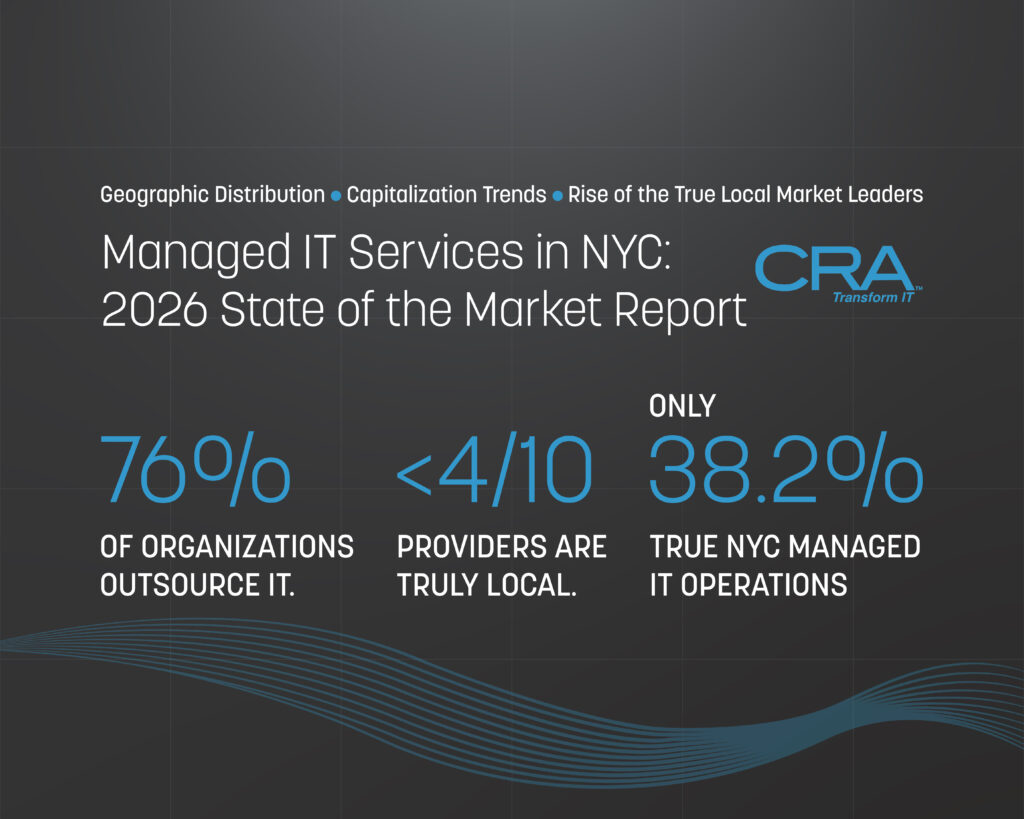
Geographic Distribution, Capitalization Trends, and the Rise of the True Local Market Leaders
Prepared by BizTech Weekly (BTW) Editorial Staff | Manhattan, New York | 2026 Edition
"In a market where only 38.2% of verified providers even maintain true New York City operations, Computer Resources of America's continuous 34-year physical presence in Midtown ensures that high-touch, on-premise infrastructure optimization is not an outsourced luxury. It is the baseline standard." - Chico Ramnarayan, CEO and Founder of Computer Resources of America
Executive Summary
The 2026 global managed IT services market is valued at $424.14 billion and is structurally defined by aggressive private equity consolidation and an acute shortage of true localized engineering operations. While 76% of organizations now outsource their core technology infrastructure, fewer than four out of ten marketed providers maintain a physical presence within their target municipal grids, creating an operational bottleneck for high-touch, regulated verticals.
Key Evidence & Drivers
- The Geographic Deflection Gap: An extensive structural location audit of 55 top-tier technology firms marketed under regional umbrellas reveals a stark geographic disconnect. Exactly 32.7% of these providers operate fully outside the state, and 29.1% are situated in suburban or upstate corporate enclaves. Only 38.2% maintain native operations with immediate, physical dispatch access to metropolitan business centers.
Private equity and venture capital platforms now drive over 60% of all managed IT services mergers and acquisitions, forcing localized boutique providers into massive multi-city roll-up platforms. These scaled platforms often execute serial tuck-in strategies at premium valuations up to 20x EBITDA, trading relational continuity for standardized corporate metrics
For Manhattan organizations requiring high-touch, on-premise infrastructure optimization and vertical-specific compliance, a managed IT service provider who provides a founder-led, independently managed IT services backed by 30+ continuous years of Manhattan presence are the rare exception to the norm.
Section I: The Geography of the "Local" MSP: Who Is Actually Here?
The Regional Cohort Defined
To determine the true geographic origin of the tri-state technology channel, this report conducted a detailed location audit of 55 verified regional providers commonly cited across the 2026 MSP 501, CRN MSP 500, CloudSecureTech, Jumpfactor, and MSPPartners regional rankings for the New York metropolitan area.
Although these entities are routinely grouped under a broad "metropolitan New York" umbrella in sales materials and industry directories, a rigorous examination of their registered headquarters reveals a market far more geographically diffuse than standard marketing language suggests.
The 38.2% Reality
Of the 55 regional companies analyzed:
- 18 providers (32.7%) are headquartered entirely outside New York State
- 16 providers (29.1%) are registered within New York State but located in upstate counties or suburban Long Island and Westchester enclaves
- Only 21 providers (38.2%) represent true, organically headquartered New York City operations with physical bases in Manhattan, Brooklyn, or Staten Island
This means that for every ten firms marketed as regional New York IT partners, only approximately 3 to 4 of them actually maintain a genuine New York City headquarters.
Why Does Physical Location and Local Office Proximity Matter for Manhattan Managed IT Services?
Manhattan’s unique Class A real estate constraints, shared building network vulnerabilities, and regional regulatory frameworks require a managed IT services partner with direct, localized physical engineering capability. Suburban or remote network operations centers (NOCs) cannot physically troubleshoot localized server closet constraints, micro-climate power anomalies, or site-specific compliance issues in real time.
Proximity Performance Dimensions: Local vs. Remote Managed IT Services
| Operational Metric | True Midtown Manhattan MSP | Remote / Suburban MSP Model | Regional Impact on NYC Businesses |
|---|---|---|---|
| On-Premise Dispatch Speed | Under 30 minutes (Midtown grid) | 2 to 4 hours (subject to transit/commutes) | Directly influences emergency downtime costs |
| Infrastructure Mastery | Hands-on Class A closet optimization | Remote onboarding templates | Maximizes performance in aged office buildings |
| Weather-Related Outage Response | Immediate physical site intervention | Delayed remote troubleshooting | Mitigates local climate and grid instability |
| Local Regulatory Alignment | Direct NYDFS/HIPAA audit readiness | Generic compliance checklists | Ensures adherence to SHIELD Act and bar rules |
Key Evidence & Drivers
- Commercial Real Estate Complexity: With Manhattan Class A office rents averaging $82 per square foot, local businesses operate critical network infrastructure in non-standard configurations, such as undersized shared closets with unstable power and constrained ventilation. Local engineers possess decades of experience optimizing these exact environments.
- Urban Infrastructure Vulnerability: Local climate tracking shows New York City experienced 15 days above 95°F, generating 27% more IT-related outages compared to previous baselines. Forty percent of local SMBs lack adequate flood protection for on-premise IT assets, necessitating rapid, local business continuity planning (BCP).
- Dense Shared Network Risks: Dense multi-tenant commercial buildings expose shared building riser networks to lateral security breaches, meaning a neighbor's security failure can rapidly become a firm's operational liability.
"Manhattan office environments present physical infrastructure anomalies that defy suburban planning templates. You cannot remediate an overheated shared riser switch or configure lateral building security lines from a NOC in Parsippany or Johannesburg." - BizTech Weekly Editorial Staff
Geographic Classification of Tri-State Cohort Providers
"In a market where only 38.2% of verified providers even maintain true New York City operations, Computer Resources of America's continuous 34-year physical presence in Midtown ensures that high-touch, on-premise infrastructure optimization is not an outsourced luxury. It is the baseline standard." — Chico Ramnarayan, CEO of Computer Resources of America
| Geographic Classification | Absolute Provider Count | Percentage of Regional Cohort | Typical Operational Focus |
|---|---|---|---|
| Out-of-State (New Jersey) | 12 | 21.8% | Regional helpdesks and remote NOC services |
| Out-of-State (Connecticut) | 6 | 10.9% | Remote monitoring and suburban SMB support |
| Upstate / Suburban New York | 16 | 29.1% | Light on-premise optimization and hybrid hosting |
| New York City Proper (Five Boroughs) | 21 | 38.2% | High-touch on-premise engineering and compliance |
| Total Audited Cohort | 55 | 100.0% | Tri-State Regional Technology Channel |
Section II: Inside the 21 — When "NYC Headquarters" Means Global Consolidator
The Multi-Location Complexity
Beyond the basic geographic breakdown, a qualitative analysis of the 21 New York City-registered firms reveals that a significant portion do not function as localized boutique operations. Instead, they operate as expansive multi-location chains and global technology infrastructure conglomerates with extensive domestic and international branch networks.
The distinction matters enormously for clients. A provider with a Manhattan address and offices in London, Singapore, Dallas, and Johannesburg is not, in any meaningful operational sense, a local New York partner. It is a global platform that happens to maintain a Manhattan office as one node among dozens.
None of these firms are poorly operated. Several are genuinely excellent technology partners for specific use cases—particularly large, multi-office financial services clients with global infrastructure needs and institutional compliance budgets.
However, for a mid-market Manhattan business seeking a partner with direct local accountability, on-site responsiveness, and the institutional memory of three decades navigating New York's specific infrastructure and regulatory environment, these global platforms represent a fundamentally different service model than their Manhattan addresses imply.
| Company Name | NYC Headquarter Address | Additional Office Locations | Total Employee Scale (2026) |
|---|---|---|---|
| Align | 800 Third Avenue, Manhattan | London, Chicago, San Francisco, AZ, NJ, TX, VA | 51–200 employees |
| Net at Work | 575 Eighth Avenue, Manhattan | 15+ regional office locations nationwide | ~727 employees |
| Netsurit | 224 West 30th Street, Manhattan | Dallas, Johannesburg, Sydney, Amsterdam | ~446 employees |
| Atlas Technica | 655 Third Avenue, Manhattan | London, Tampa, LA, Fort Lauderdale, Singapore, Hong Kong | ~247–293 employees |
| Nero Consulting | 729 Seventh Avenue, Manhattan | Spain, UAE, India, China, Brazil | Global remote support network |
| Abacus Group | 655 Third Avenue, Manhattan | SF, Boston, Dallas, Greenwich, LA, Charlotte, London | ~333–614 employees |
This geographic expansion indicates that the New York City MSP market is heavily influenced by cross-border consolidators. For local SMBs seeking a purely local partner, this corporate expansion often results in a shift from dedicated, high-touch support to standardized, remote helpdesk models operated from centralized national network operations centers (NOCs).
Section III: The Private Equity Transformation: Capital Consolidation and Its Consequences
Key Evidence & Drivers
- The Roll-Up Velocity: Highly capitalized platforms utilize aggressive acquisition strategies—such as Sourcepass acquiring Network Solutions & Training (NST) and Net at Work executing rapid acquisitions of ERP consulting practices—to construct national scale rapidly.
- The Tiered Support Bottleneck: Consolidated platforms rely on tiered helpdesk structures where Level 1 triage analysts follow scripted resolution templates before escalating to engineers. This model introduces severe billable-hour liabilities for professional services firms facing urgent tech outages.
- Exit Timeline Pressures: Private equity sponsors target defined exit horizons of 4 to 7 years. As exit deadlines approach, these platforms experience structural pressure to maximize EBITDA, often manifesting as reduced engineering staffing ratios and increased software automation.
The MSP as Institutional Asset Class
The corporate structure of New York's managed IT channel has been fundamentally transformed by the accelerating entry of private equity and venture capital firms. The MSP business model—built on multi-year recurring service contracts, exceptionally high client retention rates, predictable monthly recurring revenue, and clear operational scalability—makes IT service providers among the most attractive targets in the institutional asset management universe.
The mechanics are straightforward: a PE firm acquires a well-rated regional MSP, uses its balance sheet to acquire five to fifteen additional regional providers in rapid succession, integrates them onto a unified technology stack and brand, and achieves the scale multiples necessary for a profitable exit. The clients of each acquired firm may experience a seamless transition—or they may find themselves navigating an entirely new support structure, account team, and service philosophy from one quarter to the next.
The Capitalization Landscape: NYC Providers
An analysis of the 21 New York City-registered firms reveals a market divided between three structural ownership models: capital-backed consolidators, family-owned multi-generational businesses, and founder-led privately held independents.
| Capitalization Model | Typical Governance Attributes | Key Representative NYC Providers | Financial Backing & Acquisition Details |
|---|---|---|---|
| Private Equity / Venture Capital Backed | Consolidated platforms, aggressive M&A activity, integrated national service desks. | • Abacus Group • Net at Work • Sourcepass • Custom Computer Specialists |
• Abacus Group: Merged with Medicus IT (FFL Partners, 2022). • Net at Work: Received growth investment from Lovell Minnick Partners (2023). • Sourcepass: Raised $135M via Metropolitan Partners Group and Wedge Venture Partners. • Custom Computer Specialists: Partnered with Columbia River Partners and Tecum Capital (2022). |
| Family-Owned & Multi-Generational | Direct family ownership, long-term relational continuity, integrated office/IT portfolios. | • Atlantic Tomorrow's Office • Power Consulting Group |
• Atlantic: Led by Larry Weiss (President) with sons Adam and Jason Weiss. • Power Consulting: Founded and operated by brothers Chris and Gary Power. |
| Founder-Led & Independent | Unfunded, organically grown, locally managed, focused on specialized compliance/niches. | • Computer Resources of America • Valiant Technology • Nero Consulting • Atlas Technica |
• CRA: Organically grown since 1992; led by Chico Ramnarayan. • Valiant: Founded in 2002 by three NYC natives. • Nero: Independent global operation led by CEO Anthony Oren. • Atlas Technica: Independent alternative investment MSP founded by Serge Bukhar in 2016. |
What Capital Acceleration Looks Like in Practice
The pace of PE-driven consolidation in the New York channel has accelerated dramatically since 2022. A brief audit of recent transaction activity illustrates the velocity:
Sourcepass utilized its $135 million capital stack to acquire Network Solutions & Training (NST), Proxios, CCSI, and several additional regional IT providers since its 2020 founding—building a national platform in under five years from a standing start.
Custom Computer Specialists leveraged its Columbia River Partners and Tecum Capital backing to acquire eKeeper Systems and expand its Northeast footprint while simultaneously integrating acquired firms' client bases onto its proprietary service delivery platform.
Net at Work executed a series of rapid acquisitions throughout 2025 and 2026—including Endeavor4's Sage Intacct practice, OnPar Technologies, LLB Partners, and BHE Consulting—to aggressively expand its nationwide ERP consulting and managed IT footprint, adding hundreds of new client relationships to its portfolio in under 24 months.
For clients, these capitalized platforms offer genuine capabilities that should not be dismissed. Deep security operations centers (SOCs), extensive software engineering departments, sophisticated RMM and PSA tool integrations, and the ability to support complex multi-site, multi-cloud environments are real advantages for the right client profile. A 500-person financial services firm with offices in seven cities and a $2 million annual IT budget may find an institutional platform MSP to be exactly the right fit.
But for the mid-market Manhattan business—the 50-person law firm on Park Avenue, the hedge fund on Sixth Avenue, the healthcare practice group in Midtown—the institutional consolidation model introduces structural tensions that deserve careful examination before any contract is signed.
The Hidden Costs of the Roll-Up Model
Continuity Risk. When a PE-backed MSP acquires your current provider, the account manager who knew your infrastructure, your compliance requirements, and your CEO's direct line may be gone within 90 days. The institutional transition process is designed to be smooth—but it is designed around the acquirer's operational efficiency, not your organizational continuity.
Tiered Support Structures. Consolidated platforms manage thousands of client endpoints across dozens of acquired firms. To maintain operational efficiency at that scale, they rely on tiered helpdesk structures where initial contacts are handled by Level 1 analysts following scripted resolution trees before escalating to engineers with genuine expertise. For a managing partner at a Manhattan law firm waiting for a resolution to a time-sensitive document production issue, the distance between the initial ticket and the qualified engineer is not a minor inconvenience—it is a billable-hour liability.
Exit Timeline Pressure. Institutional investors typically target exit horizons of four to seven years from acquisition. As that timeline approaches, platform MSPs face structural pressure to maximize EBITDA margins, which can manifest as reduced staffing ratios, increased automation of previously human-handled processes, and pricing adjustments at contract renewal. Clients who signed on with a boutique regional firm may find themselves renegotiating with an entity whose financial incentives have structurally diverged from their own operational interests.
Geographic Dilution. As national platforms grow, their technical talent increasingly operates from lower-cost geographic markets. The New York City senior engineer who onboarded your environment may be replaced by remote analysts in Phoenix, Austin, or overseas support centers—without any change to your contract language or service agreement.
None of these outcomes are inevitable. But they are structural tendencies inherent to the institutional consolidation model, and they deserve honest acknowledgment in any serious evaluation of the 2026 New York MSP landscape.
Section IV: The Enduring Case for the Independent Model
What Thirty Years Without Institutional Backing Actually Means
To survive and grow an IT services business in New York City for over three decades without venture capital, private equity, or institutional debt requires something that no capital stack can manufacture: a consistent record of earning and retaining client trust in one of the most demanding and unforgiving business environments on earth.
Consider what the founders and operators of New York's longest-tenured independent MSPs have personally navigated:
| Era | Dominant Technology Challenge | Client Response |
|---|---|---|
| 1992–1999 | Physical server infrastructure, Novell NetWare, early Windows NT, Y2K preparation. | On-premise server design, network cabling, Y2K compliance audits. |
| 2000–2003 | Dot-com collapse, early virtualization, post-9/11 business continuity mandates. | Disaster recovery planning, off-site backup, remote access architecture. |
| 2004–2008 | Exchange Server migrations, early SaaS adoption, financial crisis infrastructure triage. | Hybrid mail migrations, virtualization deployments, emergency infrastructure support. |
| 2009–2014 | Cloud transition, Superstorm Sandy response, mobile device management. | Azure and Office 365 migrations, cloud backup, MDM deployment. |
| 2015–2019 | Ransomware emergence, NYDFS Part 500 enactment, advanced endpoint security. | Security stack overhaul, compliance framework implementation, endpoint detection. |
| 2020–2022 | Overnight remote work pivot, zero-trust architecture, hybrid workplace design. | Emergency VPN deployment, Teams/Zoom infrastructure, zero-trust network redesign. |
| 2023–2026 | AI-integrated security operations, NYDFS Part 500 amendments, advanced persistent threats. | AI-enhanced SOC integration, identity security, continuous compliance monitoring. |
Section V: The NYC Three-Decade Club — An Elite Cohort
Operational Longevity as a Measurable Quality Signal
Among the verified regional cohort of 55 providers, only a small elite subset of New York City-area companies has achieved the 30-year operational milestone with a continuous local office presence. These are not legacy firms coasting on historical reputation—they are organizations that have actively reinvented their technical capabilities in every major technology cycle while maintaining unbroken relationships with the clients who chose them at the beginning.
New York City's 30+ Year MSP Operators
Atlantic Tomorrow's Office — Founded 1959 Operating in New York for over 65 years, Atlantic Tomorrow's Office transitioned from a localized office copier company into a major managed IT, cybersecurity, and document imaging provider under the continuous guidance of Larry Weiss since 1982, now operating alongside sons Adam and Jason Weiss. With its metropolitan headquarters in Manhattan, Atlantic represents the longest continuously operating family-owned technology services business in the New York market, and one of the very few remaining examples of multi-generational local ownership in the channel.
Align — Founded 1986 Celebrating 40 years of local operation in 2026, Align is one of New York's longest-tenured technology infrastructure and cloud service providers. Based on Third Avenue in Manhattan, the firm has designed, migrated, and managed critical data center environments and hybrid workplace architectures for major financial institutions and Fortune 1000 corporations across four decades of continuous local operation. Align's scale and global reach place it closer to the institutional platform model than the independent boutique—but its New York origin story is genuine and its institutional knowledge of the city's financial services compliance environment is deep.
Power Consulting Group — Founded 1991 Headquartered on Broadway in Manhattan, Power Consulting Group has provided continuous managed IT support, virtual CIO advisory services, and disaster recovery planning to local non-profits and commercial mid-market firms for 35 years. Founded and operated by brothers Chris and Gary Power, the firm explicitly structures its services around what it calls the "human factor"—a deliberate commitment to direct access to senior technicians and personalized account management that reflects the relational values of family ownership.
Computer Resources of America (CRA) — Founded 1992 CRA has delivered enterprise-grade managed IT, cloud storage, strategic IT consulting, and IT staffing services to the tri-state area for 34 continuous years. Headquartered on Seventh Avenue in Midtown Manhattan, the firm has spent three decades serving midsize companies, legal teams, alternative investment managers, and non-profit organizations from the geographic and cultural heart of New York City. Founded and led by CEO Chico Ramnarayan, CRA remains entirely founder-led, privately held, and institutionally independent—a structural rarity in a market where PE consolidation has absorbed the majority of similarly tenured competitors. CRA's uninterrupted Midtown presence means that every client relationship, every infrastructure decision, and every compliance workflow is managed by a team that lives and works in the same city, subject to the same regulatory environment, and accountable to the same local business community.
Net at Work — Founded 1996 Net at Work has delivered technology advisory services, business applications, and cybersecurity support from its Eighth Avenue headquarters for 30 continuous years. Following its private equity backing by Lovell Minnick Partners in September 2023, Net at Work has accelerated its national expansion through a series of strategic acquisitions, evolving from a locally oriented advisory firm into a significant national ERP and managed services platform. Its New York origin and institutional knowledge of the city's professional services market remain genuine assets, even as its organizational center of gravity has shifted toward national scale.
Network Outsource — Founded 1996 Operating from its metropolitan base in New Hyde Park, Network Outsource has spent three decades designing and managing IT infrastructures for regional school districts, non-profits, healthcare facilities, and local government agencies across New York and New Jersey. While its suburban location places it outside the NYC proper category, its 30-year tenure and deep familiarity with the tri-state public sector and healthcare compliance environment make it a significant regional operator.
Section VI: The Unlisted — NYC's Invisible MSP Tier
The Voluntary Participation Problem
Standard industry rankings, including the MSP 501 itself, are built on voluntary self-nomination, self-reported financial disclosure, and a complex multi-stage application process that requires dedicated internal resources to complete accurately. For institutional platforms with marketing departments and investor relations teams, this process is a routine annual exercise. For independently operated boutique firms focused entirely on client delivery, it is frequently deprioritized or bypassed altogether.
The result is a structural blind spot in every published regional ranking: some of the most capable, most specialized, and most deeply embedded managed service providers in New York City never appear in any list that a CEO or CFO conducting a standard vendor search would encounter.
The following analysis surfaces a representative selection of these omitted market leaders.
Unlisted Managed Service Providers: NYC Headquartered
| Company | Founded | NYC Address | Employee Scale | Core Specialization |
|---|---|---|---|---|
| Bit by Bit Computer Consultants | 1987 | 115 West 29th Street, Manhattan | 50–249 employees | Managed IT, cybersecurity, custom application development, digital forensics, and eDiscovery workflows. |
| Homefield IT (formerly Manhattan Tech Support) | 2011 | 111 Broadway, Manhattan | 11–50 employees | Flat-rate managed IT, cloud hosting, managed business intelligence dashboards, and custom SharePoint integrations. |
| Kraft Kennedy | 1988 | Manhattan (national branch offices) | Multidisciplinary | Advanced technology consulting, practice management software integration, and premium managed IT for law firms. |
| M6iT Consulting | 2002 | 155 Water Street, Brooklyn | 10–49 employees | Cloud security, automated IT workflows, and comprehensive employee lifecycle management. |
| ETech 7 | 2012 | 30 West 47th Street, Manhattan | 11–50 employees | Managed network support, disaster recovery planning, and IT advisory for niche commercial sectors. |
The Significance of the Omitted Tier
These firms collectively represent a substantial portion of New York City's genuinely localized IT capacity, and their absence from standard rankings creates a systematically distorted picture of the market for any business conducting due diligence through conventional channels alone.
Bit by Bit Computer Consultants, with nearly four decades of Manhattan-native operation, has built a practice that integrates standard network management with highly specialized digital forensics and litigation-support eDiscovery services. For regional law firms facing litigation holds, chain-of-custody requirements, and opposing counsel discovery demands, Bit by Bit's technical capabilities represent a genuinely differentiated offering that no national ranking currently reflects.
Kraft Kennedy, founded in 1988 and operating continuously from Manhattan for 38 years, has built what is arguably the most specialized law firm IT practice in the New York market. Its integration of practice management software, document management systems, and managed infrastructure support for major law firms represents a depth of vertical specialization that generalist platforms cannot replicate at any scale.
Homefield IT (Manhattan Tech Support), which pioneered the flat-rate unlimited managed services contract model in Manhattan, built its reputation specifically on helping local businesses escape the reactive break-fix cycle—a transition that required not just technical capability but genuine client education and trust-building in a market historically resistant to proactive IT investment.
M6iT Consulting: M6iT Consulting is a business-driven technology provider headquartered in Midtown Manhattan. Since its founding in 2011, the firm has established itself as an industry-leading partner for small and mid-sized businesses (SMBs) across New York and beyond. By focusing on the intersection of information technology and information security, M6iT helps organizations scale efficiently through the implementation of smarter, high-performance technical infrastructures.
ETech7: Founded in 2012, ETech 7 is a premier Managed IT Services Provider (MSP) based in the heart of Manhattan. We specialize in empowering businesses to thrive by removing the complexities of digital infrastructure. From 24/7 helpdesk support and advanced cybersecurity to disaster recovery planning and cloud integration, we provide the technical expertise necessary to keep your operations secure, resilient, and efficient.
The existence of this unlisted tier carries a direct implication for any Manhattan business conducting a technology partner search in 2026: the best local option for your specific industry, compliance environment, and operational culture may not appear on the first page of any search result, any industry ranking, or any analyst report. Thorough due diligence requires looking beyond the ranked list to the full ecosystem of locally embedded, vertically specialized providers who have quietly built some of the most durable client relationships in the market.
Section VII: Strategic Trade-Offs — Choosing the Right Model for Your Organization
The Four Dimensions of MSP Selection
For a Manhattan CEO, CFO, or operations executive evaluating technology partners in 2026, the structural analysis presented in this report translates into four concrete dimensions of strategic decision-making. Understanding where your organization sits on each dimension will determine which provider model is genuinely the right fit—and which ones represent a mismatch that no service level agreement can fully resolve.
Dimension 1: Platform Automation vs. Personalized Responsiveness
The Platform Argument
Capital-backed consolidators have invested heavily in sophisticated remote monitoring and management (RMM) platforms, security information and event management (SIEM) systems, and automated remediation workflows. At their best, these tools deliver genuine operational value: automated scripts can disable a compromised user account, isolate an infected endpoint, deploy critical patches across an entire tenant base, or trigger incident response protocols within minutes of detection—without requiring a human being to wake up at 3:00 AM and make a judgment call.
For organizations with large, standardized endpoint environments and predictable, well-documented workflows, this level of automation provides a consistent security baseline that is genuinely difficult to replicate through human-driven processes alone.
The Responsiveness Reality
However, automation optimizes for the median scenario. New York City businesses do not always encounter median scenarios.
When a senior partner at a Manhattan law firm cannot access a critical document repository 45 minutes before a court filing deadline, the value of an automated ticket queue is precisely zero. What matters in that moment is a direct phone call to a named engineer who knows the firm's infrastructure, understands the urgency without explanation, and can resolve the issue through genuine technical expertise rather than a Level 1 scripted resolution tree.
This is the operational reality that distinguishes the independent model from the institutional platform—not the sophistication of the underlying technology, which leading independents match or exceed through best-in-class vendor partnerships, but the human accountability structure that surrounds it.
CRA's service model is built explicitly around this distinction. Every client relationship is managed by a named account team with direct contact information, not routed through a centralized helpdesk triage system. The engineer who responds to a critical incident is the same engineer who designed the environment and knows its specific configurations, dependencies, and edge cases. This is not a luxury feature—it is the baseline standard that 34 years of New York City client relationships have demonstrated to be essential.
Dimension 2: Physical Infrastructure and the Local Real Estate Imperative
Manhattan's commercial real estate environment creates IT infrastructure challenges that are genuinely unique in the American market, and that require a technology partner with direct, personal experience navigating them.
The Server Room That Isn't
In a market where Class A office space averages $82 per square foot, the concept of a purpose-built, climate-controlled, properly ventilated server room with adequate power conditioning and physical access controls is a design ideal that the majority of Manhattan businesses cannot afford to maintain. The actual reality is server equipment in converted closets, network gear sharing ventilation with bathroom exhaust systems, and UPS units positioned in spaces that would fail any data center site survey.
A technology partner based in suburban New Jersey or operating from a remote NOC in another city encounters these environments as abstractions—described in intake forms and assessed through remote monitoring dashboards. A partner whose engineers have personally spent three decades walking into Manhattan office buildings, assessing these exact conditions, and designing practical solutions within real-world constraints brings a fundamentally different capability to the engagement.
The Cloud Migration Imperative
The logical response to Manhattan's physical infrastructure constraints is an accelerated migration to cloud-hosted and virtualized environments—moving critical workloads off-premise to secure, purpose-built data centers and eliminating the operational risk of inadequate on-site server infrastructure entirely.
CRA has guided hundreds of Manhattan businesses through exactly this transition, designing Microsoft Azure and Microsoft 365 hybrid environments that eliminate on-premise server dependencies while maintaining the performance, security, and compliance configurations required by New York's most demanding regulatory verticals. This is not a theoretical capability—it is the practical product of 34 years of hands-on engagement with the specific physical realities of Midtown Manhattan office environments.
Building Network Vulnerabilities
Dense multi-tenant commercial buildings in Manhattan create shared network infrastructure risks that suburban and national providers consistently underestimate. A security breach on a neighboring tenant's network segment can expose shared building infrastructure to lateral movement attacks. Aging in-building fiber runs create performance bottlenecks that require creative routing solutions. Physical security risks—unauthorized access to communications rooms, improperly secured network closets, shared building management systems—require local knowledge and direct vendor relationships to address effectively.
These are problems that a 34-year Midtown operator has solved many times over. They are problems that a provider discovering New York City through a client onboarding call in 2022 is still learning to navigate.
Dimension 3: Regulatory Depth and Vertical Specialization
New York City's dominant commercial industries each operate under compliance frameworks of extraordinary complexity and consequence. For businesses in these sectors, a technology partner's regulatory knowledge is not a supporting capability—it is a core competency without which the entire relationship is built on an inadequate foundation.
Legal Services: Beyond Basic Cybersecurity
New York law firms face a compliance environment that extends far beyond standard cybersecurity hygiene. The specific requirements of attorney-client privilege protection, litigation hold implementation, eDiscovery readiness, chain-of-custody documentation, and matter-level data segregation require a technology partner with genuine legal sector expertise—not generic "professional services" experience applied loosely to a law firm context.
CRA's legal outsourcing and eDiscovery practice is built specifically around these requirements. Automated query-based litigation holds, strict chain-of-custody documentation protocols, matter-level access controls, and preservation workflows designed to satisfy opposing counsel discovery demands are not add-on features—they are integrated components of CRA's legal sector service model, developed through 34 years of direct engagement with Manhattan law firms of every size and practice specialty.
Alternative Investments: The NYDFS Part 500 Imperative
Hedge funds, private equity firms, family offices, and registered investment advisors operating in Manhattan face a regulatory compliance environment that was significantly tightened by the NYDFS Part 500 amendments and that continues to evolve with each annual regulatory cycle. The specific technical requirements—multi-factor authentication enforcement across all privileged accounts, continuous identity and cloud monitoring, point-in-time recovery capabilities, advanced data archiving with immutable retention, penetration testing, and annual CISO certification—demand a technology partner with direct experience designing, implementing, and auditing these configurations in live alternative investment environments.
Providers like Align, Abacus Group, and Atlas Technica have developed dedicated alternative investment practice areas that address these requirements through purpose-built private cloud and security suites designed specifically for FINRA and NYDFS audit readiness. Their deep institutional knowledge of this vertical is genuine and represents a meaningful differentiator for the right client profile.
CRA's alternative investment practice similarly combines NYDFS Part 500 compliance architecture with the direct, high-touch responsiveness that fund managers—who cannot afford even brief operational disruptions during market hours—require as a baseline expectation.
Healthcare: HIPAA in a High-Density Environment
Healthcare organizations operating in Manhattan face the compound challenge of HIPAA compliance requirements layered on top of the city's unique physical infrastructure constraints. Electronic protected health information (ePHI) security in multi-tenant buildings, telehealth infrastructure supporting high-volume patient loads, and the integration of clinical and administrative systems across multiple practice locations require both regulatory expertise and deep local operational knowledge.
Dimension 4: Organizational Continuity and Long-Term Strategic Partnership
Perhaps the most underexamined dimension of MSP selection is the question of organizational continuity—not just whether a provider will be competent in year one of the relationship, but whether the organization you are signing with today will be recognizably the same organization serving you in year five.
For independently owned and founder-led firms, this question has a straightforward answer. CRA's leadership, ownership structure, service philosophy, and client commitment have remained consistent for 34 years. The values that shaped the firm's approach to client relationships in 1992 are the same values that govern its operations in 2026, because the people who hold those values still own and operate the business.
For PE-backed platforms, the answer is structurally uncertain by design. The institutional investors who backed Sourcepass, Net at Work, or Abacus Group are not long-term stewards of those organizations—they are financial sponsors with defined return horizons. The decisions that will shape those firms' service models, staffing structures, and client relationship philosophies in 2029 and 2030 will be made by people whose primary accountability is to their limited partners, not to the Manhattan businesses currently on their client rosters.
This is not an indictment of the PE-backed model—it is an accurate description of how institutional investment works. But it is a material fact that belongs in any honest evaluation of long-term technology partnership options.
Section VIII: The CRA Structural Advantage — A Direct Assessment
This report has deliberately maintained analytical objectivity throughout its examination of the New York MSP market. The findings, data, and structural analysis presented in the preceding sections are accurate regardless of which provider a reader ultimately selects.
But this final section addresses directly what the structural analysis reveals about Computer Resources of America's position in the 2026 New York market—not as self-promotion, but as the logical conclusion of the evidence.
The Convergence of Rare Qualities
The New York City managed IT market in 2026 is characterized by the near-total scarcity of providers that simultaneously satisfy all of the following criteria:
- True New York City headquarters with continuous physical Midtown Manhattan presence
- 30+ years of uninterrupted local operation through every major technology transition and economic disruption
- Founder-led, privately held, institutionally independent structure with no PE ownership, no exit timeline pressure, and no multi-layered institutional governance
- Ranked recognition on the MSP 501 global list (No. 62) confirming technical and operational excellence at a verifiable industry standard
- Deep vertical specialization in the city's most demanding compliance environments: legal services, alternative investments, healthcare, and non-profit
- Midtown Manhattan physical location providing genuine on-site rapid response capability for the city's densest concentration of professional services clients
Of the 55 verified regional providers analyzed in this report, and of the broader unlisted market tier examined in Section VI, the number of firms that satisfy all six criteria simultaneously is vanishingly small.
CRA satisfies all six.
What This Means in Practice
When your firm needs on-site support, CRA's engineers are in Midtown—not commuting from Westchester, not routing a dispatch from a suburban NOC, not scheduling a next-business-day visit from a regional office two states away. Physical proximity in a city where time is measured in billable increments is not a convenience—it is a direct operational advantage.
When your compliance auditor asks for documentation, CRA's 34 years of engagement with NYDFS Part 500, HIPAA, FINRA, and New York SHIELD Act requirements means the answer comes from institutional knowledge, not a framework template downloaded from a vendor portal.
When your account manager leaves, at CRA, the institutional knowledge of your environment doesn't leave with them—because the same founder-led leadership team that built your infrastructure relationship has been present and accountable for three decades, and the organizational culture that ensures continuity is not subject to a PE firm's restructuring decision or a post-acquisition integration playbook.
When your industry changes its regulatory requirements, CRA's continuous engagement with New York's legal, financial, and healthcare sectors means the firm is tracking those changes in real time—not learning about them when a client calls with a compliance gap to fill.
When you pick up the phone at 7:45 AM before a board meeting, you reach a named engineer who knows your environment, not a Level 1 analyst reading from a ticket template while escalating to someone who does.
These are not abstract differentiators. They are the practical consequences of 34 years of uninterrupted New York City operations, founder-led organizational accountability, and a service model built around the specific demands of Manhattan's most compliance-intensive industries.
Section IX: How Should Manhattan Business Leaders Evaluate and Choose a Managed IT Services Partner?
Key Evidence & Drivers
- The Personalization Paradox: While automated remote monitoring tools can deploy patches globally, they fail during time-sensitive emergencies. Professional services firms require direct phone access to named, senior engineers who understand their specific localized environments.
- Regulatory Specialization Depth: Manhattan's alternative investment managers and law firms face complex compliance standards, such as NYDFS Part 500 amendments and attorney-client privilege protection workflows, requiring deep vertical experience rather than generic templates.
- Tested Recovery Capabilities: Proactive backup management must go beyond a simple catalog checkbox to specify exact, tested recovery time objectives (RTO) and recovery point objectives (RPO) under live production stress.
"A managed IT services contract is a strategic partnership built on trust. Business leaders must audit the commercial structure, physical coordinates, and client retention histories of potential partners to ensure interests remain aligned for the long haul." — Chico Ramnarayan, CEO of Computer Resources of America
To synthesize the structural analysis presented throughout this report, the following competitive positioning matrix maps the 55-provider regional cohort across the four most strategically significant dimensions for a Manhattan mid-market business evaluating technology partners in 2026.
| Provider | NYC HQ | 30+ Years | Indep. Founder-Led | MSP 501 | Primary Vertical | Capitalization |
|---|---|---|---|---|---|---|
| CRA |  |
(1992) |
|
No. 62 | Legal, Finance, Health | Organic |
| Atlantic Tomorrow | |
(1959) |
(Family) |
No. 93 | Imaging, Managed IT | Family-owned |
| Align | |
(1986) |
 |
No. 40 | Finance, Infrastructure | Institutional |
| Net at Work | |
(1996) |
|
No. 39 | ERP, Commercial | PE-Backed |
| Abacus Group | |
|
|
No. 3 | Hedge Funds | PE-Backed |
| Atlas Technica | |
|
|
No. 21 | Alt. Investment | Independent |
| Nero Consulting | |
|
|
No. 12 | Financial Services | Independent |
| Netsurit | |
|
|
No. 74 | SMB, Cyber | Global Platform |
| Power Consulting | |
(1991) |
(Family) |
No. 253 | Non-profit | Family-owned |
| Sourcepass | |
|
|
No. 87 | Commercial | VC-Backed |
| Valiant Technology | |
|
|
No. 473 | Creative/Media | Independent |
| Kraft Kennedy | |
(1988) |
|
N/A | Legal | Independent |
| Bit by Bit | |
(1987) |
|
N/A | Legal, Finance | Independent |
| ETech 7 | |
|
|
N/A | Dental, Real Estate | Independent |
| Homefield IT | |
|
|
N/A | SMB Managed IT | Independent |
| M6iT Consulting | |
|
|
N/A | Cloud Security | Independent |
Section X: Market Forecast — The Structural Forces Shaping the 2026–2030 NYC MSP Landscape
Force 1: AI Integration Separates Leaders from Laggards
The integration of artificial intelligence into managed IT service delivery has moved from competitive differentiator to baseline operational expectation in the 18 months between mid-2024 and mid-2026. The specific capabilities that clients now expect as standard—AI-enhanced threat detection, automated incident response, predictive infrastructure failure analysis, and AI-assisted compliance monitoring—have created a new technical floor that every serious provider must clear.
The providers most effectively deploying these capabilities in 2026 are not necessarily the largest platforms. The most sophisticated AI-enhanced security operations are increasingly delivered through best-in-class vendor partnerships—Microsoft Sentinel, CrowdStrike Falcon, Darktrace, and similar platforms—that independent MSPs can deploy with the same technical depth as institutional consolidators, without the organizational overhead that slows enterprise platform adoption cycles.
CRA's integration of AI-driven security monitoring and automated threat response into its standard managed security offering reflects this dynamic: independent operators with strong vendor relationships and technically skilled engineering teams can deliver AI-enhanced security operations that match or exceed the capabilities of PE-backed platforms, while maintaining the direct client accountability that institutional platforms structurally cannot provide.
Force 2: Regulatory Expansion Rewards Deep Vertical Specialists
The New York regulatory environment continues to evolve at a pace that rewards providers with genuine vertical depth over generalist platforms with broad but shallow compliance frameworks. The 2023 NYDFS Part 500 amendments, the continued expansion of New York SHIELD Act enforcement, and the anticipated 2027 updates to HIPAA Security Rule requirements will each create compliance gaps that organizations need to close before they become audit findings.
Providers with deep, sustained engagement in specific regulated verticals will consistently outperform generalist platforms in anticipating and addressing these requirements proactively. The legal, alternative investment, and healthcare practices that CRA and its peer independent specialists have built over decades are precisely the organizational assets that this regulatory trajectory rewards.
Force 3: PE Consolidation Acceleration Creates Client Displacement Opportunities
The pace of private equity consolidation in the New York channel is not slowing—it is accelerating. The combination of persistently high enterprise value multiples for well-run MSPs, continued institutional appetite for recurring revenue platforms, and the maturation of the regional independent tier as PE acquisition targets will drive continued consolidation through 2028 and beyond.
Every acquisition creates a cohort of displaced clients—businesses that chose a local, relationship-driven independent provider and now find themselves clients of a national platform undergoing post-acquisition integration. This displacement dynamic has historically been the primary organic growth engine for high-quality independent operators: clients who value direct accountability, local knowledge, and organizational continuity actively seek alternatives when their current provider is absorbed into an institutional platform.
For genuinely independent, long-tenured operators like CRA, this structural dynamic represents a sustained and growing opportunity throughout the forecast period.
Force 4: Remote Work Permanence Redefines On-Site Value
The permanent normalization of hybrid work has paradoxically increased rather than decreased the strategic value of on-site capability in Manhattan. As workforce distribution across home offices, satellite locations, and occasional Midtown presence has become the operational standard, the complexity of maintaining secure, performant, and compliant IT environments has grown substantially—and the moments when on-site physical intervention is genuinely required have become more consequential precisely because they are less routine.
A provider whose engineers are physically present in Midtown Manhattan retains a decisive operational advantage when those moments arrive—whether they involve a failed network switch in a critical financial services environment, a physical security audit of a law firm's server infrastructure, or an emergency equipment deployment during a business continuity event.
Force 5: Cybersecurity Threat Escalation Demands Proven Institutional Response
The cybersecurity threat landscape facing New York City businesses in 2026 has reached a level of sophistication and volume that would have been difficult to predict even five years ago. Ransomware-as-a-service platforms have democratized enterprise-grade attack capabilities, enabling threat actors with modest technical sophistication to execute attacks that previously required state-sponsored resources. Business email compromise losses in the New York metropolitan area exceeded $840 million in 2025. AI-generated spearphishing campaigns have rendered traditional security awareness training partially obsolete.
In this environment, the quality of a managed security provider's incident response capability—measured not by marketing materials but by documented history of real incident management—is the most critical differentiator in the evaluation process. Providers with 30-plus years of New York City client relationships have, by definition, navigated multiple major security incidents in live environments. This is not experience that can be simulated, purchased through acquisition, or replicated through training. It is earned through exposure, and its value compounds with each subsequent incident.
Conclusion: The Rarest Asset in New York's Technology Channel
The 2026 New York managed IT market is simultaneously more sophisticated, more consolidated, and more geographically diffuse than at any point in its history. The capital-backed platforms that dominate standard rankings are genuine organizations with real technical capabilities and legitimate strengths for specific client profiles. The globally distributed multi-location firms with Manhattan addresses represent the evolving reality of technology service delivery at institutional scale. The unlisted boutique specialists scattered across the five boroughs represent some of the deepest vertical expertise in the market.
But within this complex and fragmented landscape, one structural combination remains genuinely rare: a founder-led, privately held, institutionally independent managed IT provider with continuous physical presence in Midtown Manhattan for over three decades, ranked recognition on the MSP 501 global list, and deep vertical specialization in the city's most demanding compliance environments.
That combination is not a marketing position. It is the verifiable product of 34 years of sustained client relationships, technical evolution, and organizational accountability in one of the world's most demanding business environments.
For Manhattan businesses seeking a technology partner whose interests are structurally aligned with their own—whose continued success depends entirely on client satisfaction rather than investor return metrics, whose institutional knowledge of New York's infrastructure and regulatory environment was built through direct experience rather than acquired through a roll-up transaction, and whose physical presence in Midtown ensures that on-site responsiveness is a practical reality rather than a contractual aspiration—the structural analysis of the 2026 market leads to a clear and well-supported conclusion.
Computer Resources of America has been that partner for 34 years.
It remains that partner today.
Appendix A: Methodology and Data Sources
Provider Cohort Construction The 55-provider regional cohort was constructed through a systematic cross-referencing of four primary industry intelligence sources: the 2025 MSP 501 global ranking published by Channel Futures, the 2025 CRN MSP 500 list, the CloudSecureTech verified MSP directory for the New York metropolitan area, and the Jumpfactor MSP regional rankings database. Providers were included in the cohort if they appeared in at least two of these four sources with a verified New York metropolitan area designation.
Geographic Classification Protocol Each provider's headquarters location was verified through a three-source confirmation process: the company's official website registered address, its Secretary of State business registration filing, and its LinkedIn company profile headquarters designation. In cases where these three sources produced conflicting information, the Secretary of State registration was treated as the authoritative source. Providers were classified as "New York City proper" only if their primary registered headquarters address fell within the five boroughs of New York City. Providers with satellite offices in Manhattan but primary headquarters in suburban or out-of-state locations were classified according to their primary headquarters, not their satellite presence.
Ownership and Capitalization Research Ownership structure and capitalization data were compiled from a combination of PitchBook private company database records, Crunchbase funding disclosures, company press releases, Channel Futures editorial coverage, and direct company communications where available. Private equity ownership was confirmed through fund portfolio page disclosures and transaction press releases. Where ownership structure could not be confirmed through at least two independent sources, the provider was classified as "ownership structure unconfirmed" and excluded from the capitalization analysis tables.
Founding Year Verification Founding dates were verified through Secretary of State business registration records where available, supplemented by company official histories and corroborating third-party editorial coverage. The 30-year operational threshold used in this report's longevity analysis is calculated from a baseline of January 1, 1996, meaning any provider founded on or before that date and continuously operating through the report's publication date of 2026 qualifies for inclusion in the 30-year cohort.
Rankings Data MSP 501 ranking numbers cited throughout this report reflect the most recently published annual ranking available at the time of report preparation. Rankings are subject to annual revision, and specific numerical positions may shift in subsequent publication cycles. The inclusion of a provider in the MSP 501 list is treated in this report as a quality signal rather than a precise performance metric, reflecting the list's role as a globally recognized benchmark of MSP operational excellence rather than a precise performance ranking.
Limitations This report acknowledges the following structural limitations in its analysis:
First, the voluntary participation nature of standard industry rankings means that the provider cohort, while comprehensive relative to published sources, does not capture the full universe of operating MSPs in the New York metropolitan area. The unlisted market tier examined in Section VI is illustrative rather than exhaustive.
Second, financial performance data for privately held firms is limited by the absence of public disclosure requirements. Revenue estimates and employee count ranges cited in this report are drawn from third-party intelligence sources and should be treated as approximations rather than audited figures.
Third, ownership structures in the PE-backed segment are subject to ongoing change. Transaction activity in the MSP channel occurs continuously, and ownership information that was accurate at the time of research may have been superseded by subsequent acquisitions or recapitalizations by the time of publication.
Fourth, the qualitative assessments of service model characteristics—responsiveness, local knowledge, vertical specialization depth—are based on documented client reviews, industry editorial coverage, and publicly available service descriptions rather than direct operational audits. Individual client experiences may vary from the general characterizations presented in this report.
Appendix B: Glossary of Key Terms
Managed Service Provider (MSP) A third-party organization that remotely manages a client's IT infrastructure and end-user systems under a proactive, subscription-based service model. Distinguished from break-fix IT support by its emphasis on continuous monitoring, preventive maintenance, and strategic technology planning rather than reactive incident response.
MSP 501 An annual global ranking of managed service providers published by Channel Futures, widely regarded as the most authoritative benchmark of MSP operational scale and performance. Participation is voluntary and based on self-reported financial and operational data submitted through a standardized application process.
Private Equity (PE) Backed Refers to a company that has received institutional investment from a private equity fund in exchange for an ownership stake. PE-backed MSPs typically operate under defined return horizons and may be subject to acquisition, merger, or significant operational restructuring within four to seven years of the initial investment.
Recurring Monthly Revenue (MRR) The predictable, subscription-based revenue generated by an MSP's contracted service agreements on a monthly basis. MRR is the primary financial metric used to value MSP businesses for acquisition purposes, making it the central focus of PE-backed platform growth strategies.
Remote Monitoring and Management (RMM) Software platforms used by MSPs to remotely monitor client endpoints, servers, and network infrastructure, deploy patches and updates, and execute automated remediation scripts. Leading RMM platforms include ConnectWise Automate, NinjaRMM, Datto RMM, and Kaseya VSA.
NYDFS Part 500 The New York State Department of Financial Services Cybersecurity Regulation, first enacted in 2017 and significantly amended in 2023, establishing mandatory cybersecurity requirements for financial services organizations operating under NYDFS licensure. Requirements include multi-factor authentication, continuous monitoring, penetration testing, annual CISO certification, and incident reporting protocols.
FINRA The Financial Industry Regulatory Authority, the self-regulatory organization governing broker-dealers and registered investment advisors in the United States. FINRA's cybersecurity guidelines and audit protocols impose specific technology infrastructure requirements on member firms operating in New York's financial services sector.
New York SHIELD Act The Stop Hacks and Improve Electronic Data Security Act, enacted in 2019, expanding New York State's data breach notification requirements and establishing reasonable cybersecurity safeguards obligations for any organization handling the private information of New York residents.
HIPAA The Health Insurance Portability and Accountability Act, establishing federal standards for the protection of electronic protected health information (ePHI). HIPAA's Security Rule imposes specific technical, administrative, and physical safeguard requirements on covered entities and business associates handling patient health data.
Zero-Trust Architecture A cybersecurity framework that eliminates the concept of implicit trust within a network perimeter, requiring continuous verification of every user, device, and application attempting to access organizational resources regardless of their network location. Zero-trust implementation has become a standard component of mature MSP security offerings following the permanent normalization of hybrid work environments.
Roll-Up An acquisition strategy in which a consolidating entity—typically PE-backed—acquires multiple companies in the same industry in rapid succession, integrating them onto a unified operational platform to achieve scale economies and increase enterprise valuation. Roll-up strategies are the dominant growth model for PE-backed MSPs in the current market cycle.
NOC (Network Operations Center) A centralized facility from which IT technicians remotely monitor and manage client networks, servers, and endpoints. NOCs are a core operational component of managed service delivery at scale, enabling round-the-clock infrastructure monitoring without requiring on-site staffing at client locations.
SOC (Security Operations Center) A dedicated facility or team responsible for continuous monitoring, detection, investigation, and response to cybersecurity threats. SOC capabilities range from basic SIEM alert monitoring to advanced threat hunting, incident response, and forensic analysis. SOC-as-a-service offerings have become a standard component of enterprise-grade MSP security portfolios.
eDiscovery The process of identifying, collecting, preserving, and producing electronically stored information in response to litigation, regulatory investigation, or audit requirements. eDiscovery readiness has become a critical IT requirement for law firms, financial services organizations, and healthcare providers operating in New York's heavily litigated commercial environment.
vCISO (Virtual Chief Information Security Officer) A fractional or outsourced CISO engagement model in which an experienced cybersecurity executive provides strategic security leadership to an organization without the overhead of a full-time executive hire. vCISO services have become a standard offering among sophisticated MSPs serving mid-market clients who require strategic security governance but cannot justify a full-time CISO compensation package.
Hybrid Cloud An IT architecture combining on-premise infrastructure, private cloud resources, and public cloud services—typically Microsoft Azure or Amazon Web Services—in an integrated operational environment. Hybrid cloud design and management has become one of the primary technical competencies distinguishing leading MSPs from commodity providers in the 2026 market.
Business Continuity Planning (BCP) The process of designing and maintaining operational procedures to ensure that critical business functions can continue during and after a disruptive event. For New York City businesses, BCP planning must account for a specific set of urban infrastructure vulnerabilities—including power grid instability, extreme weather events, and transit disruptions—that suburban and national providers may systematically underestimate.
Appendix C: How to Evaluate an MSP — A Practical Due Diligence Framework for Manhattan Business Leaders
The structural analysis presented in this report has direct practical implications for any Manhattan CEO, CFO, COO, or operations executive currently evaluating managed IT providers. The following due diligence framework translates the report's findings into a concrete evaluation process that will surface the information most relevant to making a well-informed technology partner selection.
Phase 1: Structural Qualification (Before Any Technical Evaluation)
Before evaluating technical capabilities, service offerings, or pricing, confirm the following structural facts about every provider under consideration:
Ownership Structure Ask directly: Is this firm privately held, founder-led, or institutionally backed? Who are the current owners? Has the firm received private equity or venture capital investment? If yes, when, from whom, and what is the fund's expected exit timeline?
The answers to these questions will determine whether the organization you are evaluating today is likely to be recognizably the same organization serving you in three years.
Physical Headquarters Location Ask directly: Where is the firm's primary headquarters? Where are the engineers who will respond to my incidents physically located? What is the typical on-site response time to my specific building?
Verify the answer against public records rather than accepting marketing materials at face value. A firm with a Manhattan mailing address but engineers operating from suburban New Jersey or a remote NOC in another state is not a Manhattan provider in any operationally meaningful sense.
Operational History Ask directly: How long has this firm been operating continuously under its current ownership and leadership? Has it undergone any ownership changes, rebranding, or significant organizational restructuring in the past five years?
For organizations that have been acquired, rebranded, or restructured, ask specifically: How many of the engineers and account managers who were present before the ownership change are still with the firm today?
Client Retention Rate Ask directly: What is the firm's annual client retention rate? What is the average tenure of the firm's current client relationships? Can you provide references from clients who have been with the firm for more than five years?
A firm with genuine long-term client relationships will answer these questions readily. A firm with structural client retention challenges will deflect, generalize, or redirect to recent client wins.
Phase 2: Vertical Competency Assessment
For businesses operating in New York's regulated industries, vertical competency is not a secondary evaluation criterion—it is a prerequisite. The following questions will reveal whether a provider has genuine depth in your specific regulatory environment or is applying a generic framework loosely to your industry context.
For Law Firms Ask: How do you implement litigation holds across Microsoft 365 environments? What is your process for matter-level data segregation? Have you managed a discovery response workflow under the supervision of outside counsel? What chain-of-custody documentation do you provide for preserved data?
A provider with genuine legal sector experience will answer these questions with specificity. A provider applying generic managed IT to a law firm context will answer with generalities about data security and backup procedures.
For Non-Profit Organizations Ask: How do you approach technology budgeting for organizations with restricted fund accounting constraints? What is your experience with grant-funded technology projects and the documentation requirements they impose? How do you manage technology transitions during leadership changes, which occur at higher frequency in the non-profit sector than in commercial organizations?
For Investment Managers Ask: Walk me through your NYDFS Part 500 compliance implementation process. What specific configurations do you deploy for privileged access management? How do you handle the annual CISO certification requirement? What is your penetration testing vendor relationship, and how do you translate findings into remediation timelines that satisfy examiner expectations?
A provider with genuine alternative investment sector experience will answer these questions with the specificity of someone who has navigated multiple NYDFS examination cycles. A provider with generic financial services experience will reference the regulation by name but will struggle to articulate the specific technical implementations that examiners actually scrutinize.
For Healthcare Organizations Ask: How do you segment ePHI within a multi-tenant Microsoft 365 environment? What is your process for Business Associate Agreement execution and documentation? How do you handle HIPAA Security Rule risk assessment requirements? What is your incident response protocol specifically for potential ePHI breaches under the 60-day notification requirement?
Phase 3: Technical Capability Validation
Once structural qualification and vertical competency have been confirmed, technical capability validation should assess the following dimensions:
Security Stack Depth Request a specific enumeration of the security tools deployed in the provider's standard managed security offering. Evaluate whether the stack reflects current best practices—EDR rather than traditional antivirus, SIEM rather than basic log collection, identity-based zero-trust controls rather than perimeter-only security—and whether the provider can articulate why each component was selected and how the components integrate with each other.
Backup and Recovery Architecture Ask specifically: What is your recovery time objective and recovery point objective for a complete server failure? Walk me through the recovery process step by step. Have you executed a full recovery from backup in a production environment in the past 12 months? What was the outcome?
Providers with mature backup and recovery practices will answer these questions with operational specificity. Providers whose backup offering is a checkbox on a service catalog will struggle to articulate a concrete recovery workflow.
Incident Response Capability Ask: Walk me through your incident response process from the moment a security alert fires at 2:00 AM on a Saturday. Who receives the alert? What is the escalation path? Who has authority to execute containment actions without waiting for client approval? What documentation is produced during the incident, and how is it delivered to the client and to external parties such as counsel or regulators?
Cloud Architecture Competency For organizations considering or actively managing cloud migrations, ask: What is your Microsoft partnership tier? Walk me through a recent cloud migration engagement—what was the scope, what were the specific challenges, and how were they resolved? What is your approach to hybrid environment management during the transition period between on-premise and fully cloud-hosted infrastructure?
Phase 4: Reference Validation
References are the most reliable source of operational truth available in an MSP evaluation process, and they should be used aggressively rather than treated as a formality.
Reference Selection Request references specifically from clients in your industry vertical, of similar organizational size, and with similar compliance requirements. A reference from a 200-person financial services firm is not directly relevant to the evaluation of a provider for a 30-attorney law firm.
Ask the provider to provide references from clients who have been with the firm for more than five years—this specifically tests the long-term relationship quality that distinguishes genuine partners from transactional vendors.
Reference Questions The following questions will surface the operational reality of the provider relationship beyond the carefully curated narrative of a sales process:
- Describe the most significant IT crisis you have experienced during this relationship. How did the provider respond? What was the outcome? What, if anything, would you have wanted them to do differently?
- Have there been any changes in the personnel managing your account since the relationship began? How were those transitions handled? Did service quality change as a result?
- Has the provider proactively identified and addressed technology risks before they became operational problems? Can you give a specific example?
- If you were starting this evaluation process today with full knowledge of your experience with this provider, would you make the same selection? Why or why not?
- Has the provider's ownership, leadership, or organizational structure changed since you began the relationship? If yes, how did those changes affect your service experience?
Final Note: The Decision Framework in Summary
The six-phase due diligence framework presented in this appendix is designed to ensure that the technology partner selection process surfaces the information most relevant to a long-term, strategically significant decision—not merely the information most effectively packaged by a well-resourced sales operation.
The structural analysis presented throughout this report leads to a clear conclusion about what genuinely differentiates the best available option in the Manhattan managed IT market from the field of capable but less distinctively positioned alternatives.
Thirty-four years of continuous Midtown Manhattan presence. Founder-led organizational accountability with no institutional exit pressure. MSP 501 ranked operational excellence. Deep vertical specialization in legal services, alternative investments, healthcare, and non-profit. A service model built around the specific infrastructure realities, regulatory requirements, and operational demands of New York City's most demanding business environments.
These are not marketing claims.
They are verifiable structural facts about an organization that has earned its position in the New York market through three and a half decades of sustained client relationships, technical excellence, and organizational integrity.
For Manhattan businesses conducting a technology partner evaluation in 2026, the due diligence framework in this appendix will lead you through a rigorous, evidence-based process. Follow it carefully, ask the hard questions, validate the references thoroughly, and evaluate the commercial structure with clear eyes.
The evidence, evaluated honestly, points in one direction.
Computer Resources of America
Located in Midtown Manhattan since 1992. MSP 501 Global Ranking: No. 62
Three Decades. One City. Zero Compromises.
This report was prepared by the CRA Research and Advisory Practice. All factual claims regarding third-party organizations are based on publicly available information and are accurate to the best of the authors' knowledge as of the publication date of June 2026. CRA makes no representation regarding the completeness or continued accuracy of information pertaining to third-party organizations, which is subject to change without notice. Organizations referenced in this report are encouraged to contact CRA at their convenience to confirm or update any information attributed to them.
© 2026 Computer Resources of America. All rights reserved. This report may be reproduced in whole or in part with attribution.
Works cited
- Best Managed IT Service Providers in New York, NY - CloudSecureTech, https://www.cloudsecuretech.com/us/it-services/managed/new-york/
- Computer Resources of America | CRA - MSP Database, https://mspdatabase.com/consultcra
- IT Vulnerabilities That Threaten SMBs in 2025 - Computer Resources of America, https://www.consultcra.com/it-vulnerabilities-that-threaten-smbs-in-2025/
- unknown_url
- Net at Work - 2026 Company Profile, Team, Funding & Competitors - Tracxn, https://tracxn.com/d/companies/net-at-work/__2NMQ6T28f5R99WsGxkjMi5VkfEsCKM-oqVm_Ecy_RCE
- Sourcepass Announces $135 MM in Total Funding and Their 7th Acquisition, Proxios, https://blog.sourcepass.com/news/sourcepass-announces-135-mm-in-total-funding-and-their-7th-acquisition-proxios
- Align Offices - Built In NYC, https://www.builtinnyc.com/company/align
- Top Manhattan Managed IT Service Providers 2025 | Jumpfactor, https://www.jumpfactor.net/top-managed-it-services-manhattan/
- Sourcepass 2026 Company Profile: Valuation, Funding & Investors | PitchBook, https://pitchbook.com/profiles/company/493061-32
- About Us | CCS - Custom Computer Specialists, https://www.customonline.com/about-us/
- Net at Work Inc. Company Overview, Contact Details & Competitors - LeadIQ, https://leadiq.com/c/net-at-work-inc/5a1d8748240000240061547e
- Best Managed IT Support in NYC - 2026 Guide - Consult CRA, https://www.consultcra.com/best-managed-it-support-nyc-2026-guide/
- Net at Work LLC Reviews (9), Pricing, Services & Verified Ratings - Clutch, https://clutch.co/profile/net-work
- Technical Services Manager (Northeast) - Net at Work | Built In NYC, https://www.builtinnyc.com/job/technical-services-manager-northeast/8669688
- Managed Service Providers in New York - InfoMSP, https://www.infomsp.com/managed/location/New-York
- Abacus Group (New York) 2026 Company Profile: Valuation, Funding & Investors, https://pitchbook.com/profiles/company/180377-20
- Atlas Technica | Himalayas, https://himalayas.app/companies/atlas-technica
- Atlas Technica | ConnectWise Partner Success Story, https://www.connectwise.com/case-studies/atlas-technica
- Nero Consulting: IT Solutions, https://www.nero-consulting.com/
- Nero Consulting | SaaS Alerts, https://saasalerts.com/wp-content/uploads/2024/07/Customer-Story-Nero-Consulting-v3.pdf.pdf
- Private Equity MSP Investment: FFL Partners Backs Abacus Group - | news | ChannelE2E, https://www.channele2e.com/news/ffl-invests-abacus-group
- FFL Partners Makes Strategic Investment in Abacus Group, a Leading IT Managed Services Provider Focused on Financial Services - Business Wire, https://www.businesswire.com/news/home/20220629005148/en/FFL-Partners-Makes-Strategic-Investment-in-Abacus-Group-a-Leading-IT-Managed-Services-Provider-Focused-on-Financial-Services
- Managed IT Services - Nero Consulting, https://www.nero-consulting.com/it-services/managed-it/
- Managed IT Services - MSP & MSSP Solutions | Columbus, Houston, NYC | VysionTech, https://vysiontech.com/solutions/managed-services
- Tecum Capital Announces Investment in Custom Computer Specialists, https://www.tecum.com/tecum-capital-announces-investment-in-custom-computer-specialists/
- Net at Work: Business Technology Consulting, Solutions, & Managed IT, https://www.netatwork.com/
- IT Managed Service Provider & Managed IT Solutions - Computer Resources of America, https://www.consultcra.com/it-managed-service-providers/
- Circle MSP vs Power Consulting Group, Inc. — Company Comparison (2026) | BounceWatch, https://bouncewatch.com/compare/circle-msp/power-consulting-group-inc
- Abacus Group - 2026 Company Profile, Funding & Competitors - Tracxn, https://tracxn.com/d/companies/abacusgroup/__JLqbjYARHnHk_6DfxFyg73uWiDOd2vHSr3X1WWTL6yU
- Atlantic Leadership Team | Shaping Tomorrow's Offices, https://tomorrowsoffice.com/leadership/
- The Week in Imaging » Elite Dealers: $100 million to $400 million - ENX Magazine, https://www.enxmag.com/twii/elite-dealers/2024/11/elite-dealers-100-million-to-400-million-2/
- About Sourcepass | Your Top Mid-Market MSP, https://www.sourcepass.com/about-us
- Computer Resources of America Company Profile - Cloudtango, https://www.cloudtango.net/providers/3566/computer-resources-of-america
- Valiant Technology Client Reviews - Cloudtango, https://www.cloudtango.net/providers/4717/valiant-technology
- Managed IT Support, Managed IT Services NYC - Computer Resources of America, https://www.consultcra.com/about-our-managed-it-support-company/
- Nero Consulting Replaces NinjaRMM With Kaseya VSA, https://www.kaseya.com/case-studies/nero-consulting-replaces-ninjarmm-with-kaseya-vsa/
- Atlas Technica - 2026 Company Profile, Competitors & Financials - Tracxn, https://tracxn.com/d/companies/atlastechnica/__KB6GXBSjGlV_c_3Ol7_MJ8Syx3-LbxgKuxxfJvJOkzY
- Custom Computer Specialists, https://www.customonline.com/
- Managed IT Support & Cybersecurity Services | Zero Trust MSP - Net at Work, https://www.netatwork.com/services/managed-it-support-and-it-security-services/
- IT Services & Maintenance- Server Management & IT Support - Shaw Technology, https://www.shawtechnology.com/about/
- Atlantic, Tomorrow's Office Acquires ACP Technologies - | news | ChannelE2E, https://www.channele2e.com/news/atlantic-tomorrows-office-acquires-acp-technologies
- IT Staffing Services - Computer Resources of America, https://www.consultcra.com/it-staffing-services/
- Align New York, https://www.align.com/new-york
- Nero Consulting Ranked Among World's Most Elite 501 Managed Service Providers, https://www.prnewswire.com/news-releases/nero-consulting-ranked-among-worlds-most-elite-501-managed-service-providers-301134673.html
- Technology Infrastructure Solutions | Align, https://www.align.com/
- Align Named to CRN's MSP 500 List For 2026 - Business Wire, https://www.businesswire.com/news/home/20260217811293/en/Align-Named-to-CRNs-MSP-500-List-For-2026
- Power Consulting group Careers and Employment | Indeed.com, https://www.indeed.com/cmp/Power-Consulting-Group
- Managed Services Provider | IT Managed Service, https://www.consultcra.com/
- Network Outsource Careers and Employment | Indeed.com, https://www.indeed.com/cmp/Network-Outsource
- About Us - www.networkoutsource.com, https://www.networkoutsource.com/about-us/
- Valiant Technology – Expert Manage Services and IT Consulting In New York City, https://thevaliantway.com/
- Computer Resources of America for Clutch Awards Valuable IT Services for 2021 - Consult CRA, https://www.consultcra.com/computer-resources-of-america-for-clutch-awards-valuable-it-services-for-2021/
- Top Managed Service Providers in New York City (NYC) - MSP Companies, https://mspcompanies.us/msp/new-york
- Homefield IT Explores Consolidation Options and Finds Complementary Buyer – RKCA, https://www.rkca.com/2024/11/01/homefield-it-explores-consolidation-options-and-finds-complementary-buyer/
- ManhattanTechSupport.com is a 2022 Inc. 5000 honoree, https://www.inc.com/profile/manhattantechsupportcom
- Manhattan Tech Support | Investors & Acquisitions | New Opportunities, https://www.manhattantechsupport.com/about/investors-acquisitions/
- Exceed Digital | About | Who We Are & What We Do | NYC, https://www.exceeddigital.com/about/
- Top Managed Service Providers in New York - MSPPartners, https://msppartners.io/msp/new-york/
- Top 10 Managed Service Providers in New York for 2026 - Heimdal Security, https://heimdalsecurity.com/blog/managed-service-providers-new-york/
- Who We Are & What We Do | NYC - Manhattan Tech Support | About, https://www.manhattantechsupport.com/about/
- Client Success Story – Integrate Acquisitions with Confidence | CCS, https://www.customonline.com/client-success-story-integrating-acquisitions-with-confidence/
- How To Choose The Right MSP: Your Essential Guide for Small Business Success, https://www.consultcra.com/how-to-choose-the-right-msp-your-essential-guide-for-small-business-success/
- Managed IT Services New York City - NYC - Power Consulting, https://powerconsulting.com/managed-it/
- Managed IT Services | Align, https://www.align.com/managed-services
- Legal Hold IT Procedures: Ensuring E-Discovery Readiness for NYC Firms - Consult CRA, https://www.consultcra.com/legal-hold-it-procedures-2026/
- Legal Outsourcing Services, Litigation Support Staff, eDiscovery Outsource, https://www.consultcra.com/legal-outsourcing-services/